Recently I analyzed how much foreign AI services cost, and each time I sadly noted the same thing: without a VPN, they simply don’t work in Russia because the developers themselves don’t open access for Russian users. And now, it seems, an unexpected breakthrough is emerging — authorities and telecom operators are seriously discussing how to restore access to Netflix, ChatGPT and other services without any workarounds.
Could services that left Russia soon work without VPN?
At the St. Petersburg International Economic Forum, Beeline CEO Sergey Anokhin stated that operators are discussing with authorities the possibility of restoring access to a number of foreign services — the very ones that currently require a VPN to be turned on. According to him, the idea has already found support from regulators, which means the conversations are gradually moving from the “it would be nice” category into the realm of real tariff options.
How Beeline Wants to Open Access to Foreign Services
The topic that Anokhin raised back in April has, in his own words, “received its continuation.” The head of VimpelCom told RBC that many discussions with regulators took place — both the technical and organizational aspects. According to him, several government agencies participated in the negotiations, but he did not reveal specific names.
It’s important to understand what exactly this is about. This is not a federal list of approved VPNs that will stop being blocked. The idea is different: the operator wants to obtain permission to independently open access to specific resources that currently can only be accessed with a VPN turned on. In other words, ideally the user won’t have to configure anything — everything will work on the operator’s side.
Anokhin directly called this a matter of fairness. In his logic, it’s unfair that Russians cannot use services that don’t violate Russian laws. And judging by the wording, the regulator tends to agree rather than disagree.
Which Foreign Services Could Start Working in Russia
This is where it gets most interesting. Anokhin specifically mentioned services that were never subject to Roskomnadzor restrictions but independently decided to leave Russia. The classic example is Netflix. And also AI services that Russians actively use, but only through VPN. The AI services in question are the very popular foreign platforms:
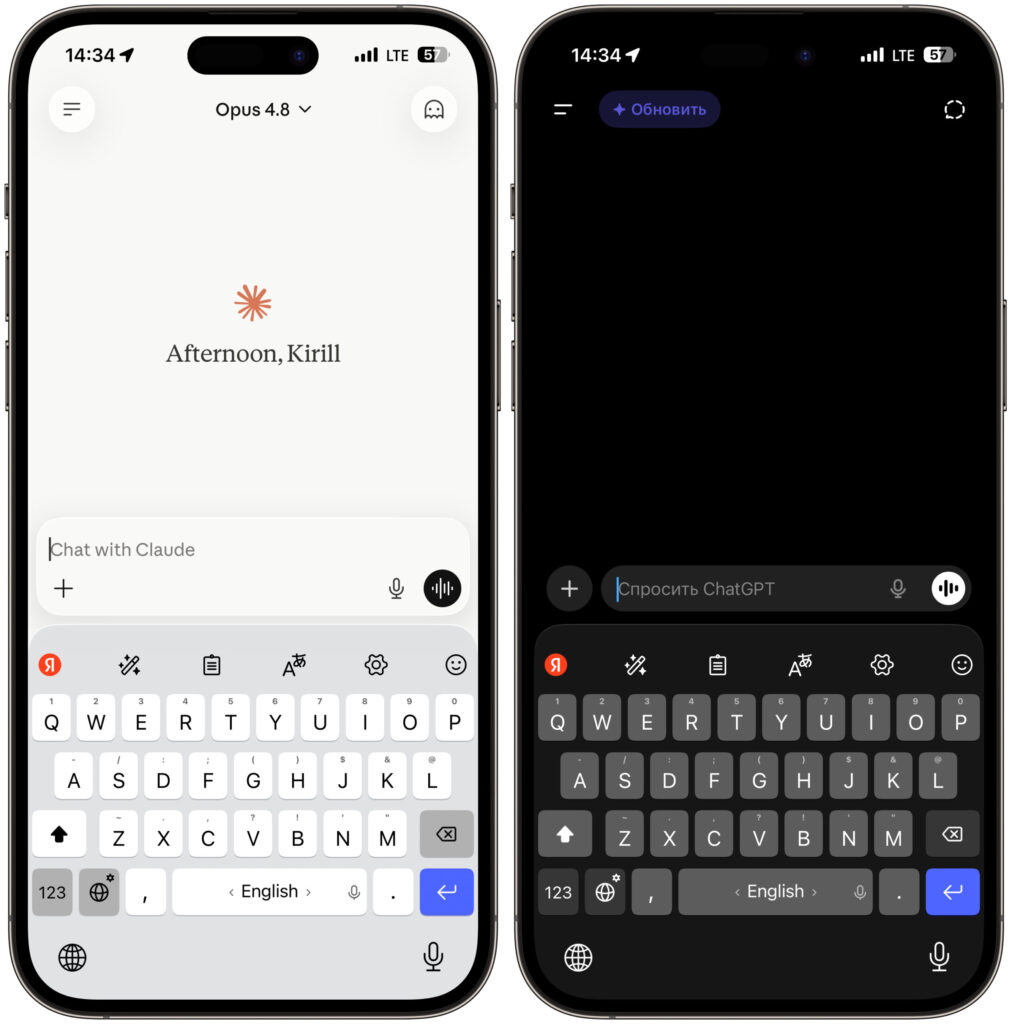
There’s hope that launching AI tools won’t require fiddling with VPN anymore
- ChatGPT by OpenAI;
- Gemini by Google;
- Claude by Anthropic;
- and other foreign AI assistants.
Currently, all three giants are officially unavailable in Russia, and these are precisely what Anokhin had in mind when talking about platforms in demand among Russians.
Let me specifically emphasize: this concerns services that voluntarily closed themselves off to Russian users. Resources that were blocked by Roskomnadzor for law violations do not fall under this initiative. So don’t expect everything to come back all at once — the list will be limited and carefully curated.
A Tariff with AI Services Without VPN: What Operators Are Proposing
According to Beeline’s plan, everything should work as simply as possible for the subscriber. Anokhin talks about changing network location at the operator level, but this won’t be a separate app — rather, it will be part of the tariff plan. No settings, profiles, or complicated workarounds — just subscribe to the right plan, and access to approved services appears automatically.
Moreover, some of this is already working right now. According to the head of VimpelCom, on certain tariff plans — for example, “Plan B” — subscribers can already use AI services without restrictions. So this isn’t “sometime in the future” but a scheme already being tested in practice.
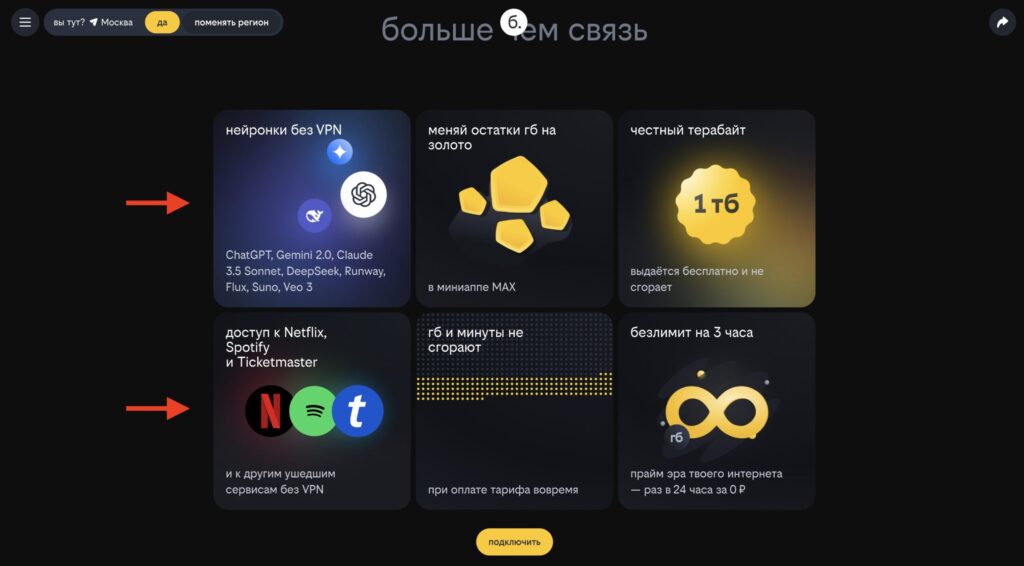
Beeline has already implemented something similar
Imagine how convenient this would be in everyday scenarios. For example, chatting with ChatGPT by voice while driving through CarPlay — without having to turn on a VPN beforehand and hoping the connection doesn’t drop mid-trip. If the option is truly built into the tariff, such things will become truly seamless.
Anokhin also added that other operators are interested in a similar option. T2 directly called it a cross-industry initiative being developed by all market players. MTS and MegaFon declined to comment for now, but the very fact that the topic is being discussed at the industry level speaks volumes.
When Could ChatGPT and Netflix Work in Russia Without VPN
And here’s where healthy skepticism kicks in. The thing is, simultaneously with these grand plans, authorities sharply intensified their crackdown on VPNs this spring. Since April, major platforms were required to restrict access for users with VPN enabled, Apple ID top-ups via phone balance were cut off, and there were discussions about charging for international traffic exceeding 15 GB per month.

And previously they wanted to block AI services entirely
This creates an interesting dilemma: on one hand, the government is cracking down on VPNs by all available means; on the other, operators are proposing to legally open access to foreign services through their own infrastructure. Essentially, this is an attempt to capture demand: since people are looking for ways to access AI services anyway, let them do it through the operator rather than through gray-market solutions.
Whether the initiative will actually be approved remains a big question. The head of the Ministry of Digital Development, Maksut Shadaev, called the current measures a “difficult compromise” and directly stated that the goal is to reduce VPN usage in the country. How the official opening of access to Netflix and ChatGPT fits into this logic is not entirely clear yet.
My cautious conclusion is this. The idea itself is sound and beneficial for users: getting access to needed services without VPN, without risk, and without extra configuration — that’s exactly what many have been waiting for. But between “the initiative found support” and “the option appeared in my tariff plan” lies a long path of approvals. I wouldn’t rush to delete my trusted VPN, but this development is definitely worth following — if everything works out, using an iPhone in Russia will become noticeably more comfortable.