The era of free AI is gradually coming to an end: speed, no limits, and advanced models increasingly come at a price. But is it worth paying $20 for ChatGPT, Claude, or Gemini when there are Russian services nearby that work without a VPN and can be paid for with a regular card? If you’re just starting to explore the topic, here are seven ideas for how to use neural networks in everyday life. And below is a practical breakdown of subscriptions so you can understand where the extra cost is justified and where you can get by with a free plan.
In 2026, it makes sense to pay for an AI subscription
Limits in ChatGPT, Gemini, and Claude Subscriptions
Before talking about prices, an important note about limits — these are restrictions on the number of requests, time spent working with advanced models, or the volume of generations. Most foreign services have dynamic limits that change frequently: they depend on server load, time of day, and query complexity.
Companies regularly revise quotas, increasing them for paid subscribers or cutting them for free users. And they don’t always publish exact numbers — often they only indicate approximate ranges like “about 50 requests per day.” So below we’ll discuss costs and types of limitations rather than specific numbers — their current values should be checked with the services’ own support teams.
ChatGPT Plus, Go, and Pro: The Difference Between Subscriptions
ChatGPT is a universal chatbot: text, voice, code, images, internet search, and research. OpenAI has three subscription tiers, and they differ significantly in price.
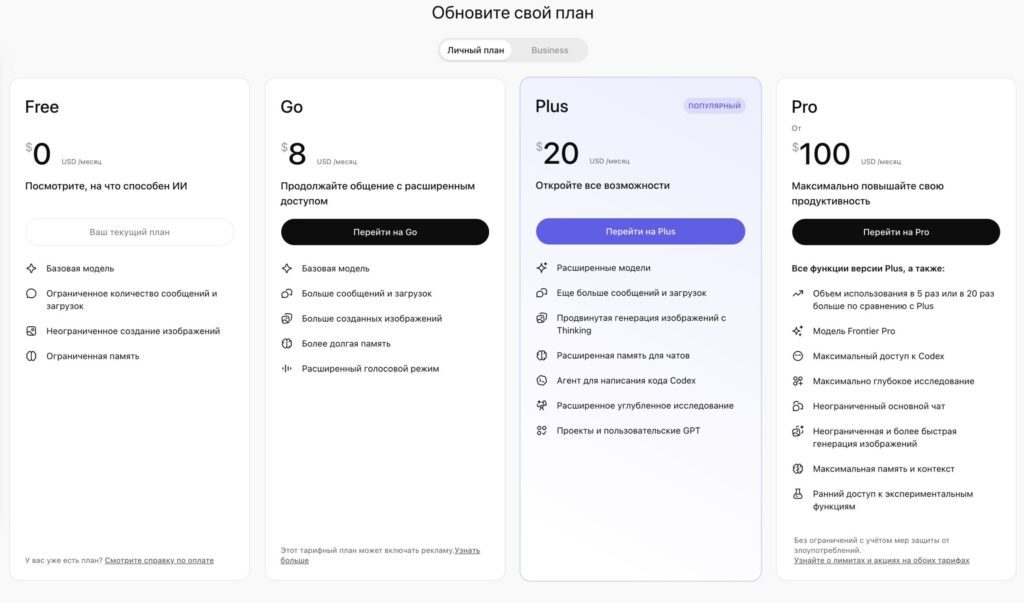
ChatGPT offers plans for every occasion
- ChatGPT Go for $8 (approximately 800 ₽/month in Russia) — slightly increases limits and conversation “memory,” but doesn’t remove ads.
- ChatGPT Plus for $20 (approximately 2,000 ₽/month in Russia) — removes ads, increases limits, lets you switch between models, speeds up image generation, unlocks Codex for coding, and provides access to AI agents.
- ChatGPT Pro for $200 (approximately 20,000 ₽/month in Russia) — removes all limits, unlocks all AI agents, and gives early access to experimental features.
For personal use, the optimal choice is Plus: it covers most tasks and costs ten times less than the Pro version. The main caveat for users in Russia is that ChatGPT doesn’t officially work in the country — you’ll need a foreign IP address and an international payment method.
Gemini AI Plus, Pro, and Ultra: How the Plans Differ
Google’s Gemini is close to ChatGPT in capabilities: it writes texts well, creates detailed reports, generates photos and videos, but is weaker with code. However, it has no ads and offers tight integration with Google services.
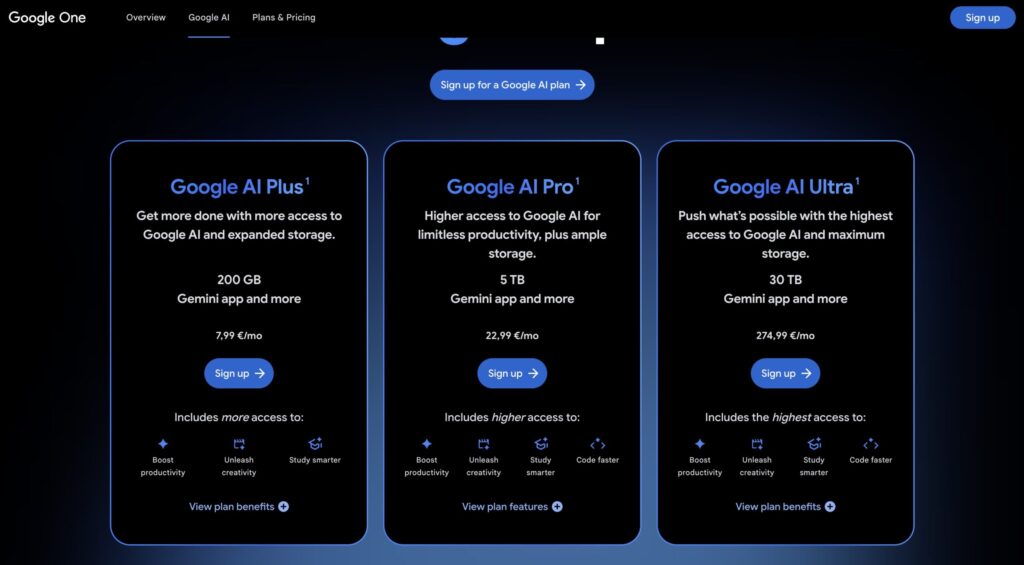
The subscription also includes Google cloud storage, which is convenient
- AI Plus for $8 (approximately 800 ₽/month in Russia) — latest models, 128,000-token context window (meaning the bot “remembers” more text in a single conversation), increased limits for image generation (Nano Banana Pro), video (Veo 3.1) and music (Lyria 3), 200 GB on Google Drive.
- AI Pro for $20 (approximately 2,000 ₽/month in Russia) — 1 million token context window, even higher limits, Gemini support in Gmail, and 5 TB on Google Drive.
- AI Ultra for $250 (approximately 25,000 ₽/month in Russia) — maximum limits, access to experimental models Project Genie and Project Mariner, 30 TB of cloud storage.
For personal use, AI Pro limits are more than enough, plus Gemini fully integrates into Gmail and Google Docs. If you only need access to the latest models, AI Plus will suffice. It only works in Russia through a foreign IP.
Claude Pro for Programming: Is It Worth Subscribing?
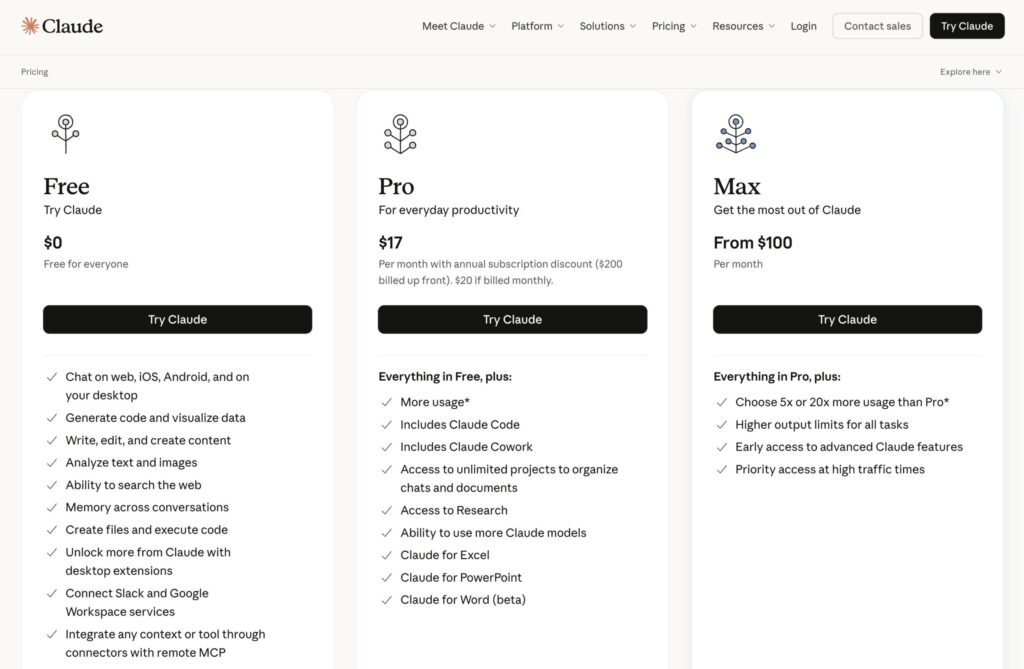
Claude’s plans are like everyone else’s, but the limits are the strictest — though nobody talks about it openly
Claude by Anthropic shines most in coding tasks. The Claude Code service can write functions, find bugs, and test programs, working locally through the terminal on macOS and Windows and quickly interacting with project files. Plans: Pro for $20 (approximately 2,000 ₽/month in Russia) and Max for $100–$200 (approximately 10,000 to 20,000 ₽/month in Russia). The difference is mainly in limits — it makes sense to start with Pro and upgrade only if you hit the restrictions. Both Grok and Claude work in Russia only through a foreign IP.
Don’t forget there’s also Grok by xAI — not the most popular, but with minimal censorship, fine-tuned bot personality, and a built-in photo editor. Response speed is often noticeably faster than ChatGPT and Gemini. Subscriptions: SuperGrok Lite for $10 (approximately 1,000 ₽/month in Russia), SuperGrok for $30 (approximately 3,000 ₽/month in Russia), and SuperGrok Heavy for $300 (approximately 30,000 ₽/month in Russia). The basic Lite doesn’t unlock all features, Heavy is for those who live in Grok, so the middle subscription SuperGrok is considered optimal.
How Perplexity Differs from Regular Neural Networks
If you don’t want to pay $20 a month, take a look at Perplexity. It’s the only major foreign service that works reliably in Russia and covers most tasks, especially when you need search and information analysis. Its standout feature is searching real sources on the internet rather than the model’s internal knowledge base. Plans: Pro for $20 (approximately 2,000 ₽/month in Russia) and Max for $200 (approximately 20,000 ₽/month in Russia).
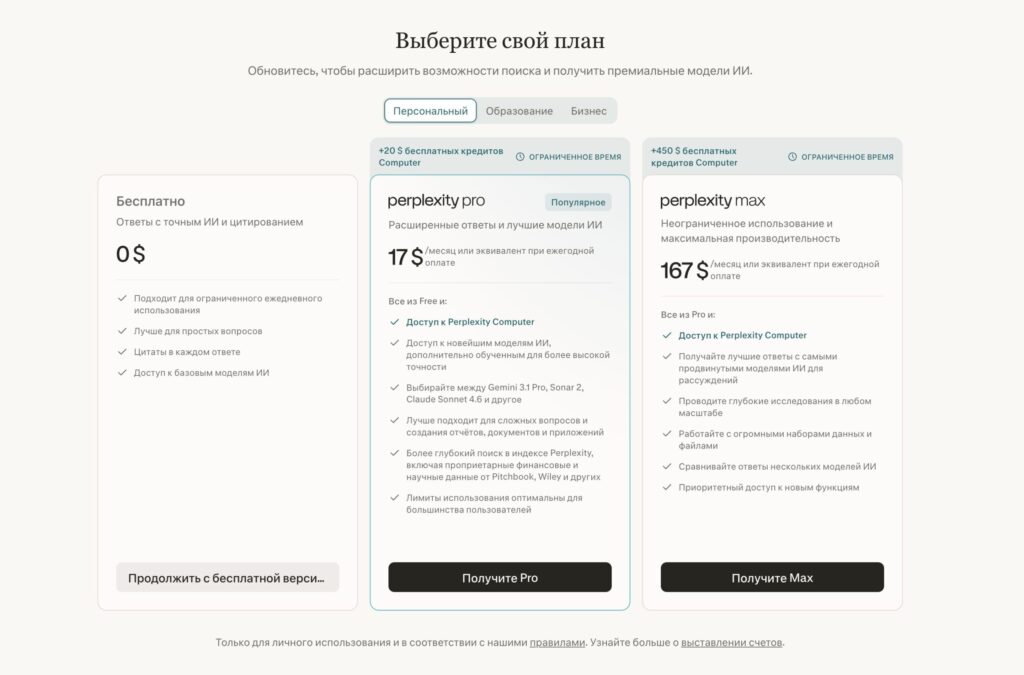
Perplexity works in Russia without a VPN, but you can’t pay for it with a Russian card
The most interesting part: Perplexity is quite capable even without a subscription — some paid features were made free in 2025. If you need it as a search engine, you won’t even notice the limitations. Pro unlocks almost all capabilities, while Max only makes sense for the limits on the Perplexity Computer AI agent.