The State Duma passed a bill in its second and third readings that introduces administrative fines for authorizing users on Russian websites and apps through foreign services and foreign email. Almost immediately, headlines spread across the internet like “Russia has banned login via Apple ID and Google.” It sounds alarming, especially if you’ve spent years logging into your favorite services with a single tap on the Apple button. In reality, everything works differently from what panic-post authors describe, and it’s definitely too early for iPhone owners to sound the alarm.
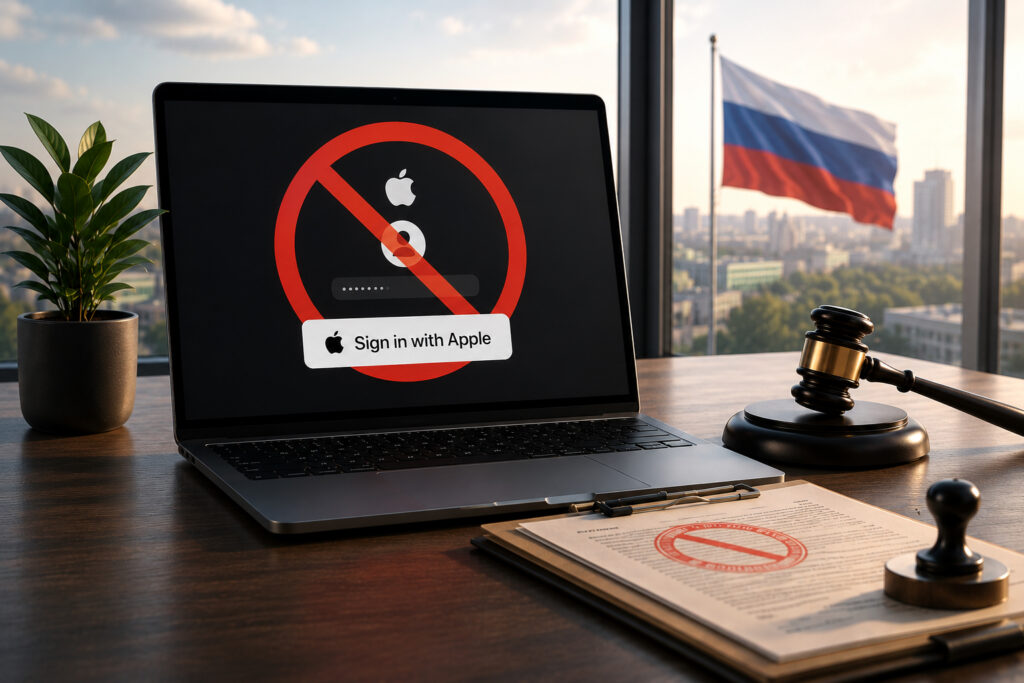
Sign in with Apple and Google buttons will finally disappear from Russian services
In short, the previously existing ban on using foreign identification methods has now been backed up with specific penalties in the Code of Administrative Offenses. The regulation existed before, but there was essentially no punishment for ignoring it. Now there is, and that’s exactly what triggered this new wave of discussion.
Will Users Be Fined for Logging In with Apple ID?
Let’s address the main myth right away. All reports claiming that you’ll now get fined for logging in with Apple ID have nothing to do with reality. The new regulation applies to owners of Russian websites and applications, not end users.
The violation is defined as failure to fulfill the obligation to authenticate users through one of the methods prescribed by Russian legislation. In other words, the problem arises for businesses that still only offer login via Apple ID, Google, and other foreign OAuth services, or use foreign email as the primary identifier. The fines are substantial: 10,000 to 20,000 rubles for individuals, 30,000 to 50,000 for officials, and for legal entities the range goes up to 500,000–700,000 rubles.

You’ve surely not only seen this button many times but used it too
In practice, this means a simple thing. Russian services will soon have to abandon the familiar login scenarios through foreign accounts or at least restructure their systems so that local identification becomes the primary method. The law directly guides resources toward approved options: login through Russian services, authentication via mobile phone number, as well as government systems like ESIA (Unified Identification and Authentication System) and the Unified Biometric System where appropriate. The “Sign in with Apple” button will either be removed entirely or kept as a secondary option.
By the way, all of this is yet another reason not to put all your eggs in one basket. If you suddenly lose access to your account, you’ll have to separately figure out how to recover your Apple ID and regain control of your phone.
Why Russian Websites Will Remove Google Login
The situation with Google accounts is exactly the same, and we can’t skip this topic. Most iPhone owners, despite the entire Apple ecosystem, have at least one Google account. Some use it for email, some for photos, and some simply got used to logging in everywhere with a single tap through Google. Well, for Russian websites, Google login falls under the exact same ban as Apple ID, since it’s equally a foreign identification service.
This means that over time, the familiar button with the colorful letter G on domestic platforms will start disappearing or moving to a secondary role. Your Google account itself isn’t going anywhere — emails and photos will stay in place, and you’ll be able to access Gmail or YouTube as usual. This only concerns Russian services no longer offering it as a login method on their platforms.
Google also got caught up in this
A separate question still hanging in the air is the fate of existing accounts created through foreign IDs. How exactly they will be treated will only become clear as enforcement practices develop. But the overall trend is obvious: all key identification points are gradually moving under Russian regulations, and the scenario of “logged in with Apple and forgot about it” on domestic platforms is becoming a thing of the past.
How to Keep Access to Websites Without Apple ID Login
The most important takeaway from this entire story: there are no fines for you. For using Apple ID, Google, or foreign email to log into Russian websites, users face no consequences: no monetary penalties, no account blocks, no liability of any kind. All obligations and risks lie with the resource owners.
Wherever you can, add a phone number and email so you don’t depend on Apple and Google
Nevertheless, it’s worth preparing for the changes. I’d recommend checking in advance which important services you log into specifically through Apple ID or Google and linking an alternative login method: a phone number or a separate password. If one fine day the “Sign in with Apple” button disappears from a website and you have no other linked method, recovering access could turn into a minor adventure with customer support.
From the government’s perspective, everything makes sense. Legislators see this as reducing the Russian internet segment’s dependence on foreign platforms and gaining control over critically important identification infrastructure. For businesses, it’s another compliance requirement involving interface and backend modifications. And for us, iPhone owners, it means a gradual transition from the convenient login through the Apple ecosystem to Russian services or classic login methods. Unpleasant, but hardly the catastrophe that loud headlines tried to prepare us for.