
Scientifically speaking, people with super memory have hyperthymesia
About 100 people on Earth remember every day of their lives — what they ate, what they wore, what the weather was like. A new study has for the first time linked this extremely rare ability with peculiarities of brain activity during deep sleep. And the explanation turned out to be not that these people are better at memorizing, but that their brains are worse at forgetting.
What Is Hyperthymesia and How Many People Have It
Highly Superior Autobiographical Memory, hyperthymesia, or HSAM (Highly Superior Autobiographical Memory) — is a rare condition in which a person can instantly recall virtually any day of their adult life. Give them a date, and they’ll tell you what day of the week it was, what was happening in the world, and what they were doing.
The first diagnosed case was Jill Price from California. In 2000, she wrote a letter to neuroscientist James McGaugh at the University of California, Irvine, describing her memory as a problem. Since then, scientists have found several dozen more such people, but fewer than 100 people worldwide have received a confirmed diagnosis of HSAM. Millions of people have heard about this phenomenon, but only a handful truly meet the criteria.
It’s important to note that this is not about photographic memory. People with this condition don’t necessarily remember faces, names, or numbers better. Their superpower concerns specifically autobiographical events — their personal past tied to dates.
People with Hyperthymesia Don’t Forget Information
At first glance, it seems logical that people with hyperthymesia simply record information into memory better. But previous research has shown the opposite: the memorization process works the same way for them as for everyone else. Tests of short-term memory, IQ, and even subjective assessments of sleep quality revealed no difference between people with super memory and ordinary volunteers.
So what’s going on? The authors of the new study suggested that the key lies in memory consolidation — the process by which short-term memories of the day are converted into long-term storage. And this process occurs only during sleep.
Imagine a computer desktop cluttered with files. Every night the system has to sort them: send some to the archive, delete others. For most people, some of these figurative files are lost during sorting. But for people with abnormally good memory, it seems that this process works more efficiently, and almost nothing gets lost.
What Are Sleep Spindles in Simple Terms
During deep sleep, the brain doesn’t just rest. It actively processes memories, transferring them from temporary storage to long-term storage. External stimuli are minimized during this time, and neurotransmitters switch to an internal processing mode.
One of the key tools in this process is sleep spindles. These are short bursts of electrical brain activity that last about a second and occur exclusively during deep sleep. On an electroencephalogram, they look like a characteristic spindle-shaped wave — hence the name.
In essence, sleep spindles are moments when the brain “moves” fresh memories from the hippocampus (temporary storage) to the cerebral cortex (permanent archive). The more such bursts there are and the more precisely they are synchronized with slow sleep waves, the more effectively memories are consolidated.
How the Brains of People Who Remember Everything Are Different
A team from Texas State University and Northwestern University conducted a comprehensive sleep study on 9 people with hyperthymesia and 13 ordinary volunteers. Participants slept in a laboratory for two consecutive nights while instruments recorded their brain activity.
The results were revealing. Total sleep time, duration of each stage, and slow-wave power did not differ between groups. But sleep spindle density in people with super memory was noticeably higher, especially in the parietal, frontal, and central regions of the brain.
The most significant increase in spindles was recorded specifically in the parietal cortex — a region that is part of the so-called parietal memory network and is responsible for vivid, detailed recall of the past. Additionally, spindles in people with super memory were more precisely synchronized with slow oscillation peaks, which could make the process of transferring memories to long-term storage more efficient.
This is the first study to link sleep physiology with the HSAM phenomenon. According to the authors, the results suggest that enhanced memory consolidation during sleep contributes to super memory.
Can an Ordinary Person Develop Super Memory
The study does not yet answer this question directly. It’s important to understand that these are preliminary data from a very small sample of 9 people. Scientists have established a correlation between sleep spindle density and super memory, but this doesn’t mean that by increasing the number of spindles, you can “turn on” hyperthymesia.
However, the overall conclusion confirms that healthy, full deep sleep is critically important not only for immunity but also for consolidating memories in any person. Sleep spindle density decreases with age and with some neurological disorders, so taking care of sleep quality is one of the few things that truly helps preserve memory.
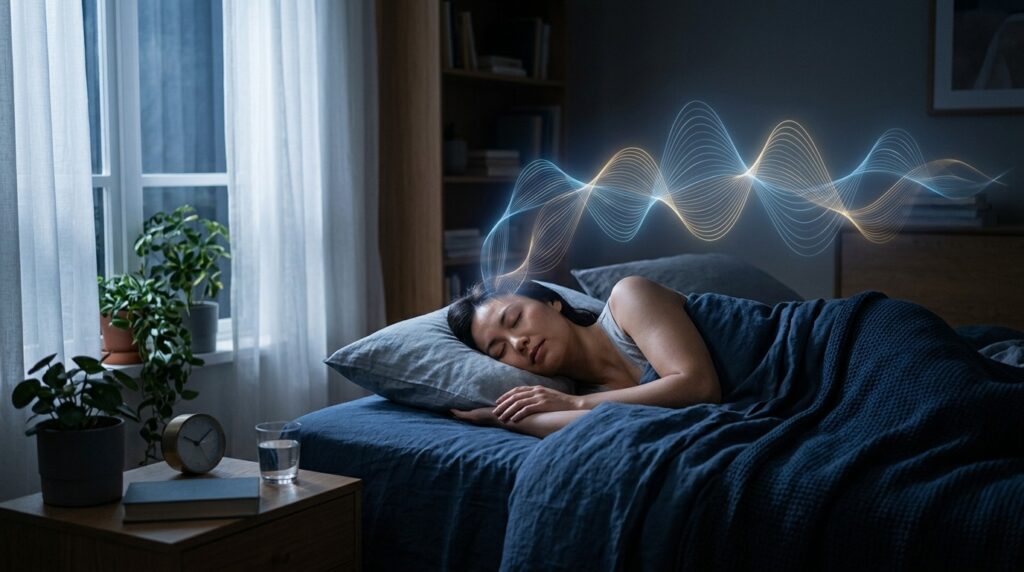
Quality deep sleep is the best ally of memory for any person
Why Remembering Everything Isn’t Always a Good Thing
From the outside, the ability to remember your entire life seems like a superpower. But people living with hyperthymesia describe it differently. Jill Price, the world’s first person to receive the diagnosis, called her memory a torment. She said she couldn’t just move on with life — the past constantly haunted her, and it interfered with everyday living.
Imagine that you can’t forget a single argument, a single awkward word, a single difficult day. Every memory is as vivid as if it happened yesterday. For some people with this diagnosis, it’s associated with anxiety and depression — the inability to let go of the past becomes a serious psychological burden. However, not everyone perceives it the same way: actress Marilu Henner, who also has HSAM, considers her memory a gift and enjoys the ability to enjoy every day all over again.
The study of sleep spindles is another step toward understanding how memory works. Scientists don’t yet know whether this mechanism can be influenced, and they’re not ready to offer practical prescriptions. But now science has its first biological marker linking sleep physiology to super memory, and this makes future research much more targeted. And for the remaining eight billion people, the main takeaway is simple: how we sleep directly determines how we remember.