
World Book Day: a celebration of libraries you should know about. Image source: ipedagog.ru
Every year, on April 23, more than a hundred countries around the world celebrate World Book Day and Copyright Day — a holiday established by UNESCO. It might seem like just another excuse to pick up a book. But behind this date lies an amazing story intertwining a medieval legend about a dragon, a Barcelona bookseller with ambitions, and an amusing calendar mix-up between two of the greatest writers in history.
Why World Book Day Is Celebrated on April 23
The date was not chosen by accident. UNESCO made the decision in 1995, noting that April 23 is a day associated with several major names in world literature. It is believed that on this very day in 1616, William Shakespeare and the Peruvian chronicler Inca Garcilaso de la Vega both died. The death of Miguel de Cervantes — the author of Don Quixote — was also long associated with this date.
But here’s where things get interesting. In reality, Shakespeare and Cervantes did not die on the same day, even though the date formally coincides. In 1616, Spain had already adopted the Gregorian calendar, while England still used the Julian calendar. The difference between them was about 11 days. Shakespeare died on April 23 according to the Julian calendar, which corresponds to May 3 on the Gregorian calendar. In other words, Shakespeare outlived Cervantes by roughly 11 days.

A World Book Day party in New York. Image source: mentalfloss.com
Moreover, according to Spanish records of that time, Cervantes most likely died on April 22 — and was buried on the 23rd. In Spain at the time, it was customary to record the date of burial, not the date of death itself. But these details did not prevent UNESCO from making April 23 a symbolic focal point for the entire literary world.
The Catalan Tradition: Roses and Books on the Same Day
The idea of celebrating a book day appeared long before UNESCO’s decision. In 1922, Barcelona publisher Vicente Clavel proposed establishing a Book Day to honor the memory of Cervantes and, at the same time, boost sales. Initially, the holiday was tied to October 7 — the presumed date of Cervantes’ birth. Later, however, it was moved to April 23 — the day of the writer’s death.
And that’s when a beautiful coincidence occurred. In Catalonia, April 23 is Diada de Sant Jordi, the feast day of the region’s patron saint, Saint George. By ancient tradition, on this day lovers exchange gifts: men give women a red rose, and women give men a book. The roots of the custom go back to a medieval legend: the knight Jordi defeated a dragon, and on the spot where the monster’s blood was spilled, a rose bush grew. The knight plucked the most beautiful rose and presented it to the rescued princess.
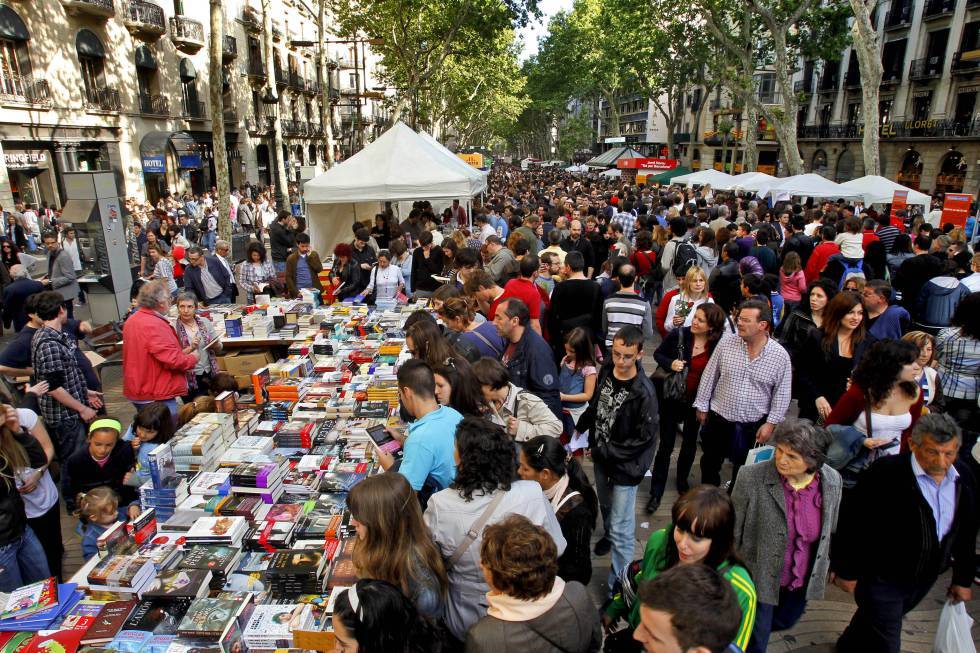
The streets of Barcelona on Saint George’s Day are filled with stalls selling books and roses. Image source: barcamania.com
Over time, Book Day and Diada de Sant Jordi merged into a single celebration. Today, in many Spanish bookstores on April 23, every purchased book comes with a red rose. And in Catalonia itself, more books are sold on this day than on any other day of the year.
How UNESCO Made Book Day a Global Holiday
In 1995, the UNESCO General Conference officially designated April 23 as World Book and Copyright Day. That was the year the UN declared the Year of Tolerance, and delegates decided to create an annual occasion to remind the world of the value of books, reading, and copyright protection. The choice of date was driven by two reasons: the literary symbolism of April 23 and the Catalan tradition, which by that time had already been successfully linking books and roses for several decades.
Since then, the holiday has been celebrated in more than 100 countries around the world. Libraries, publishers, museums, and schools hold special events on this day — from reading marathons and literary competitions to copyright awareness campaigns.
World Book Capital 2026: Rabat and Its Program
One of the key UNESCO initiatives associated with this holiday is the “World Book Capital” program. Every year, the organization — together with international associations of publishers, librarians, and booksellers — selects a city that will promote reading and book culture throughout the entire year.
In 2026, this honor went to Rabat — the capital of Morocco. It became the 26th city in the history of the program. Before it, the title was held by Rio de Janeiro (2025), Strasbourg (2024), and Accra (2023). The first city to receive this distinction, back in 2001, was Madrid.

Rabat — the capital of Morocco and the World Book Capital for 2026
Rabat’s program focuses on expanding access to books, supporting the local publishing industry, and promoting literacy among all age groups. It also draws attention to Arabic-language literature and the book culture of North Africa.
How to Celebrate World Book Day on April 23
There are many ways to celebrate this day, and they are all surprisingly simple:
- Visit a library or bookstore — many of them hold special events on April 23
- Give a book to a loved one — following the Catalan tradition, you can add a rose
- Organize a reading evening or join a book club
- Dress up as your favorite book character — this tradition is especially popular in the United Kingdom
- Simply pick up a book and spend the evening with it — that’s exactly what I’m going to do.
By the way, it’s worth knowing one detail: in the United Kingdom and Ireland, there is a separate “World Book Day” held on the first Thursday of March — it is a distinct charitable initiative aimed at children’s reading. The global UNESCO holiday is specifically on April 23.
World Book Day is one of those rare holidays where behind the simple idea of “read a book” lies a truly rich history. Medieval legends, calendar quirks, Catalan roses, and the decision of an international organization — all of this came together to form a date that reminds us: the book remains one of the most powerful instruments connecting generations and cultures. And the most honest way to celebrate it is simply to open one.