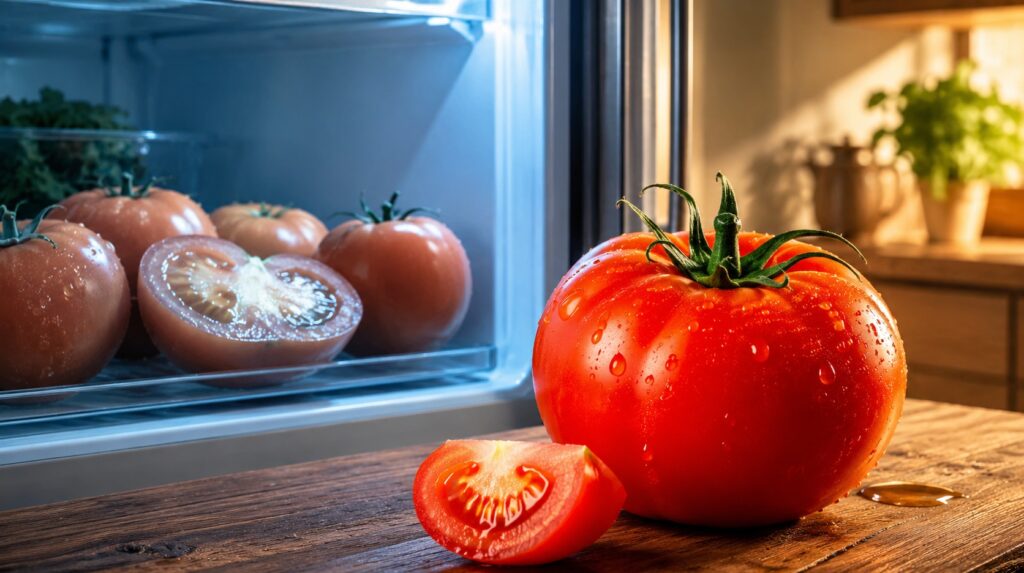
By storing tomatoes in the fridge, we only rob them of flavor
Many people store tomatoes in the refrigerator, and until recently I was one of them. But the other day I learned that tomatoes in the fridge lose their flavor. The refrigerator turns a juicy, sweet fruit into a watery ingredient for a cheap sandwich. On top of that, some people store tomatoes next to potatoes, which is absolutely something you should never do. But why do tomatoes become tasteless? And where should you store them instead?
What Happens to a Tomato in the Fridge
A picked tomato is still a living fruit. Enzymes and ripening genes continue to work inside it. The tomato constantly produces sugars, acids, pigments, and most importantly, volatile aromatic compounds. These are exactly what give it that juicy, distinctly tomato-like flavor.
Tomatoes lose their flavor not because of the refrigerator itself, but because of the temperature inside it. Typically, it keeps around 2–5 degrees Celsius, which is too cold for tomatoes. According to the UC Davis Postharvest Center, at temperatures below 10 degrees, tomatoes ripen poorly, develop color and flavor inadequately, may become soft, develop spots, and spoil faster. The comfortable temperature for tomato ripening is approximately 18–21 degrees Celsius, which is normal room temperature.
Why Tomatoes Lose Their Flavor and Aroma
The most noticeable thing a chilled tomato loses is its aroma. A tomato’s flavor depends not only on sugar and acid. If that were all, we could easily eat syrup with citric acid. The smell and taste of the fruit are strongly influenced by volatile aromatic compounds in the tomato. These are the very substances that rise into your nose and create the sensation of a fresh, herbaceous tomato.
A study published in the journal PNAS showed that chilling reduces the amount of aromatic compounds in tomatoes, and the flavor becomes flat as a result. In other words, the sugar and acid remain in the tomato, but the full, “living” aroma disappears, and the fruit seems empty.
How to Restore Tomato Flavor and Aroma
Think that if you take tomatoes out of the fridge, their flavor and aroma will return 100%? I thought so too, but it’s much more complicated. Cold can shut down the genes responsible for aroma for a long time.
An analysis of the same study in Nature Index states that some genes switch back on after returning to warmth, but some remain suppressed. In taste tests, chilled tomatoes turned out to be blander compared to fresh ones. So it’s worth warming up a tomato before eating, but don’t expect miracles, because some of the aroma may not return.
Why Tomatoes Become Watery
The second problem after aroma is texture. In the cold, cell membranes get damaged, and normal cell function is disrupted. Because of this, a tomato can become mealy, cottony, or watery inside, even though it looks perfectly fine on the outside.
Store-bought tomatoes picked while unripe suffer especially. They are often harvested early to make it to the store shelf, and the refrigerator finishes off whatever flavor remains. Here are the consequences that await such tomatoes:
- inability to ripen properly;
- incomplete development of color and flavor;
- premature softening;
- increased susceptibility to spoilage.
This is exactly why a beautiful-looking winter tomato so often turns out to be tasteless. First, early harvesting ruins them, then refrigerator storage finishes the job.
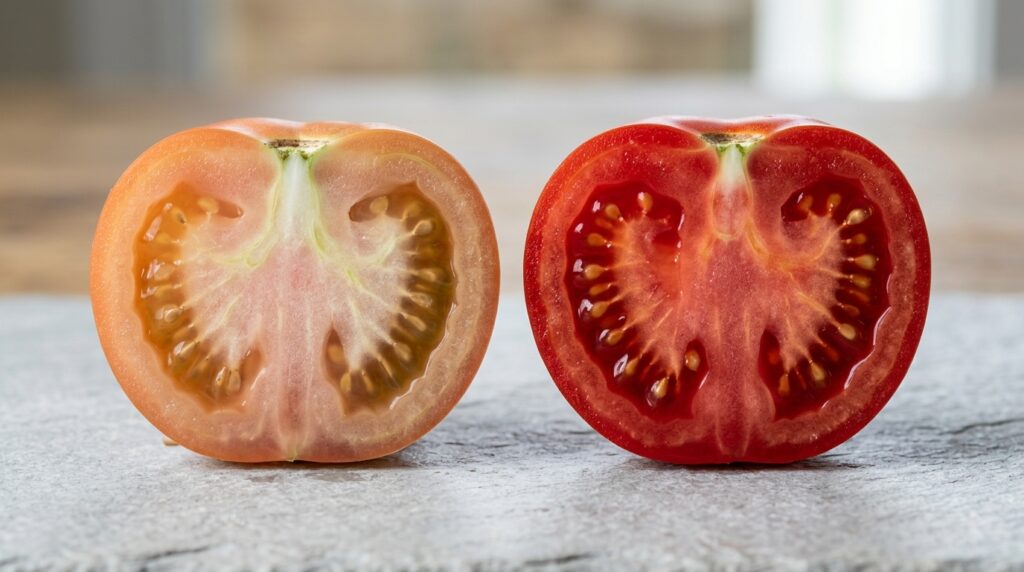
Cold damages the internal texture, even if the tomato looks fine on the outside
Where Is the Best Place to Store Tomatoes at Home
The best way to store tomatoes depends on their condition. If a tomato is firm, pale, and unripe, the refrigerator is not recommended. Keep unripe tomatoes at room temperature around 18–21 degrees, but not in direct sunlight and not near the stove. You can lay them out in a single layer on a plate or in a basket. Don’t wash tomatoes in advance, because excess moisture speeds up mold growth. Wash them right before eating.
If a tomato is already ripe, fragrant, and springs back softly under your finger, the best option is to eat it within the next day. In a cool apartment, it will be perfectly fine sitting on the counter. However, if your home is hotter than 25–27 degrees and the tomato is on the verge of being overripe, you can put it in the fridge for a maximum of 1–3 days, and not in the coldest zone. Before eating, let it warm up to room temperature.
Where to Store Cut Tomatoes
There is one case when the refrigerator is not just acceptable but mandatory, and that’s cut tomatoes. And this isn’t about preserving flavor — it’s about not getting food poisoning.
Cut tomatoes are classified as foods that require temperature control: the exposed surface can support the growth of dangerous bacteria, including salmonella. After cutting, tomatoes should be placed in the refrigerator at 5 degrees Celsius or below.
Here’s the final cheat sheet for storing tomatoes:
- Unripe tomatoes — on the counter at room temperature, not in the fridge;
- Ripe tomatoes — best eaten quickly, keep on the counter in a cool spot;
- Very ripe tomatoes in a hot apartment — can go in the fridge for 1–3 days, but warm them up before eating;
- Cut tomatoes — fridge only, in a sealed container, eat within 1–2 days;
- Rotten or moldy tomatoes — throw them out entirely
The refrigerator doesn’t make a tomato poisonous, but it robs it of flavor and aroma. The thing is, cold disrupts ripening, kills aroma, and ruins texture. For a whole, ripe tomato, flavor matters more than an extra couple of days of storage, so keep it at room temperature and don’t buy more than you can actually eat. Cut tomatoes, however, are a matter of food safety and belong in the fridge. The simple habit of not turning vegetables into warehouse stockpiles noticeably improves their taste — and that’s perhaps the cheapest cooking hack there is.