
Dying from fear is difficult, but possible
Theoretically, anyone can die from fear — and this is not a figure of speech. In rare cases, a strong emotional reaction triggers a surge of adrenaline that proves fatal for the heart. It sounds like the plot of a horror movie, but there is perfectly understandable physiology behind it. Let’s break down what exactly happens in the body during a moment of intense fright and why the heart suffers first.
What Happens in the Body During a Moment of Intense Fright
It all begins with the “fight or flight” response — an ancient mechanism inherited from our ancestors. As soon as the brain identifies a threat, the hypothalamus (the brain region that controls many automatic processes) sends a signal to the adrenal glands. They instantly release adrenaline and noradrenaline into the bloodstream.
These hormones prepare the body for emergency action: the heart begins to beat faster, muscles tense up, and blood glucose levels spike — fuel for a quick burst of action. You feel this as a rapid heartbeat, sweating, trembling, and a sharp sense of anxiety. Under normal circumstances, such a reaction saves lives, helping you quickly run away or fight back. Problems begin when too many hormones are released.
Why Adrenaline Strikes the Heart Specifically
Adrenaline and noradrenaline in large doses are toxic to certain organs — the heart, liver, kidneys, and lungs. But the most deadly blow is to the heart: it is the only organ whose damage can kill instantly.
The mechanism works like this: adrenaline opens the pathway for calcium to reach the heart. When too much calcium floods in, the heart muscle loses its coordinated rhythm. Ventricular fibrillation occurs — a specific rhythm disturbance in which the heart, instead of making clear contractions, begins to chaotically “quiver.”
In this state, the organ cannot properly pump blood. The brain and other tissues are left without oxygen, and without immediate help, this leads to sudden death. In essence, the heart cannot withstand not the emotion itself, but the chemical overload it causes.
“Broken Heart Syndrome”: How Stress Damages the Heart Muscle
It’s worth separately mentioning a condition that doctors call broken heart syndrome (takotsubo cardiomyopathy). It occurs against the backdrop of extreme emotional stress — the loss of a loved one, shock, fright — and its symptoms resemble a heart attack: chest pain, shortness of breath, and impaired heart function.
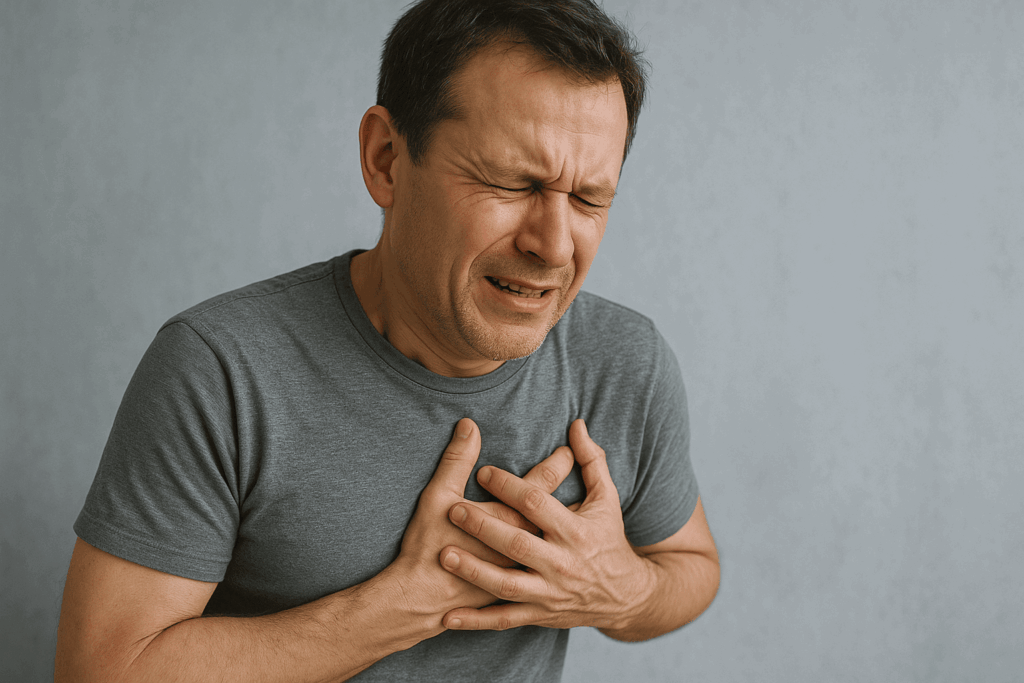
The key is to recognize a heart attack in time
The cause is the same — a massive release of stress hormones that literally stuns the heart muscle. In most cases, the person recovers, but in severe situations, this condition can also lead to death. This is a clear example of how emotions and heart physiology are connected far more closely than it may seem.
Not Just Fear: Which Emotions Are Dangerous for the Heart
An important nuance: high adrenaline levels are not only caused by fear. Any sufficiently strong emotion can trigger a dangerous hormonal surge. Among documented causes of sudden death linked to emotions are:
- severe fright and shock
- intense sports competitions and excitement
- sex under extreme cardiac strain
- sudden joy or grief
In other words, it’s not about whether the emotion is positive or negative, but about its intensity and how many hormones the body releases into the bloodstream. The body responds to strong arousal in roughly the same way, whether it’s terror or delight.

If you already have a heart condition, the risk of dying from fear is higher
Who Is at Risk of Dying from Fear
The good news is that death from fear occurs extremely rarely. Most people survive even the most intense fright without any consequences for the heart. But the risk is not zero, and for some people it is noticeably higher.
The increased risk group primarily includes people with pre-existing heart conditions — their heart muscle is more vulnerable to a hormonal attack. However, this does not mean that healthy people face no threat: an absolutely healthy person can also fall victim to an adrenaline surge, though the probability is vanishingly small.
This is precisely why doctors advise people with heart problems to avoid excessive stress and sudden emotional overloads — not because fright will definitely kill them, but because there’s no point in unnecessarily testing the heart’s resilience.
Where Is the Line Between Ordinary Fear and Mortal Danger to the Heart
It’s worth soberly assessing the scale of the threat. Ordinary fright — a sudden loud noise, a friend unexpectedly jumping out from around a corner, a scary movie — is virtually harmless for a healthy person. The heart handles such spikes thousands of times over a lifetime.
Real danger arises at the intersection of several factors: a very strong emotion plus a vulnerable heart plus, sometimes, additional strain such as physical exertion. It is the combination of circumstances, not fear itself, that makes a situation lethal. Therefore, the phrase “scared to death” is better understood not as a scare story, but as a reminder of how powerfully emotions control our bodies.
The main takeaway is simple: dying from fear is indeed possible, but it is an exceptional rarity, not an everyday threat. It is far more useful to know that behind the common phrase lies real physiology — an adrenaline surge, calcium overload of the heart, and rhythm disruption. Understanding this mechanism helps you relate more calmly to your own emotions and more attentively to your heart health, especially if it is already making itself known.