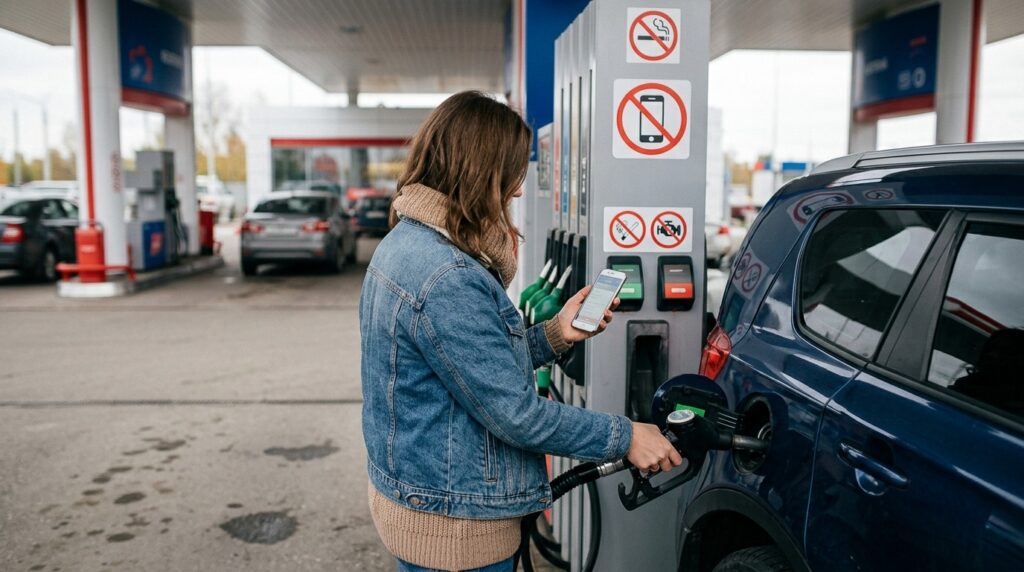
Phones at gas stations: they’re banned for a reason. Here’s what can happen
At most gas stations, you can see a sign with a crossed-out mobile phone, but many drivers have long stopped paying attention to it. We stand by the pump, scroll through our feeds, answer calls, and calmly go about our business. Well, starting June 1, 2026, the measures are getting stricter: for using a phone, you may be refused fueling, put on a blacklist, or even have the police called. That’s because a phone at a gas pump can indeed be dangerous, but not quite in the way you might think. Let’s figure out why this ban actually makes sense.
Can a Phone Cause a Fire at a Gas Station
The main fear goes like this: a phone creates electromagnetic radiation, it causes a spark, the spark ignites gasoline vapors — and that’s it, the gas station goes up in flames. It sounds logical and scary. But in this exact form, it’s more of a myth than a real threat.
A regular smartphone doesn’t produce enough power to ignite fuel vapors with its signal. Over decades of mass mobile phone use, there are no confirmed cases where a gas station exploded specifically because of an incoming call. So a phone conversation by the pump in itself is not the thing that will instantly cause a fire.
But this doesn’t mean the ban was invented for no reason. The real danger is just hiding somewhere slightly different.
The Real Danger at Gas Stations — Static Electricity
Much more serious than a phone signal is static electricity that accumulates on our bodies. This most often happens in winter, in dry air, while wearing synthetic clothing. It’s exactly this kind of discharge that sometimes sparks when you touch a door handle or when you touch another person.
This is precisely what can ignite gasoline vapors. Gasoline evaporates very actively, and there’s always a cloud of flammable vapors around the fuel nozzle. If a static discharge occurs at that moment — it, not the phone, can be the cause of ignition.
The dangerous scenario looks like this: a driver inserts the nozzle, sits back in the car to warm up, then quickly gets out, rubs against the seat, accumulates a charge, and reaches for the nozzle. The discharge sparks right at the tank opening. That’s why many instructions advise not to get back into the car while fueling.
Why Phones Are Still Banned at Gas Stations
If a smartphone by itself is almost safe, why ban it? The reason is simpler and more human: a phone distracts your attention. A person with a screen in front of their face stops noticing what’s happening around them.
And at a gas station, there are plenty of things that require attention:
- you can accidentally create that very static spark while fiddling with your phone and not thinking about grounding,
- it’s easier to fail to react if a real danger arises nearby,
- it’s easy to forget to remove the nozzle before driving off,
- you might not notice fuel overflowing (if there are still gas stations like that somewhere).
So it turns out that the phone ban is primarily about static electricity and your concentration. A gas station remains a place with a large amount of fuel vapors, and it’s better to stay focused here.
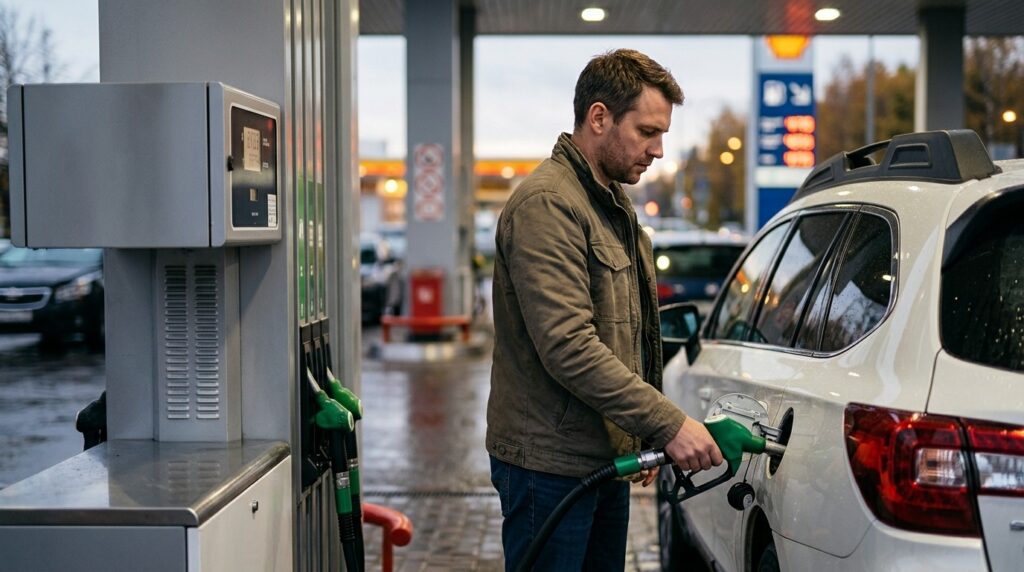
While fueling, it’s better to keep your hands and mind free from the phone
What You Shouldn’t Do While Fueling and How to Refuel Safely
To minimize the risk, simple habits are enough. These recommendations seem obvious, but they’re the ones most often forgotten.
- Put your phone away during fueling — calls and messages can wait a couple of minutes.
- Don’t get back in the car while fueling to avoid accumulating static.
- If you did get back in, before grabbing the nozzle, touch a metal part of the car body with your hand — this way the discharge will dissipate safely.
- Don’t smoke or use open flames — this is far more dangerous than any smartphone.
- Wait until the nozzle fully shuts off and don’t yank it out prematurely.
These rules apply year-round but are especially important in winter, when dry air turns us into little generators of static electricity.
What’s More Dangerous Than a Phone at Gas Stations: Static, Fuel Vapors, and Driver Mistakes
If you rank threats by real significance, the picture looks like this: the most dangerous things at a gas station are static and inattention, not a phone signal. Open flames and cigarettes remain an absolute taboo, and those deserve to be taken as seriously as possible.
Phones are banned based on the principle of reasonable caution: they distract and increase the chances of making a mistake. So the sign with the crossed-out smartphone is not an empty formality: near fuel, it’s best to be present in the moment, not scrolling through your news feed.