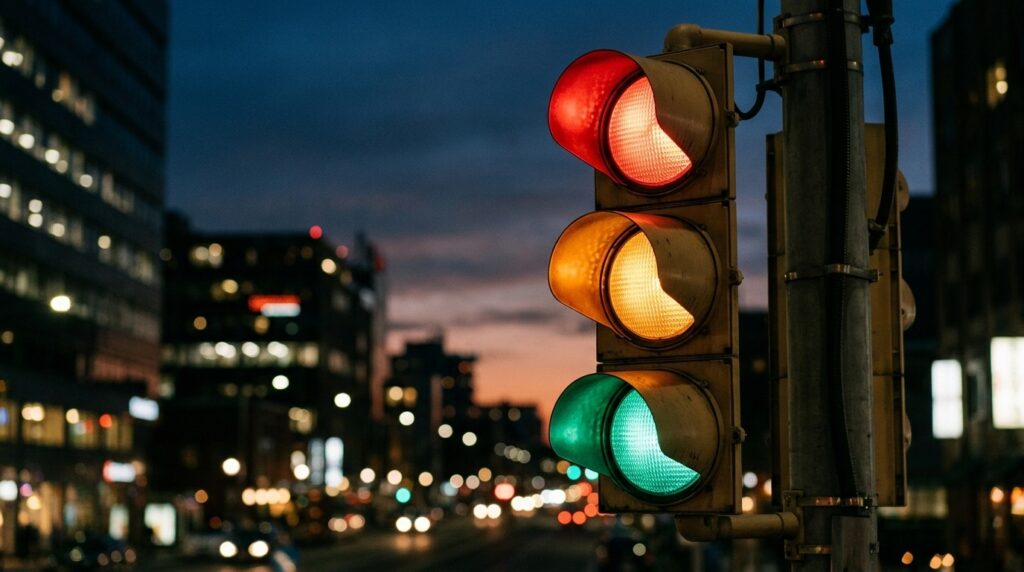
We encounter traffic lights almost every day, but rarely think about them
The three colors of a traffic light are familiar to everyone from childhood, but few people wonder why red, yellow, and green were chosen from the entire spectrum. The answer lies not in someone’s whim, but at the intersection of physics, the physiology of vision, and 19th-century railroad history.
The History of Traffic Light Colors: From Railroads to Roads
The history of the traffic light begins long before automobiles. In the first half of the 19th century, British railroads already used color signaling: red meant “stop,” white meant “clear,” and green meant “caution.” The system worked, but with caveats. A white signal was easily confused with an ordinary star or streetlamp, which sometimes led to accidents.
Over time, green replaced white as the permissive signal, and yellow took the intermediate position — “attention.” When one of the first electric traffic lights for automobile traffic was installed in Cleveland, Ohio in 1914, the railroad color palette migrated to city intersections virtually unchanged.
Why Red, Yellow, and Green Are Highly Visible on the Road
The choice of colors is not merely a nod to tradition. Each of the three signals has an important physical advantage. Red light has the longest wavelength in the visible spectrum — approximately 620–750 nanometers. The longer the wavelength, the less light is scattered in the atmosphere. This is precisely why a red signal is visible at the maximum distance even in fog, rain, or dust — the ideal choice for the most critical warning.
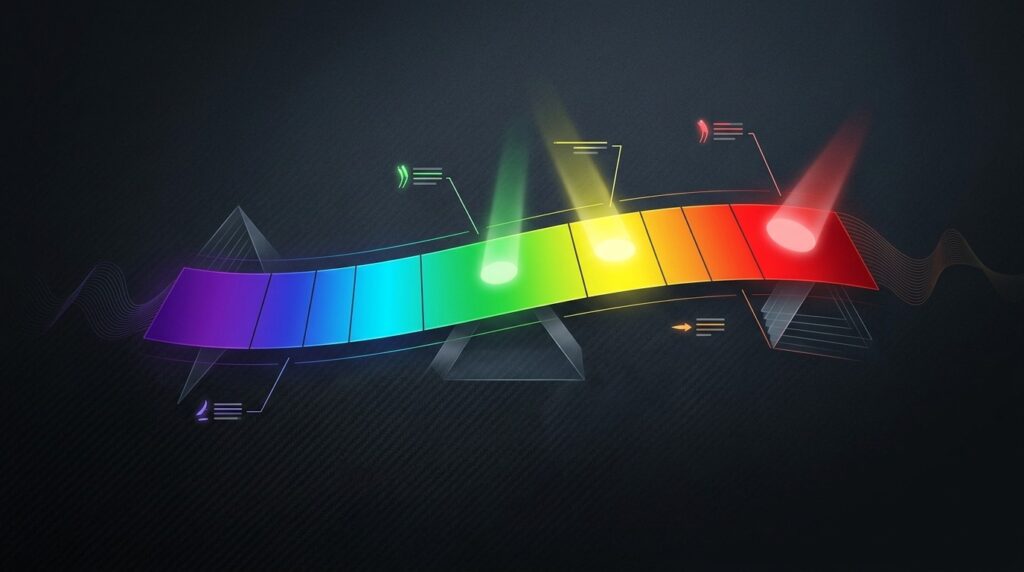
Red light has the longest wavelength and scatters the least in the atmosphere
Green light (495–570 nm) is also easily distinguishable, and its contrast with red is sufficient to eliminate confusion. Yellow (570–590 nm) sits between them in the spectrum and occupies an “intermediate” position — both physically and in terms of signal meaning.
Why the Human Eye Distinguishes Traffic Light Colors So Well
The physics of light is half the explanation. The other half lies in the structure of our vision. The retina contains three types of cones (photoreceptors responsible for color vision), each most sensitive to a specific wavelength range: short-wave (blue), medium-wave (green), and long-wave (red).
Red and green activate different types of cones with maximum intensity and in maximally different ways. Simply put, our brain distinguishes red and green quickly and confidently, even in the periphery of our visual field — and that is exactly where the traffic light most often appears when a driver is looking at the road. Yellow, in turn, is perceived as the brightest color in daylight thanks to the eye’s peak sensitivity in the yellow-green part of the spectrum.
It’s important to note: approximately 8% of men and 0.5% of women have some form of color vision deficiency, most commonly difficulty distinguishing red and green. This is precisely why in modern traffic lights, the position of the signal (top, middle, bottom) is no less important than its color.
Why Traffic Light Colors Are the Same in Every Country
By the mid-20th century, inconsistencies in traffic light systems were creating problems for international traffic. In 1968, the Vienna Convention on Road Signs and Signals was signed, establishing red, yellow (amber), and green as mandatory traffic light colors for participating countries.
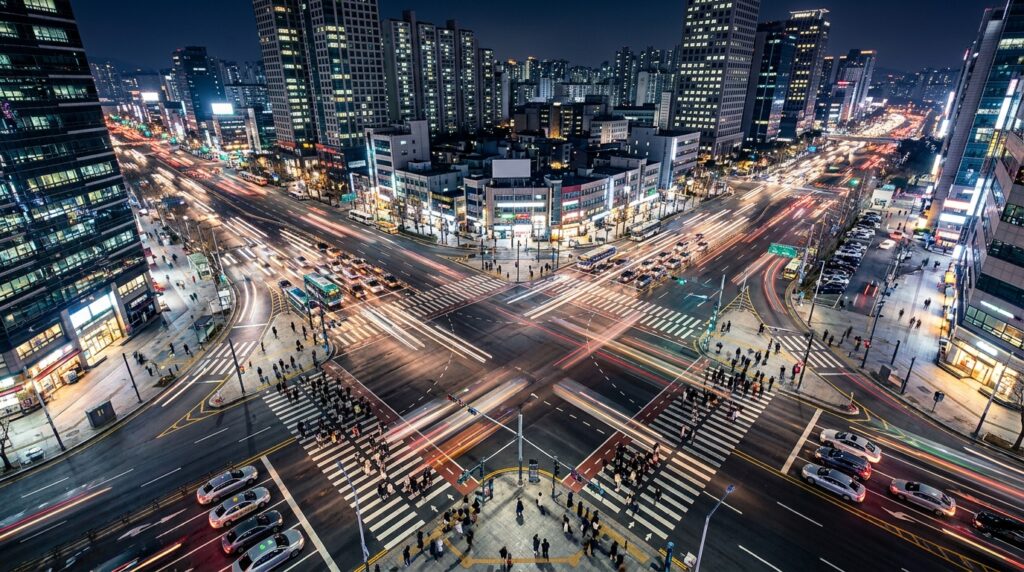
Traffic lights with the same color scheme operate around the world
Standardization addressed a specific problem: a driver crossing a border must instantly understand signals without translation or training. Today, the red-yellow-green scheme is used in virtually every country in the world — it is one of the few truly universal visual codes.
What New Colors and Signals May Appear in Traffic Lights
Despite the established palette, engineers continue to experiment. In some cities, traffic lights with an additional blue or white signal are being tested — for example, to indicate public transit priority. In South Korea in 2024, a proposal was made to add a fourth signal specifically for autonomous vehicles.
Another direction is adaptation for people with color blindness. In Japan, for example, the green signal is given a noticeable bluish tint so it can be better distinguished from red by people with color vision deficiencies. In some countries, different signal shapes are being added: red as a square, green as a triangle.
The three colors of the traffic light are not the result of a random choice, but the intersection of railroad engineering, the laws of optics, and the structure of the human eye. Red is visible from the farthest distance and signifies danger. Green provides maximum contrast with red for our vision. Yellow is the most noticeable in daylight. Together they form a system that works faster than we can think about it — and that is precisely its greatest value.