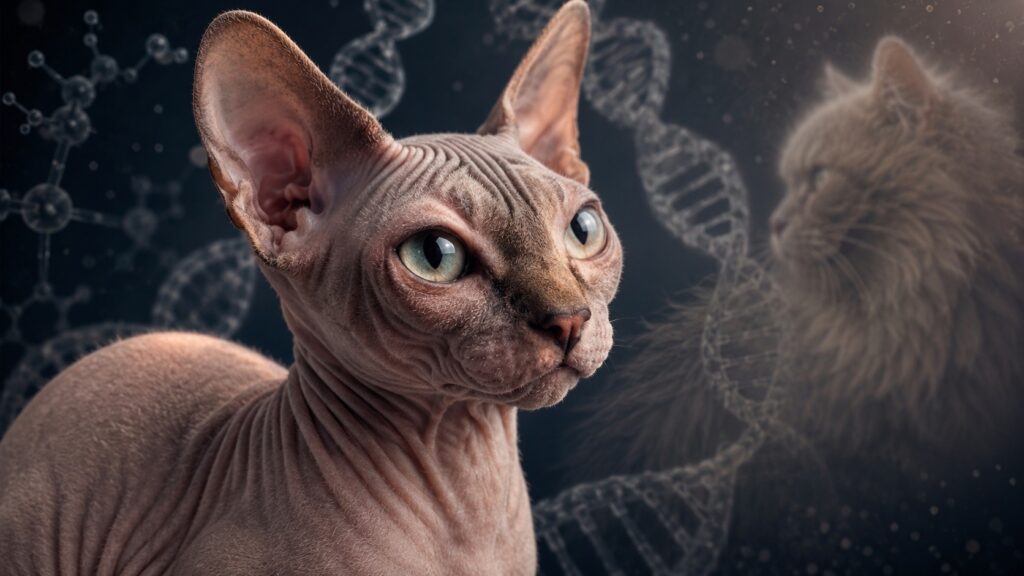
In reality, Sphynx cats do grow fur, but very faintly
Sphynx cats are arguably the most recognizable cats in the world. People either adore them or find them a bit intimidating, but no one remains indifferent. Few people know that the Sphynx’s lack of fur is not the result of a selective breeding whim but rather a consequence of a natural genetic accident that humans later reinforced through breeding. How exactly did one mutation strip an entire breed of its familiar coat, and what does this mean for the health of the cat?
Why Sphynx cats are hairless
According to The International Cat Association, the history of the Sphynx breed began in 1966 in Toronto, Canada, when an ordinary domestic cat gave birth to a hairless kitten. He was named Prune (apparently for his wrinkled appearance), and it was from him that the first breeding program for hairless cats began.
Later, scientists discovered that the cause was a mutation in the KRT71 gene, which is responsible for the keratin protein in hair follicles. Keratin is the building material for hair, nails, and the outer layer of skin. In normal cats, this gene works as intended: a hair forms in the follicle, receives a strong keratin framework, and grows outward. In Sphynx cats, the hair also begins to form, but due to the gene defect, its structure turns out fragile. Such a hair quickly breaks and falls out before it has a chance to fully grow.
This mutation is recessive. This means a kitten will only be born hairless if it receives a “broken” copy of the gene from both parents. If the copy comes from only one parent, the cat will look normal but will remain a carrier of the gene.
Sphynx cats aren’t actually completely naked
If you think Sphynx cats are absolutely bald, you’re mistaken. In reality, most Sphynx cats are covered in fine peach fuzz that feels like suede or the skin of a peach to the touch. Some may have slightly more hair on the bridge of the nose, ears, or tip of the tail.
Sphynx owners often compare the feeling of touching them to a warm suede hot water bottle. Sphynx cats come in all sorts of colors: spotted, solid, with “socks” — it’s just that all of this shows up on the skin rather than on fur. So a Sphynx is not a naked cat but a cat in an extremely thin velvet suit.
The degree of “baldness” in Sphynx cats also varies: one cat may appear almost completely hairless, while another will be noticeably velvety to the touch. Sometimes the fuzz is more visible on the paws, tail, face, and ears, and with age, season, or hormonal changes, the amount can shift slightly. Even Sphynx whiskers often look unusual: they can be short, broken, curled, or nearly absent.
How Sphynx cats live without fur
The absence of normal fur is not just a cosmetic feature of Sphynx cats. It directly affects the cat’s daily life.
In regular cats, skin oils are distributed along the fur and gradually removed through grooming. Sphynx cats have no fur, so the oil accumulates directly on the skin, and the cat needs to be bathed regularly — roughly once every one to two weeks. Without this, the skin becomes sticky, a characteristic odor appears, and irritation can develop in the folds.
There are other peculiarities as well:
- Sphynx cats get cold more easily because fur is a cat’s primary thermal insulator. In winter, they need a warm sleeping spot, and some owners even put clothes on them;
- In summer, they easily get sunburned, which is why most Sphynx cats live exclusively indoors;
- Due to accelerated heat exchange, Sphynx cats eat more — energy goes toward heating the body.
It’s also worth debunking the myth that Sphynx cats don’t cause allergies. Few people know this, but cat allergies are not caused by the fur itself but by proteins from saliva and skin particles. Sphynx cats produce these particles just like any other cats. Admittedly, without fur flying around the apartment, there may be slightly fewer allergens, but still, Sphynx cats are not hypoallergenic.
The curly hair gene in animals
Interestingly, the KRT71 gene mutates not only in cats. A 2010 study showed that mutations in this same gene are responsible for curly and wavy fur in dogs, mice, and rats. The difference lies in which exact part of the gene is affected: one defect completely destroys the hair structure, while another only slightly deforms it, creating curls.
This fact nicely illustrates how one and the same gene can produce completely different external manifestations depending on the type of mutation. Incidentally, Cornish Rex and Devon Rex cats with their characteristic curls also owe their appearance to variations in keratin gene function.
Other hairless cat breeds
The Sphynx is far from the only hairless cat. Some breeds descended directly from Sphynx cats, while others appeared independently.
The Donskoy (Don Sphynx) is a Russian breed discovered in 1987. Unlike the Canadian Sphynx, its hairlessness is caused by a dominant mutation. This means that just one copy of the “broken” gene from one parent is enough for a kitten to be born without fur.
From crossbreeding the Donskoy with other breeds came:
- Peterbald — a cross with the Oriental Shorthair, originating from St. Petersburg. Its coat ranges from velvety to completely absent;
- Ukrainian Levkoy — a cross between the Donskoy and the Scottish Fold, with characteristic inward-folding ears.
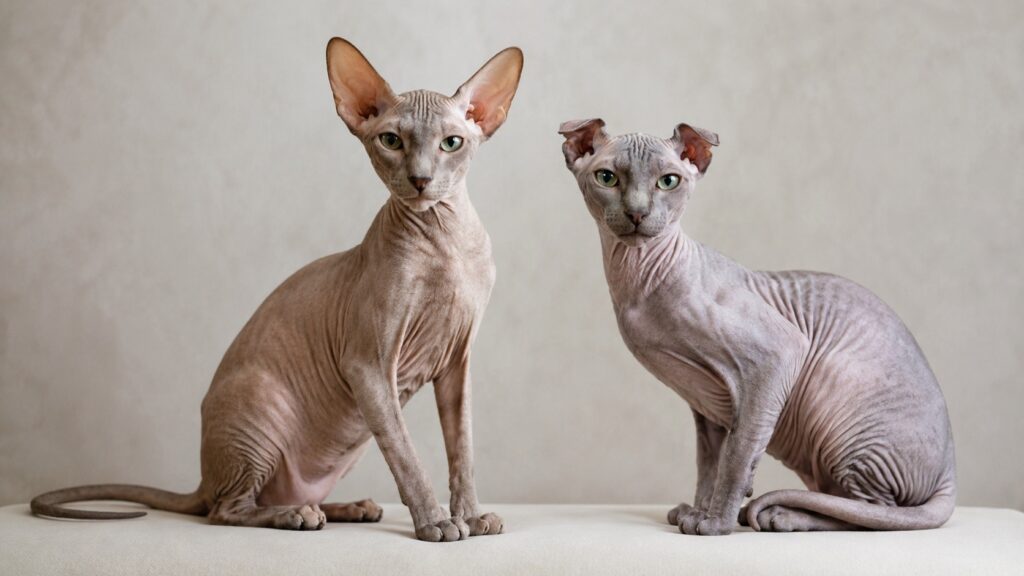
Peterbald and Ukrainian Levkoy cat breeds
From the Canadian Sphynx came:
- Bambino — a cross with the Munchkin, a small cat with short legs and large ears;
- Elf — a cross with the American Curl, with backward-curving ears;
- Dwelf — a hybrid of three breeds at once: Sphynx, Munchkin, and American Curl, with a long body on short legs.
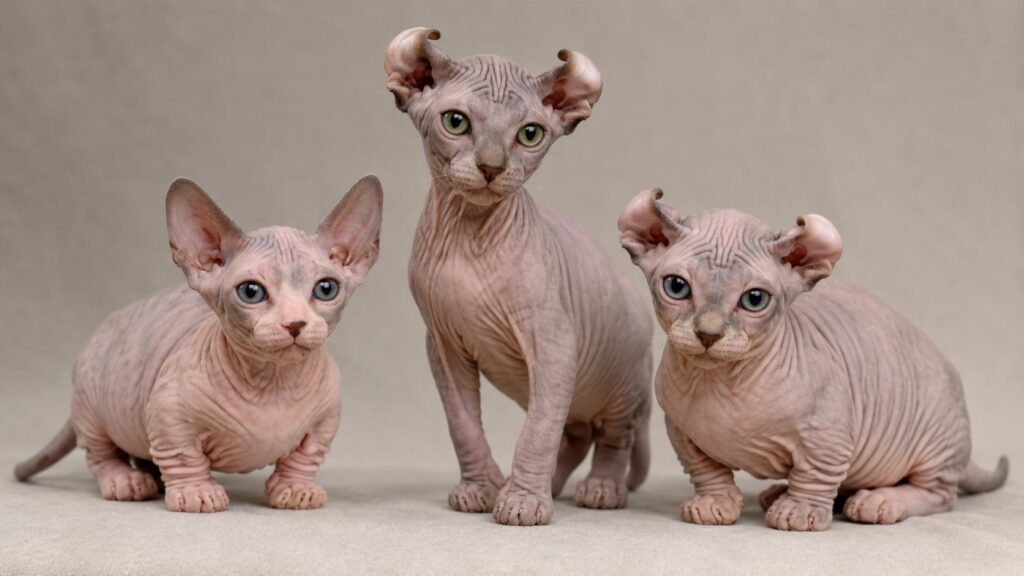
Bambino, Elf, and Dwelf cat breeds
It is believed that hairless cats were kept by the Aztecs as early as around 1300. There was even a Mexican Hairless cat breed, which unfortunately went extinct.
What is the Sphynx’s temperament like
In terms of personality, Sphynx cats are no less endearing than their furry counterparts — they purr, play, and hunt flies just the same. But when it comes to care, the difference is substantial.
The main things a Sphynx owner needs to know:
- Regular bathing is the foundation of care — without it, the skin quickly gets dirty;
- Protection from cold in winter and from the sun in summer;
- Slightly more food than furry cats need, due to increased energy expenditure on staying warm;
- Attention to skin folds where dirt can accumulate.
For this reason, getting a Sphynx is not recommended for people with limited time. But in return, this cat breed offers an extremely unusual tactile experience and a devoted personality. Many owners say that after having a Sphynx, it’s hard to go back to regular breeds.
The history of the Sphynx is an excellent example of how one random mutation in a single gene can create an entire direction in pet breeding. And although their unusual appearance still sparks debate, from a genetics standpoint, Sphynx cats are not an anomaly but a great demonstration of how heredity works in mammals.