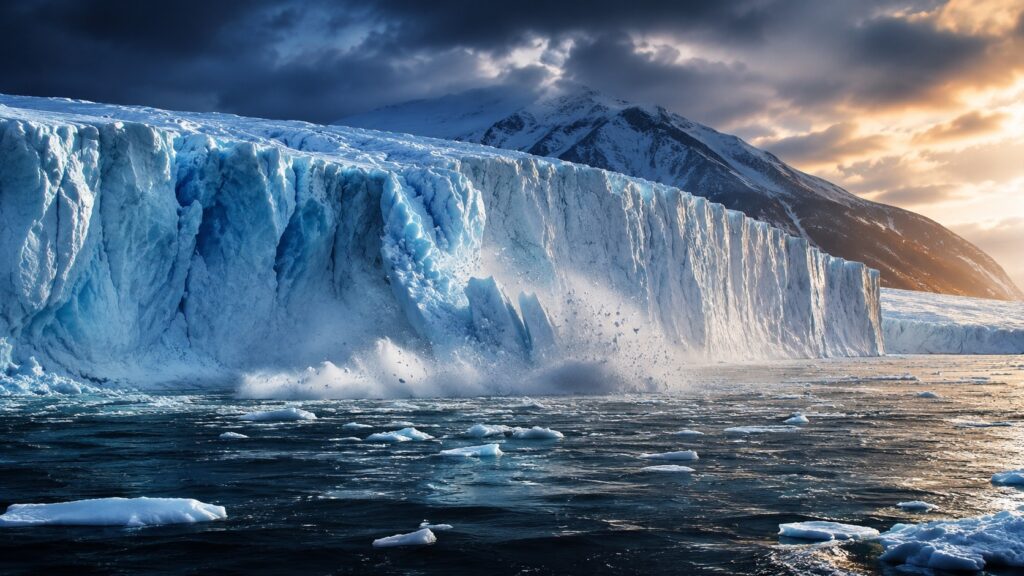
In the future, Saint Petersburg could end up underwater due to glacier melting
The Thwaites Glacier in Antarctica, which scientists have dubbed the Doomsday Glacier, continues to deteriorate due to warming waters. If it melts along with neighboring glaciers, global sea levels could rise by three meters. Saint Petersburg, the Baltic coast, and Western Siberia would be at risk.
What Is the Doomsday Glacier and Where Is It Located
The Thwaites Glacier is located in West Antarctica and is comparable in area to the United Kingdom. It received its unofficial name, the Doomsday Glacier, because of the colossal volume of ice it contains. If this ice ends up in the ocean, the consequences for coastal cities around the world would be catastrophic.
In 2024, the scientific journal Nature published an article stating that the Thwaites Glacier is rapidly melting due to rising water temperatures. Warm ocean currents are eroding the glacier from below, weakening its foundation. Imagine a piece of butter on a warm frying pan: it melts not from the top but from the bottom, and at some point simply loses its support. The Thwaites Glacier behaves in much the same way — its underwater portion is deteriorating faster than the visible part.
The problem is also that Thwaites acts as a cork. It holds back enormous masses of ice from the West Antarctic Ice Sheet. If this plug disappears, melting could accelerate dramatically.
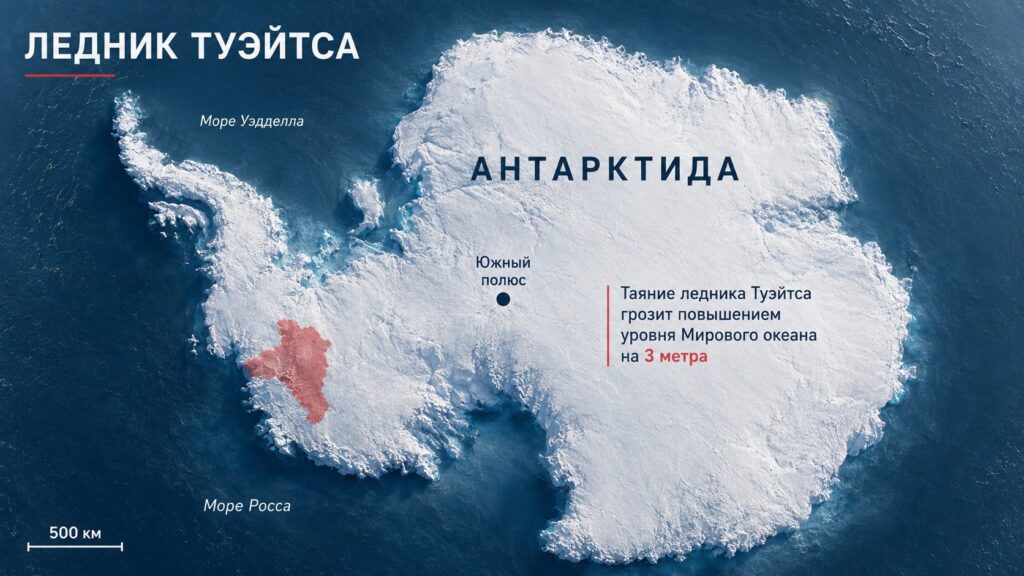
Thwaites Glacier on the map of Antarctica
How the Melting of Thwaites Glacier Affects Ocean Levels
The Thwaites Glacier contains so much ice that its complete melting would raise global sea levels by approximately 65 centimeters. But the main threat is a chain reaction. If Thwaites collapses, it would open a path for warm water to reach neighboring glaciers, and then the total sea level rise could reach three meters.
Three meters is not an abstract number. It is the height of a ceiling in an average apartment. If the ocean rises by that much, dozens of major cities around the world would be partially or completely flooded.
How quickly this could happen is a question scientists do not yet have a precise answer to. It could take decades or centuries, but scientists are already warning that even a one-meter rise would pose a serious threat.
Scientists have been debating for several years how quickly water levels will rise due to the destruction of Antarctic glaciers. The process depends on numerous factors: the rate of warming, the behavior of ocean currents, and the stability of neighboring ice masses.
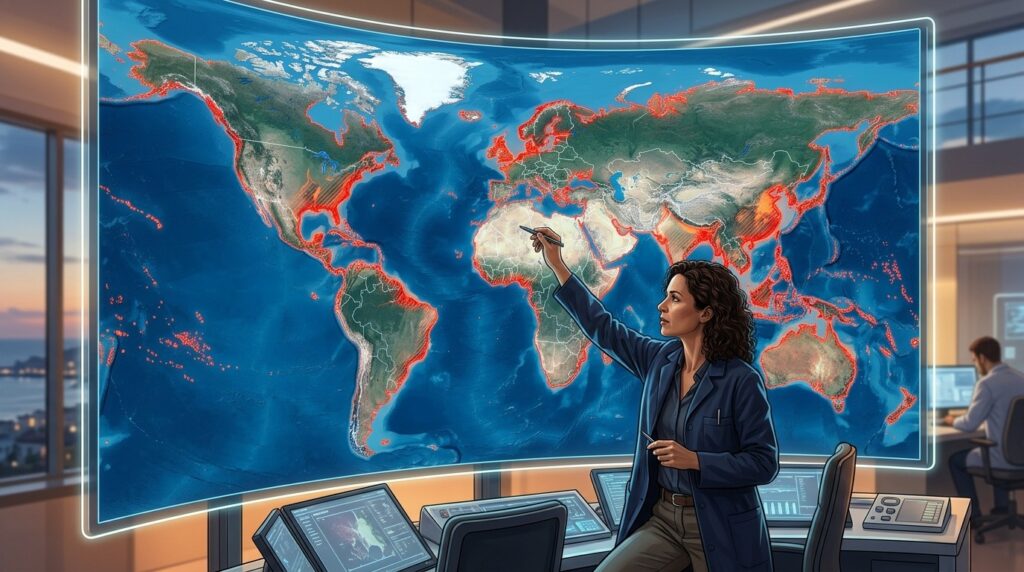
Map of coastal territories that would be at risk if ocean levels rise
Why Saint Petersburg and the Baltic Could Be Flooded
According to RIA Novosti, among Russian territories in the potential risk zone are Saint Petersburg, the Baltic coast, and Western Siberia. And this is not a random selection.
Saint Petersburg is located at the mouth of the Neva River, on low-lying islands and reclaimed land. The city’s average elevation above sea level is only about 1–3 meters. Even without global warming, the city suffers from flooding — throughout its history, Saint Petersburg has experienced more than three hundred major floods.
If the ocean rises by even one meter, current protective structures may prove insufficient. The Baltic Sea coast, which includes the Kaliningrad and Leningrad regions, would also come under pressure.
Western Siberia is on the list for a different reason: it is an enormous lowland, a significant portion of which lies at an elevation of less than 100 meters above sea level. In the event of a massive ocean rise and changes in the hydrological regime of rivers, these territories would be affected as well.
Could the Ocean Rise by Several Meters
A three-meter rise in global ocean levels is not a forecast for the coming years. It is a scenario that would materialize in the case of the complete destruction of Thwaites and neighboring glaciers. Scientists cannot yet say precisely when this will happen or whether it will happen at all on such a scale.
But the trend is concerning. According to research, the rate of Antarctic glacier melting is accelerating. Warm currents are penetrating ever deeper beneath the ice sheet, and each degree of ocean warming increases the volume of melting ice.
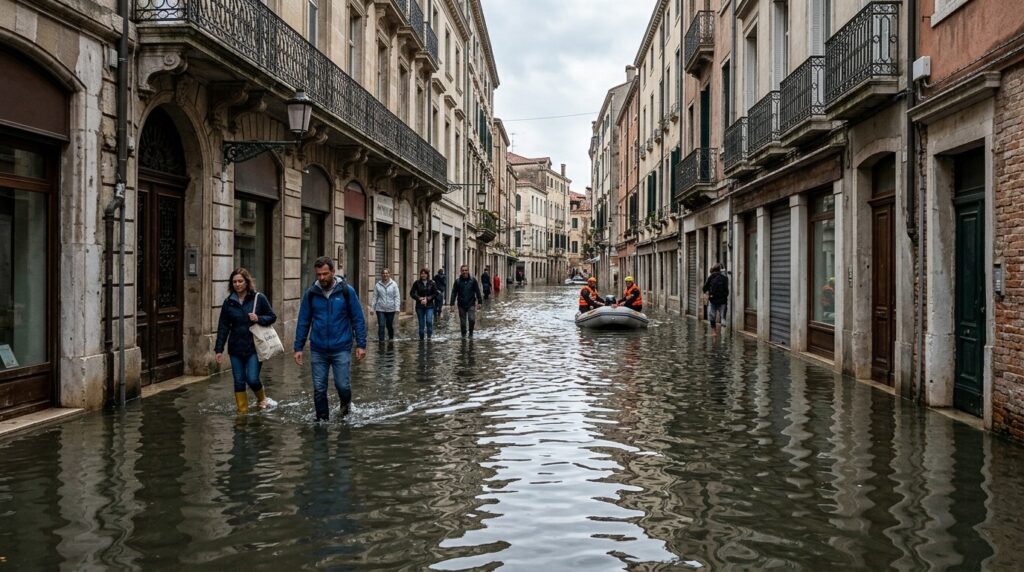
This is what the flooding of a coastal city could look like with rising sea levels
Scientists have previously warned about the large-scale consequences of Antarctic glacier destruction and what it means for humanity.
How to Protect Cities from Flooding
Can we prepare for such a scenario? The experience of different countries shows that partially — yes. The Netherlands, a third of whose territory lies below sea level, has been building and improving a system of dams and barriers for decades. Japanese and South Korean cities are implementing underground reservoirs for water diversion.
For Russia, key flood protection measures could include:
- Improving existing protective structures, primarily Saint Petersburg’s dam, taking into account projections for global ocean rise;
- Revising construction standards for coastal territories;
- Developing sea level monitoring and early warning systems;
- Planning infrastructure with consideration for possible flooding of low-lying areas.
However, the scale of the problem goes beyond the work of engineers in any single country. The melting of Antarctic glaciers is a global process, and slowing it down depends on whether humanity can reduce greenhouse gas emissions and limit further warming.
The story of the Doomsday Glacier is a serious reason to reflect. The process of destruction is already underway, and although the worst-case scenarios may unfold over decades, preparations for the consequences need to begin now. Especially for those who live in cities where there are only a few meters between sea level and the ground floor.