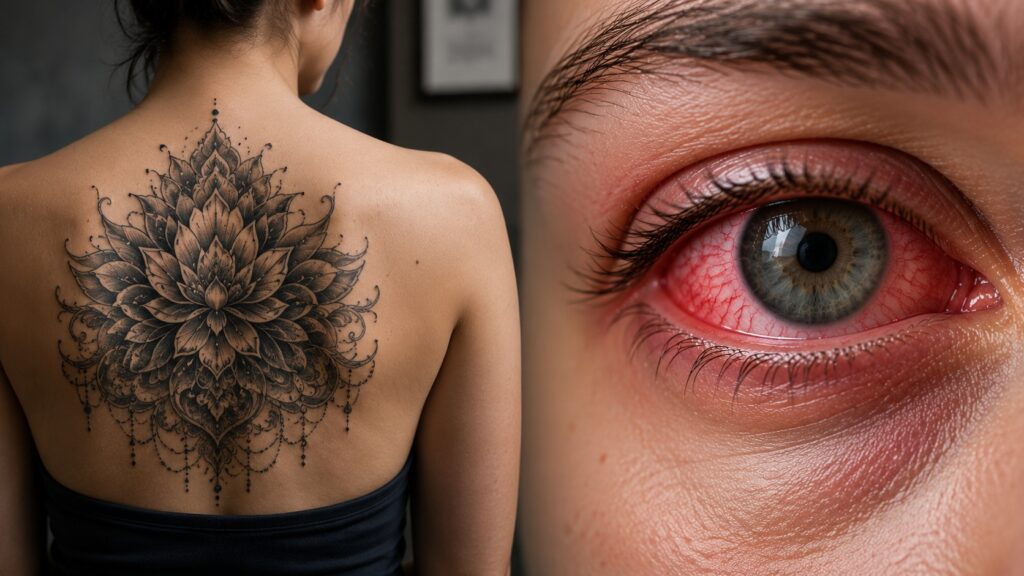
You can go blind from a tattoo, and such cases really exist
An Australian woman named Nelise Pretorius first noticed that one eye was losing vision, then the other. Doctors thought it was ordinary conjunctivitis, but tests showed something different. The source of the problem turned out to be a tattoo on her back, done several years earlier. It sounds absurd, but behind it lies a perfectly understandable, though not yet fully studied, mechanism.
When specialists in Australia began comparing their patients, they described 40 cases of so-called tattoo-related uveitis. And the main point here is not the sensation, but understanding how pigment under the skin can even reach the eye and why it sometimes ends in vision loss.
What Is Uveitis in Simple Terms
Uveitis is an inflammation of the vascular layer of the eye. To understand, you can imagine the eye as a camera. It has a transparent front part, a retina at the back, and between them lies a layer rich in blood vessels that nourishes the eye and regulates light. When this particular layer becomes inflamed, uveitis begins.
The problem is that the symptoms are easily mistaken for something harmless. Uveitis symptoms include blurred vision, pain, redness, and sensitivity to light. That’s exactly why Nelise’s doctors initially suspected conjunctivitis — because the outward appearance is similar. But if uveitis is left untreated, the inflammation can progress to glaucoma or lead to irreversible vision loss.
The main treachery is that the inflammation in this story doesn’t start because of an infection in the eye itself. The source is in a completely different place — in the skin, where tattoo ink particles reside. The details were described in the scientific journal Clinical and Experimental Ophthalmology.
How a Tattoo Can Cause Eye Inflammation
The strangest thing in this story is the distance between cause and effect — because the tattoo is on the back, but the eyes are suffering. Scientists suggest it’s about an immune reaction. The body perceives the pigment as a foreign substance and starts fighting it, but for some reason, eye tissues also come under attack.
The source states that doctors don't understand why specifically eye cells come under fire. There is something in the immune reaction itself that targets the eye, but the exact mechanism is still unknown.
Clues come from similar diseases. An inflamed tattoo under a microscope looks almost the same as sarcoidosis — a condition in which immune cells cluster together in various organs, such as the lungs and skin. In other words, the body reacts to the ink in roughly the same way as in certain autoimmune diseases.
How the Immune System Reacts to Tattoos
When an artist does a tattoo, they inject ink particles into a deep layer of the skin. These particles are too large for the body to fully eliminate, so they remain there for years. That’s precisely why tattoos last so long: immune cells literally surround the pigment but cannot get rid of it.
For most people, that’s where it ends — the ink sits quietly without causing any harm. But in some people, the immune system reacts differently. Black tattoo ink is found most frequently among affected patients, and in some cases the problem was linked to red and pink inks.
Why some people react to tattoos and others don’t remains unclear. Scientists cautiously name two possible factors:
- genetic predisposition — the specific characteristics of an individual’s immune system;
- the microbiome, meaning bacteria living in the body, which can influence the immune response.
It’s important to emphasize that these are still preliminary hypotheses, not proven causes. Additionally, everything is complicated by the fact that many tattoos are done abroad, and tracing the exact chemical composition of the inks is virtually impossible.
Why Vision Problems Begin Years Later
One of the most frightening details is the time delay. Eye disease symptoms usually appeared one to two years after getting the tattoo, but in one case, the inflammation made itself known more than thirty years later.
This is what makes the connection so non-obvious. A person has long forgotten about the tattoo, lives a normal life, and then suddenly starts losing their vision. Neither they nor their doctors initially connect it to the ink on their back. That’s exactly what happened with the Australian woman — she was losing her vision, and nobody could explain why. Due to her deteriorating eyesight, she was even unable to continue working as a chef.
Vision problems don’t manifest immediately, and that’s the main danger. Image source: ZME Science
What particularly concerns doctors is that such patients are difficult to cure completely. Most require long-term immunosuppressive treatment. Only three patients maintained normal vision throughout their treatment; the rest experienced some degree of deterioration. And, unlike typical autoimmune eye diseases, many patients cannot be taken off medication because the disease returns.
Which Uveitis Symptoms Should Not Be Ignored
The main practical takeaway from this story is not to be scared of tattoos, but to notice warning signs in time. Early uveitis diagnosis truly helps prevent irreversible damage, especially if unexplained eye inflammation appears in a person with tattoos.
Here are uveitis symptoms that warrant a visit to an ophthalmologist rather than being dismissed:
- noticeable blurring of vision, especially if it’s getting worse;
- eye pain;
- persistent redness;
- increased sensitivity to light, photophobia.
If such symptoms appear and standard conjunctivitis treatment doesn’t help, it makes sense to mention to your doctor that you have tattoos — this could steer the diagnosis in the right direction.
However, researchers explicitly state that the overall risk of uveitis from tattoos is small. According to surveys, about 20-30% of Australians have tattoos — that’s millions of people — and the vast majority have no eye problems whatsoever.
Can You Lose Your Vision from a Tattoo
Yes, going blind from a tattoo is possible, but it’s rare. Several people with this uveitis lost their vision permanently. The Australian woman herself considers herself lucky because her case was brought under control. Although she spent thousands of dollars on treatment and still uses steroid eye drops.
At the same time, neither doctors nor patients are calling for people to give up tattoos. So many people get tattoos that stopping it is hardly realistic. Instead of bans, scientists want to make tattoos safer: identify potentially dangerous tattoo colors and raise awareness among doctors so they can more quickly recognize this rare complication.
As tattoos become commonplace, medical professionals have discovered a rare pathway through which the immune response to pigments in the skin can threaten vision. And now the two most important things are early diagnosis and a deeper study of the mechanism itself. So if after getting a tattoo — whether fresh or very old — you suddenly notice that your eye hurts, turns red, and sees worse, that’s a reason not to chalk it all up to fatigue, but to see a specialist.