
Just three days without sleep can cause irreparable harm to the body
Over a lifetime, a person spends an impressive amount of time sleeping, and sometimes it seems like those years could be put to better use. But sleep is not a pause — it’s active work by the body, without which everything quickly breaks down: from concentration to the perception of reality. Let’s break down day by day what exactly happens to the body if you stubbornly refuse to get nighttime rest.
The First 24 Hours Without Sleep: What You Notice Right Away
Almost everyone has experienced a sleepless night at least once — exams, work, a flight, or a party that went on too long. If you manage to get proper sleep afterward, nothing terrible happens. Problems begin when an active night is followed by an equally active day.
After just 24 hours, headaches appear, it becomes difficult to concentrate, and appetite spikes sharply — the body tries to compensate for sleep deprivation with high-calorie food. Many people drink coffee by the liter at this point, but the energy boost doesn’t last long.
The most unpleasant part is the decrease in reaction time. Studies show that the effects of a single sleepless night are comparable to having 0.1% blood alcohol content, which significantly increases the risk of traffic accidents. Yale School of Medicine psychologist John Cline explains that after 24 hours without sleep, cortisol and adrenaline levels rise — these hormones keep the body alert because the brain cannot “reboot” in the normal way.
36 Hours Without Sleep: Microsleeps and Hidden Inflammation
By a day and a half without sleep, the desire to fall asleep becomes almost irresistible. If you resist it, microsleeps begin — lapses from reality lasting fractions of a second or up to half a minute. A person may not even notice such a lapse, but behind the wheel or at a machine, it’s enough for a catastrophe.
Meanwhile, inflammatory markers rise in the blood, and the constant flow of cortisol keeps the body in a state of prolonged stress. This hits the cardiovascular system and can raise blood pressure. Because glucose metabolism is disrupted, stomach pains, dizziness, watery eyes, slowed reactions, and a weakened immune system appear. All the symptoms from the first 24 hours return, but many times stronger.
48 Hours Without Sleep: Immunity Drops and the Psyche Gives Way
By two days, a person is literally sleeping on their feet: the brain shuts off more and more frequently, microsleeps come one after another. At this stage, behavior changes dramatically — it becomes difficult to think clearly and retain information, irritability appears, along with outbursts at those around you.

On the second day without sleep, the brain increasingly shuts off for brief moments
The immune system suffers separately. In a study of volunteers who gave up sleep for three days, after just 48 hours of wakefulness, NK cell counts dropped by 37%. These “natural killer cells” help the body fight viruses and suppress tumor growth, so their sharp decline makes a person more vulnerable. Pulmonologist and sleep specialist Hussam Al-Sharif notes that some people at this stage fall into depression, while others experience euphoria and even begin to see and hear things that aren’t there.
On Which Day Without Sleep Do Hallucinations Begin
After three days without sleep, all systems malfunction simultaneously. Even gait changes — a person moves as if heavily intoxicated. Speech impairments, chills, tremors, and nervous tics appear, while appetite, on the contrary, disappears. Continuing to stay awake at this stage is already life-threatening.
It is precisely around 72 hours that the brain “ripens” for hallucinations, delusions, and paranoia. In an experiment published in the journal Comprehensive Psychiatry, 12 subjects who endured 72 hours without sleep showed tachycardia, depressed mood, and suppressed state. According to John Cline, the body desperately wants to shut down, but the person forcefully makes the brain fight this desire — and the psyche becomes extremely fragile.
By the fourth day, the extreme stage arrives — sleep deprivation psychosis. The perception of reality becomes so distorted that a person can no longer correctly interpret it, and the desire to fall asleep becomes unbearable. Against this backdrop, the line between real and imaginary is lost.
What Happens to the Brain and Heart If You Don’t Sleep for Several Days
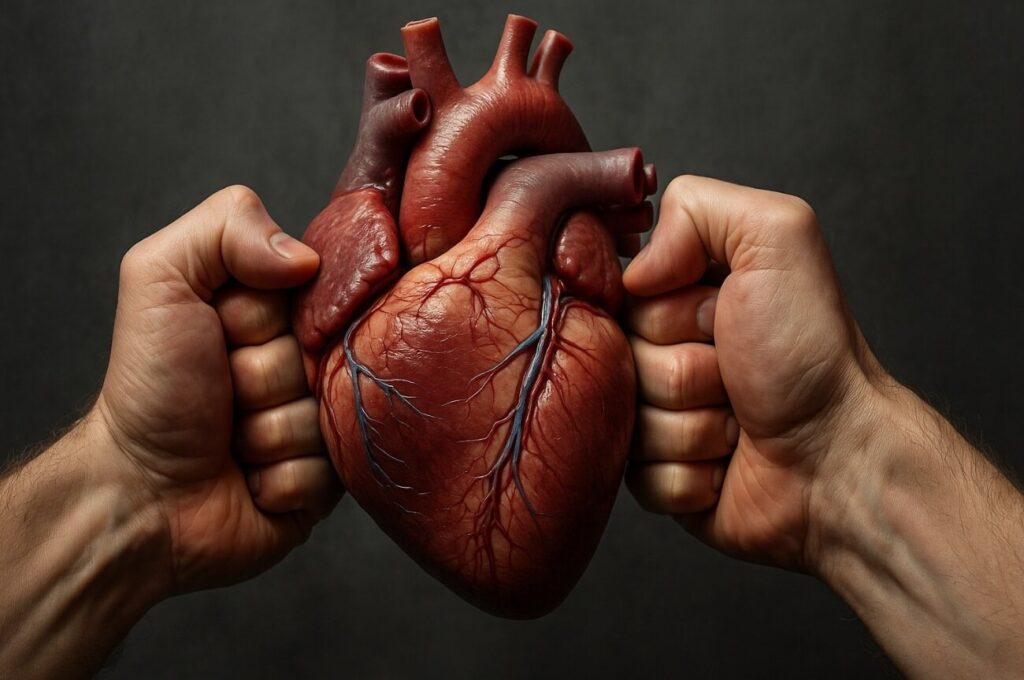
Stress from lack of sleep can quickly destroy the heart
If you put the whole picture together, it’s clear that sleep deprivation strikes two critical systems at once. The brain loses its ability to reboot: it runs on stress hormones, falls into microsleeps, and gradually slides toward hallucinations and paranoia. Meanwhile, the heart works on overdrive due to tachycardia, elevated blood pressure, and chronically high cortisol.
Add glucose metabolism disruption, inflammation, and immune system collapse — and it becomes clear why sleep deprivation is linked to cardiovascular risks. The principle is simple: the longer the wakefulness, the deeper the malfunction and the harder it is to recover afterward. According to estimates, just one hour of lost sleep requires about four days to return to normal.
Can You Die From Not Sleeping, and How Did Wakefulness Records End
Sources directly state: after three days of insomnia, further refusal to sleep becomes life-threatening. The body literally demands shutdown, and resisting this desire pushes the body and psyche into a critical state.
At the same time, it’s important to remain clear-headed: the vast majority of described effects are severe but reversible disturbances, not an instant death sentence. The main threat of prolonged sleep deprivation is not so much direct death from wakefulness, but rather catastrophes caused by microsleeps, exacerbation of heart disease, psychosis, and complete loss of grip on reality. Therefore, any “records” for the number of days without sleep are not a source of pride, but a serious health risk.
The main takeaway is simple: sleep is not a luxury or wasted time, but the fundamental maintenance system for the brain, heart, and immune system. And if you calculate how many hours of sleep you’re currently missing, it becomes clear why fatigue accumulates so imperceptibly — and why catching up on sleep “all at once” almost never works.