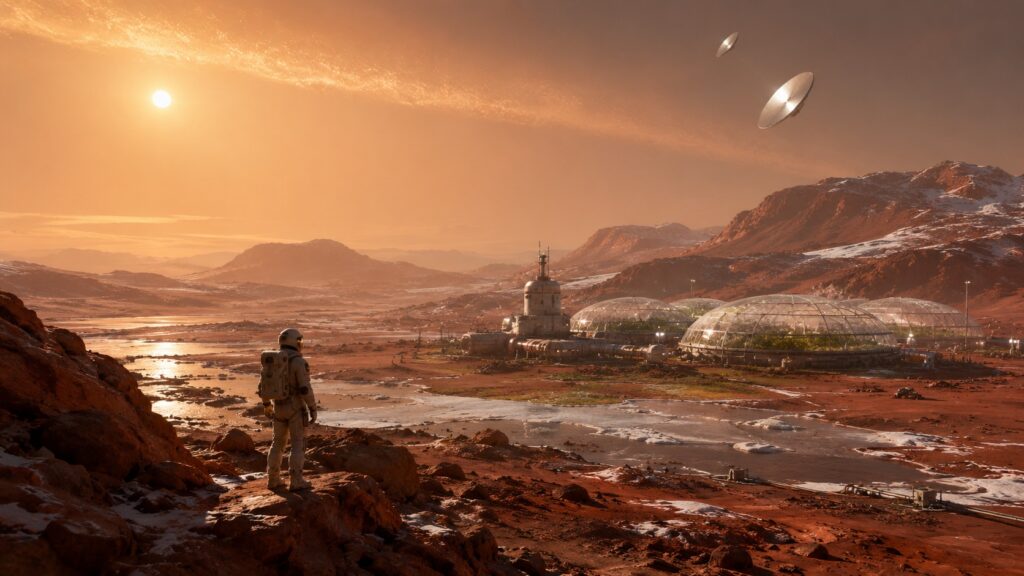
Scientists have proposed yet another plan for how to make Mars a habitable planet
We are used to thinking of Mars as a dead, cold, and forever alien place where we can only send robots and wistfully look at images of the red desert. But what if all this time we simply didn’t know how to bring it back to life? Scientists claim they have found the key, and terraforming Mars has stopped being a plot for science fiction writers. There is a plan, and it doesn’t require colonization over centuries — we’re talking about things that can be started right now.
Greenhouse Effect on Mars
For a long time, creating a biosphere on another planet seemed like a storyline for books, but now applied astrobiology — a new scientific discipline studying the creation of sustainable ecosystems beyond Earth — is taking on the task. A team led by geophysicist Edwin Kite has presented a detailed plan that doesn’t merely fantasize about green gardens, but calculates risks, costs, and necessary technologies. His plan was covered by the authors of the Daily Galaxy website.
The main idea is to enhance Mars’s weak greenhouse effect. To achieve this, the researchers propose releasing specially designed microscopic particles into the atmosphere. This should become the first step toward climate change on a planetary scale. Of course, these calculations are still experimental in nature, but they could actually work.
How to Raise the Temperature on Mars
Nobody is planning to instantly change the climate of the entire planet. The roadmap describes a gradual approach in which, during the initial stages, warmth will be maintained only around human settlements.
For localized heating, it is proposed to use solid-state greenhouse membranes. These installations will be able to extract liquid water from underground ice, which is critically important for growing food and maintaining life support systems.
In the next phase, orbital reflectors will come into play, directing additional sunlight onto selected areas of the surface. Over time, if Mars could once have become more habitable in the past, new technologies will attempt to restore at least some of that hospitality by expanding warming zones.
An Experiment in Mars’s Atmosphere
To test the theory in practice, scientists propose conducting an elegant technological experiment. The plan is to create an automated module that will disperse less than one kilogram of microscopic artificial particles into the Martian air.
Lasers will then track how these particles rise and disperse. This will help determine how effective the aerosol warming strategy is under the real conditions of Mars’s cold and thin atmosphere.
But before sending it to the Red Planet, the system needs to be tested on Earth. Such equipment is already being developed and is planned to be tested in a special NASA laboratory in California, where it is possible to recreate Mars’s atmosphere. Data from these tests will provide information that cannot be obtained through computer modeling alone.
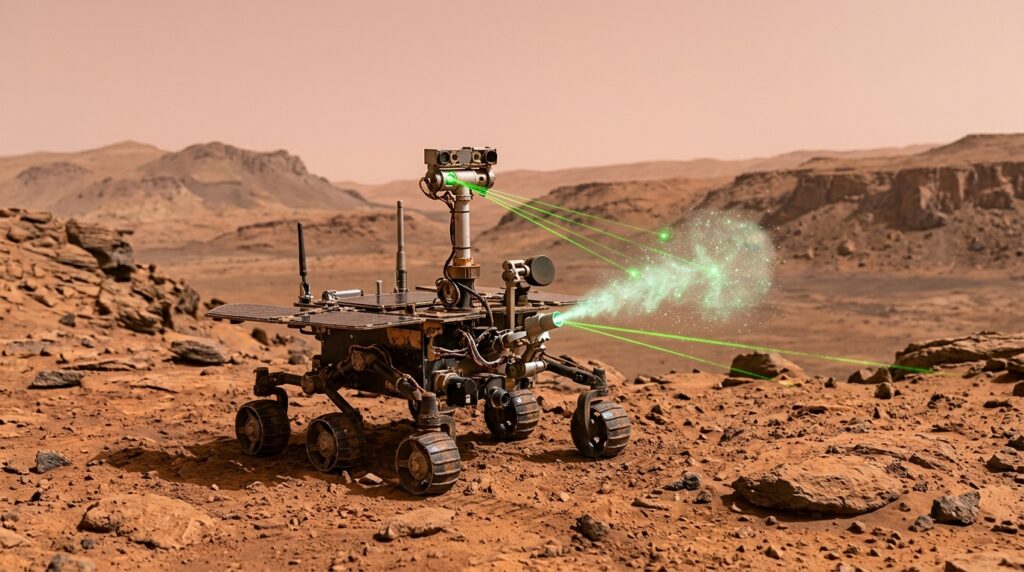
Laser systems will help track the movement of artificial particles in Mars’s thin atmosphere
What Stands in the Way of Making Mars Habitable
Despite the thoroughness of the plan, scientists acknowledge enormous gaps in knowledge. To move forward and seriously discuss transforming the planet Mars, researchers critically need new data:
- detailed maps of underground ice deposits and deep aquifers;
- results from long-term monitoring of the Martian climate;
- new geological samples from the surface of the Red Planet.
International cooperation will play an important role in this. For example, Edwin Kite places great hopes on the Chinese space mission “Tianwen-3.” According to new plans, the agency intends to use a helicopter to collect samples across a vast Martian territory. If these rocks become available for study in laboratories around the world, science will take a huge leap forward.
In the end, it turns out that turning Mars into a habitable place is a task that will take many decades, and creating a full-fledged biosphere will require centuries. Even by the most optimistic forecasts, localized warming over an area of several square kilometers will not be possible for at least ten years. However, developing such plans today preserves this chance for future generations. And although Mars remains a cold desert for now, science finally has a structured path toward answering the question: will humanity ever be able to bring an entire planet to life.