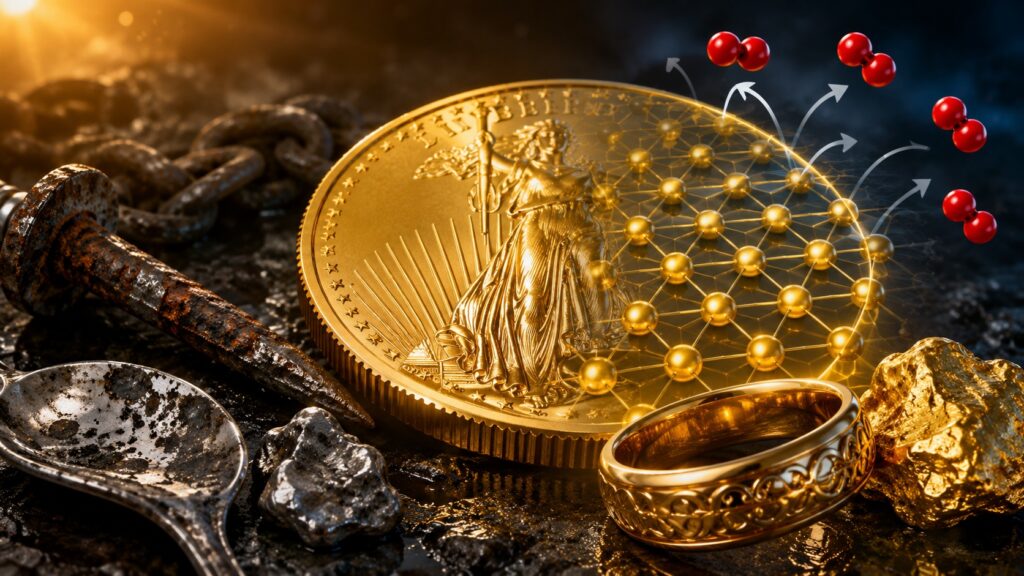
Scientists studied gold at the atomic level and understood why it doesn’t rust
Iron rusts within a couple of years, silver tarnishes within a month, yet gold coins that have lain on the ocean floor for thousands of years look brand new. We’ve grown accustomed to treating this as simply a property of a noble metal — a given that requires no questions. But in reality, nobody truly knew why gold doesn’t rust until scientists peered into its structure at the atomic level. It turns out gold has a clever protective mechanism that no one had previously suspected. How exactly do the atoms of this metal deceive oxygen and time?
How Rust Forms on Metals
Oxygen is the primary cause of rust and tarnish on most metals. To initiate an oxidation reaction, an oxygen molecule must first split into individual atoms, which then bond with the metal surface. Copper turns green in this process, iron develops an orange coating, and silver darkens.
For a long time, it was believed that gold belongs to the noble metals and simply doesn’t engage in active chemical reactions due to its inertness. However, researchers from Tulane University decided to examine this process at the atomic level using complex quantum-mechanical modeling. The results of the study were reported by the authors at ZME Science.
Chemists Santu Biswas and Matthew Montemore studied how oxygen behaves upon contact with a fresh cross-section of gold. It turned out that atoms on the outer layer of the metal don’t remain in the same positions as those inside the ingot. They shift and form a new configuration — a process in physics called surface reconstruction.
What Protects Gold from Rust
A fresh, not yet reconstructed gold surface has a fairly loose structure with a square arrangement of atoms. In this state, oxygen molecules have enough free space to split apart and initiate a reaction. It’s similar to a crowd of people standing in rows — an outsider can easily squeeze between them.
But as soon as the metal surface undergoes the reconstruction stage, the atoms shift and pack tightly together, forming a perfect hexagonal lattice. In our analogy, the crowd locks shields and stands shoulder to shoulder. On such a smooth and tight armor, oxygen molecules simply don’t have enough space to split apart.
The difference between the two states turned out to be colossal. According to the study’s authors, on the reconstructed surface, the rate of oxygen dissociation slows down by a billion or even a trillion times compared to the original structure. Of course, gold’s protection isn’t absolute, and gold oxide does exist, but it is extremely unstable.
This is precisely why ancient gold rings, pharaohs’ sarcophagi, and coins on sunken galleons preserve their luster from generation to generation. Their surface assumes a state of minimum energy, making oxidation virtually impossible.
How Gold Can Be a Catalyst
The discovery by American scientists also explains a long-standing chemical paradox. Back in the 1980s, researchers noticed that tiny gold particles work as excellent catalysts for chemical reactions, even though massive ingots are completely unsuitable for this purpose.
A catalyst needs to capture and activate other molecules, and ordinary gold seemed too inert for such a task. Now the reason has become clear: due to their small size, gold nanoparticles cannot fully reconstruct into smooth hexagonal armor.
Their surfaces retain numerous disordered areas with a square arrangement of atoms. In these zones, oxygen finds the necessary space to split and react with other substances.
Due to their tiny size, gold nanoparticles cannot form a perfect protective surface
New Gold-Based Catalysts
Controlled oxidation and oxygen dissociation are critical processes for modern industry. Catalysts are essential for numerous production chains. Already, gold-based compounds are successfully used to solve several large-scale problems:
- Converting toxic carbon monoxide from automobile exhaust into less dangerous carbon dioxide;
- Producing vinyl acetate, a base for creating durable plastics and adhesives;
- Synthesizing propylene oxide, which is widely used in the chemical industry around the world.
Gold is ideally suited for such processes. Unlike more reactive metals, it doesn’t degrade over time and doesn’t produce unwanted byproducts. The main difficulty was simply getting it to work.
Previously, to improve gold catalysts, the metal was mixed with other elements. The new study, published in the journal Physical Review Letters, proposes a different approach — learning to artificially fix the square surface structure. If chemists can prevent the protective atomic rearrangement, the most inert metal in the world could become an incredibly powerful and durable chemical tool.
Paradoxically, the very atomic structure that has protected gold jewelry from tarnishing for centuries limits its usefulness to science. By understanding the mechanics of this process, researchers have gained the key to creating a new generation of reliable materials capable of making chemical production much cleaner and more efficient.