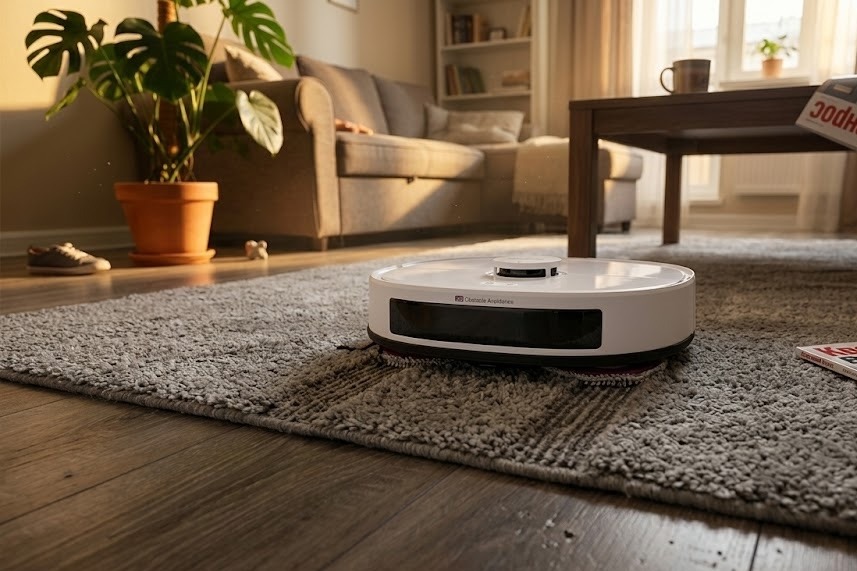
Midea V15 Evo Ultra — a powerful robot vacuum with 22,000 Pa suction power
I got my first robot vacuum back in 2022. At the time, it was a very good model: it not only had a mopping function but also came with a docking station that both washed the mopping pads and even dried them. Well, at least that’s what was claimed. In reality, a lot didn’t add up: the pads wouldn’t dry, the vacuum couldn’t clean carpets, and overall it didn’t have a particularly wide feature set, since it didn’t even support Alice. But finally the old thing gave up the ghost, and I decided it was time to get something more modern. That’s how I became the owner of the Midea V15 Evo Ultra, lived with it for a whole month — and now I can tell you how it went.
What Makes the Midea V15 Evo Ultra Different from Other Mopping Robot Vacuums
Midea is a brand that in Russia is known mainly for refrigerators, air conditioners, and at best washing machines. Robot vacuums, however, are far from this manufacturer’s most well-known product. That’s why I didn’t initially even consider the V15 Evo Ultra. Although, frankly speaking, I should have. After all, it’s one of the few vacuums with an extending mop that lets it wipe floors right up against the baseboard.
Here’s the thing. The vast majority of mopping robot vacuums, even the most expensive ones, have the same problem: their mopping pad is located on the underside. And since the devices themselves are usually round, when cleaning in corners and along the perimeter there’s a pretty significant blind zone that physically can’t be wiped. That, combined with nearly 5,000 reviews on Ozon, is what sold me. And I wasn’t wrong.
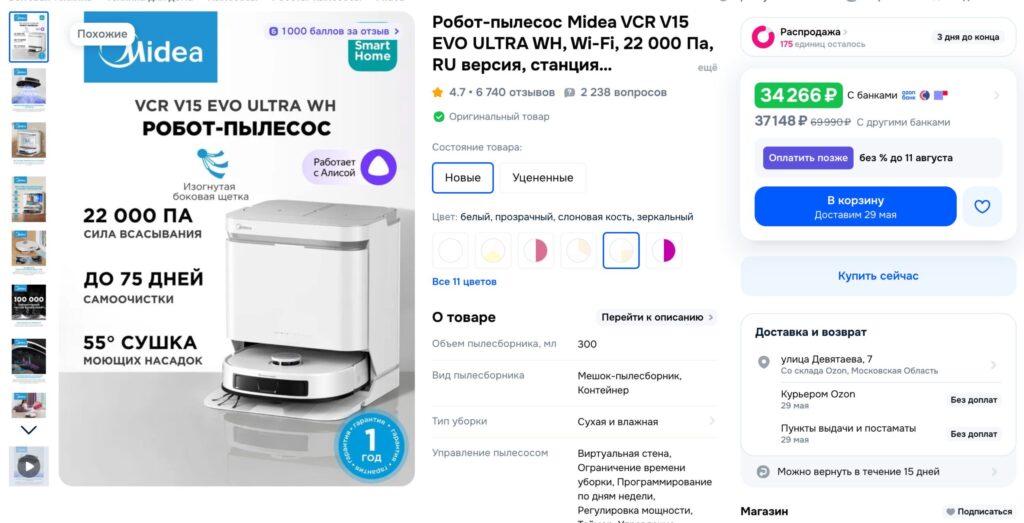
Look at how many reviews! That many people surely can’t be wrong
Because here everything is different. On the V15 Evo Ultra, one of the two round mopping pads sits not on a rigid axle but on an extending arm. So when the robot drives along a wall, this mop extends beyond the body like a turtle’s head and scrubs what my old vacuum couldn’t reach.
First, yes, I was watching. And second, that same matte strip along the baseboards that my old vacuum never touched at all now became shiny with water thanks to the V15 Evo Ultra. In the specs, this is called ScrubExtend. Why so fancy? Apparently because the vacuum not only extends the mop but also presses it against the floor for better cleaning. They even say the pressure reaches 7 newtons.
Whether that’s true or not, I don’t know. I didn’t measure it. But it definitely feels cleaner. A TÜV Rheinland certificate confirms it. In case you didn’t know, that’s a German organization that usually tests industrial equipment for safety. They confirmed that the extending mop really covers the baseboard “with no gap,” with a tolerance of 0 mm. I normally couldn’t care less about such certificates, but in this case I can see the result myself.
There’s no need to worry about the reliability of the mechanism either. The manufacturer claims it’s rated for at least 100,000 cleaning cycles. That’s 270 years if you run the vacuum at least once a day. Even if you divide the manufacturer’s claimed figure by 10, that’s still a lot. I’m not sure I’ll be testing this vacuum for 27 years, but we’ll see.
To be honest, I generally believed in the mechanism itself. But I didn’t believe the vacuum wouldn’t accidentally break it off. However, one time when the vacuum was cleaning and I accidentally ran over it with a chair, something happened that I totally didn’t expect. I was sure the extending “arm” would at least crack, but no. It simply retracted — just like a turtle. It was scary on one hand, but really cool on the other.
LiDAR and Navigation: How the Midea V15 Evo Ultra Maps Your Apartment
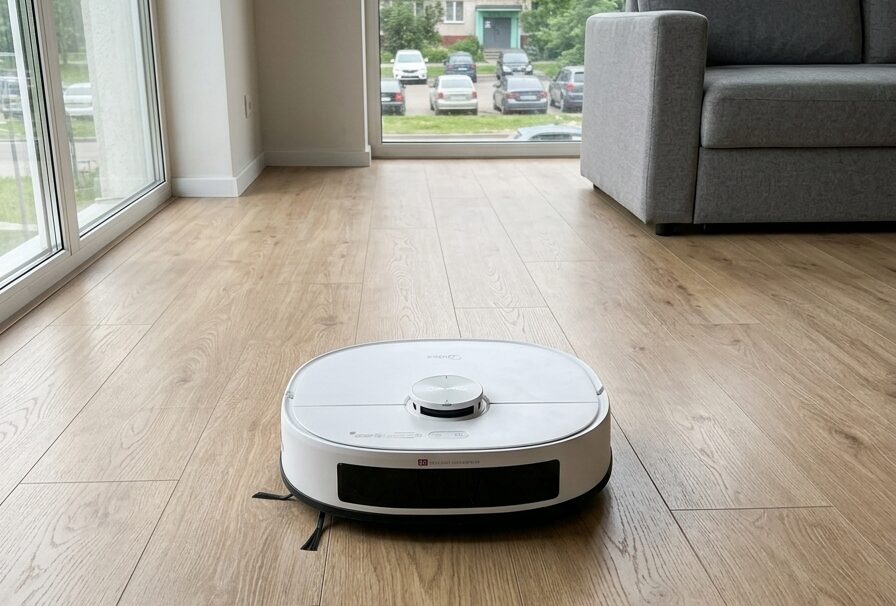
In addition to LiDAR, the V15 Evo Ultra also has a smart vision system located on the front
On top of the V15 Evo Ultra there’s a LiDAR sensor. Yes, for modern robot vacuums this is completely standard. But the problem is that my old vacuum used this mechanism somewhat oddly. For example, because of a mirror, it was convinced we had another room and constantly tried to get there. Here, by the way, that doesn’t happen. The robot drove around the apartment, built a map, and surprisingly wasn’t even confused by the mirror.
Here’s the map it built:
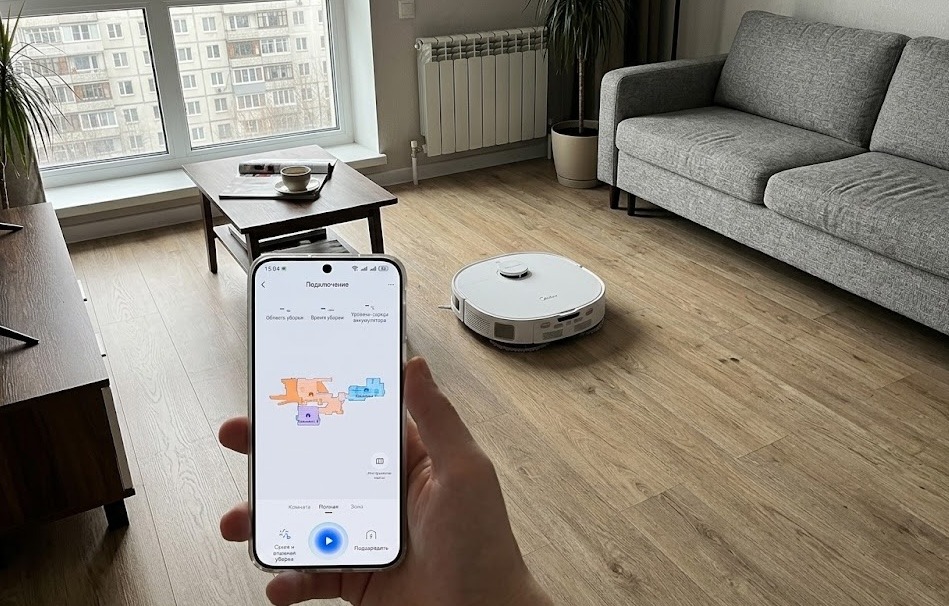
The mirror didn’t confuse the vacuum or make it detect an additional room
Apparently, the additional laser sensor called 3D-AI IntelliView makes a difference. It recognizes up to 150 types of objects and works even in the dark because it has built-in illumination. Again, I don’t know if that’s what deserves the credit, but my old vacuum would chew up shoelaces like it was nothing, while this one just drives around them. I even deliberately scattered socks on the floor, and it didn’t care one bit.
But what the robot still hasn’t conquered is curtains. If you have long drapes that touch the laminate, the V15 Evo Ultra sweeps them with its regular brush as if they’re part of the wall. It doesn’t tear anything, but it doesn’t drive through them either. I wish it would, because that’s usually where a lot of dust accumulates.
But overall, I have no complaints about the route. Honestly, my old vacuum didn’t race around randomly either, but it would sometimes start cleaning from one room and sometimes from another. I can’t say it bothered me. It just seemed odd. But here everything is precise. First, the V15 Evo Ultra covers the perimeter — strictly starting from the living room — then cleans the middle in a neat zigzag pattern. And between passes, it goes back to wash.
And this was new to me. The V15 Evo Ultra has no built-in water tank. Only mops. And as you can imagine, they tend to get dirty during cleaning. To avoid smearing dirt across clean floors, the robot periodically returns to the station to wash the mops right in the middle of cleaning. Washed up — drove on, right back to where it stopped. At first I thought I’d saved money. Turns out it’s actually better this way.
Plus — the robot automatically detects thresholds and increases suction power when approaching them. That is, when it crawls up to the junction between laminate and tile, it literally boosts suction for half a second to pull out debris that usually accumulates in the seam. I noticed this by accident — I heard the motor sound briefly change in certain spots. At first I thought it was a glitch, then figured out — it’s by design.
Puddles are detected the same way: if you spilled something and forgot, the robot will see it, won’t drive through the puddle, and will alert you in the app. I haven’t personally encountered this situation yet, but I’ve read about it in reviews. Although I’m not sure that’s a plus. In my opinion, it would be better if the vacuum just cleaned up the puddle itself.
How the Midea V15 Evo Ultra Handles Pet Hair, Human Hair, and Carpets
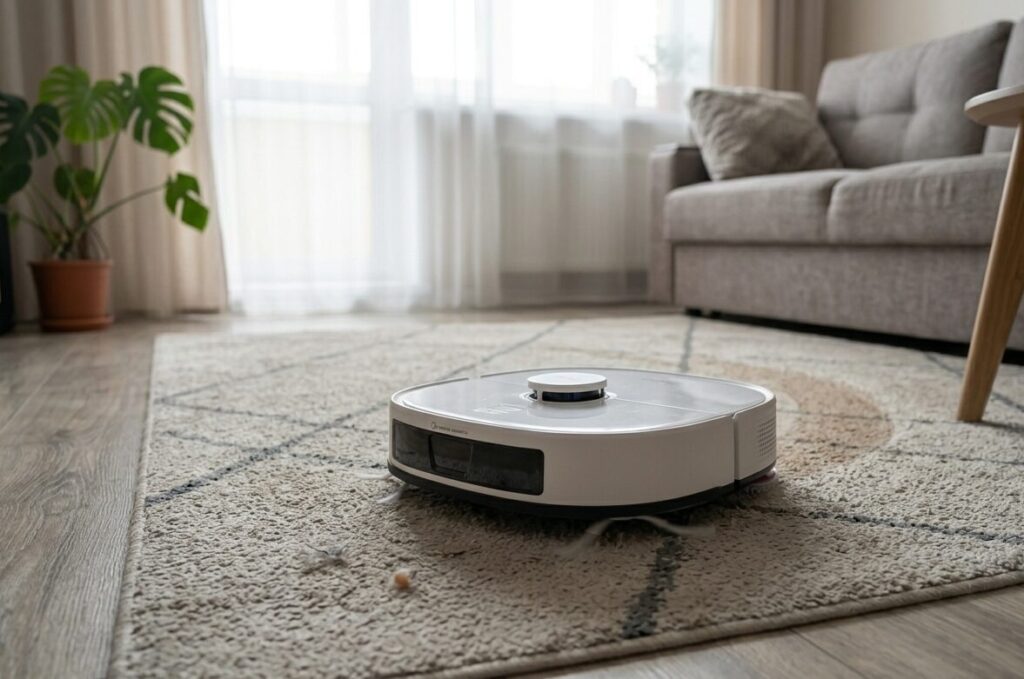
The V15 Evo Ultra does a great job fluffing up the carpet while collecting all dust and dirt
Now for the most pressing issue — pet hair, human hair, and carpets. This, in my opinion, is the main pain point for any robot vacuum owner. My old unit’s side brush would turn into a fuzzy cocoon a couple of times a week at least. I’d take a lancet from the box and cut off the wound-up hair, then wash the brush under the faucet. It wasn’t an especially painful procedure, but every week it was my mandatory ritual.
The V15 Evo Ultra handles this differently. At first I was even surprised: there’s no cutter in the box. Turns out the side brush here isn’t ordinary — it has bristles arranged in a V-shape. It even has its own name — DragonClaw. The name is definitely weird, but the idea is brilliant: hair and threads simply don’t catch on such a brush. And you know what — it works.
Additionally, the main turbo brush (the one on the belly) has small blades on top that also cut off wound-up hair. So you get two anti-tangle systems working simultaneously: geometry on the side brush, blades on the main one. Over the month