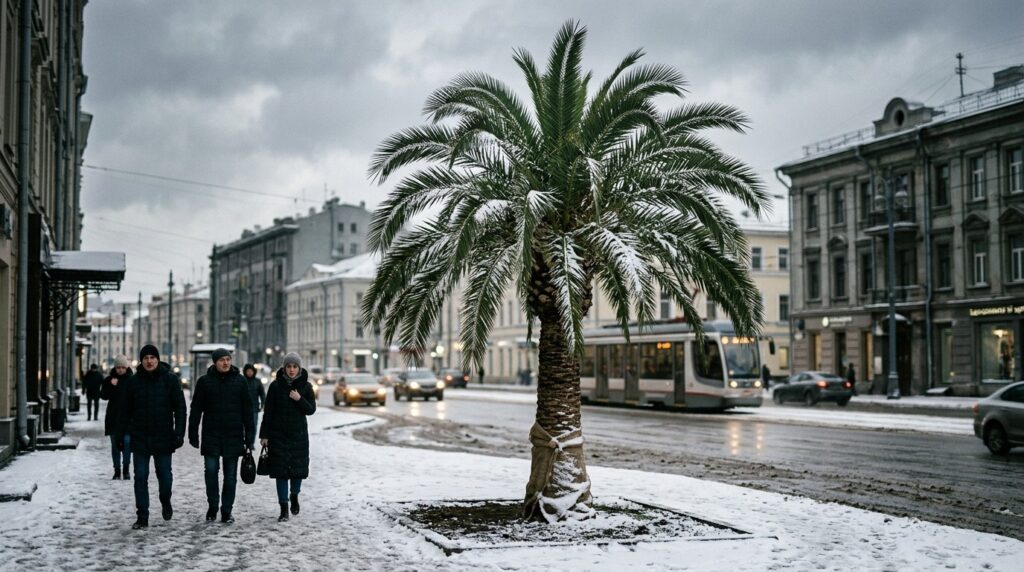
Palm trees don’t grow in Russia not because of poor soil — the reason is entirely different
Can you also imagine a tall palm tree in a Moscow park or somewhere in the forests of Tatarstan? In American movies, they look so beautiful and are associated with summer and delicious cocktails. And scientists continue to discover new species of palms. Palm trees indeed don’t grow in Russia, with very rare exceptions. And it’s not because we have poor soil. The reason is entirely different, and you may already have guessed what we’re about to discuss.
In Which Countries Do Palm Trees Grow
Palms belong to a family of heat-loving plants that were definitely not designed to battle snowdrifts. According to the Kew Plants of the World Online database, the palm family includes more than 180 genera and over 2,500 species, and they are distributed across nearly all tropical and many warm temperate regions of the planet.
This means that palms are fundamentally unable to survive in cold places. A birch or oak tree sheds its leaves, slows down all processes, and calmly waits for spring. A palm tree, by its very nature, expects that serious cold simply won’t come. When it does arrive, the plant has no Plan B.
That’s exactly why what matters for a palm is not the average annual temperature, but the winter minimum. You could say that a palm tree is a plant from an entirely different climate league than the tall trees we’re used to seeing in Russia.
Why a Palm Can Grow in Summer but Die in Winter
In summer, a palm tree can be quite comfortable in Russia because it’s warm and bright here. The problem is that summer ends. Experts at the University of Florida IFAS directly note that palms can survive for years in cooler climates, but sooner or later they encounter temperatures that kill them.
For example, in Russia there can be several years of mild winters, giving palms a tiny chance of survival. But then an inevitably cold winter comes along, and all the accumulated “success” is wiped out. For a palm tree, what matters is not the July heat but that very January minimum, which in most regions of Russia drops to -30 degrees Celsius. And in some places, frost records in Russia are broken regularly.
For most palms, this is a lethal threshold. Even if the plant survives one such season, the next harsh winter can finish it off.
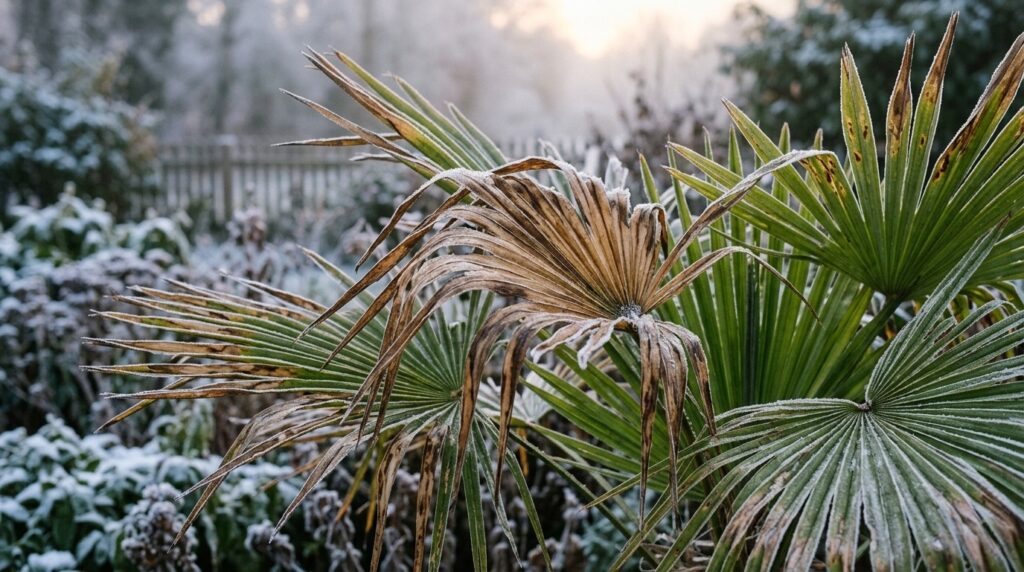
After a severe frost, a palm’s leaves turn brown, and the plant often cannot recover
Why Palm Trees Cannot Survive in the Cold
Palms have a feature that makes them especially defenseless against cold. In many species, growth occurs from a single point at the top, also called the growing point. If frost damages this specific area, the palm can no longer recover.
This fundamentally distinguishes it from the trees we’re familiar with. A birch can lose a branch, grow a new one, and act like nothing happened. A palm doesn’t have that kind of resilience. If the growth center is damaged, the plant is doomed to die.
Why Are There Palms in Sochi but Not in Moscow
To say that palm trees don’t grow in Russia at all would be untrue. They can easily be seen in the Sochi area and along parts of the Black Sea coast of the Caucasus. The secret lies in the climate. In these regions, it’s humid subtropical; winters are mild, and the sea and mountains smooth out sharp temperature fluctuations.
The numbers confirm this. According to the Great Russian Encyclopedia, the average January temperature in Sochi is around +6 degrees, and the climate itself is described as humid subtropical. The Black Sea coast of the Caucasus is also generally classified as a predominantly humid subtropical climate zone with warm winters and moderately hot summers.
Now compare this with Moscow, Kazan, or Novosibirsk, where severe frosts regularly occur in winter. The difference between +6 and −25 degrees is an enormous gap for a palm tree.
Can You Grow a Palm Tree in Russia
If we’re talking about open ground in central Russia, then no, planting a palm tree in Russia won’t work. Winters that are too cold and too long leave most species no chance. Even the most frost-resistant palms are designed at most for mild winters, not sustained temperatures of −20 degrees and below.
If we briefly compile all the reasons why palm trees don’t grow in Russia, we get the following list:
- Frost damages the palm’s tissues and its vulnerable growing point;
- The long winter prevents the plant from growing and recovering normally;
- Most of the country has a harsh climate: too hot in summer and too cold in winter;
- Palms are by nature plants of warm regions, not northern latitudes;
- The exception is the Black Sea coast, especially Sochi, where the climate is milder due to the sea and mountains.
Theoretically, some particularly dedicated gardeners can grow cold-hardy species in large pots, bringing them indoors for winter, or carefully covering them outside. But these are tricks that are not available to everyone.
Why Palm Trees Don’t Take Root in Russia
We can conclude that palm trees don’t grow en masse in Russia because almost the entire country is too cold for them in winter. In summer, a palm can be quite comfortable, but the Russian winter quickly reminds it that this is not the Mediterranean. One severe frost, and all the tropical landscaping turns to compost.
If you want to see palm trees outdoors in Russia, there’s only one way — head to the Black Sea coast.