
Why casinos have no clocks: the truth turned out to be nothing like what you thought
Walk into any casino in the world — from a luxurious hall in Macau to a modest establishment on the outskirts of a city — and try to find a wall clock. You won’t succeed. Casinos almost never have clocks, and most people are sure they know why. But the real reason may turn out to be far more interesting than the usual explanation.
Why Casinos Remove Clocks and How Time Gets Lost
The most common explanation sounds logical and even a bit sinister. Without clocks and windows, a casino turns into an enclosed world where there is neither morning nor evening. Players lose their sense of time, don’t think about how many hours they’ve spent at the table or how much money they’ve spent — and keep playing.
This technique, which psychologists call “temporal distortion,” actually works. Research shows that casino players tend to lose their sense of time and stay longer than they planned. The absence of natural light amplifies the effect: without sunlight through windows, your biological clock doesn’t receive its usual signals, and you don’t notice day turning into night.
This is precisely why casinos are often devoid not only of clocks but also of windows, stained glass, and any sources of daylight. The only way to check the time is to pull out your phone or look at your wristwatch. But when you’re absorbed in the game, time flies by unnoticed, and your hand doesn’t reach for them right away.
How Casino Design Makes Players Stay Longer
To understand how casinos are designed from the inside, it’s worth remembering Bill Friedman — a former casino manager in Las Vegas who spent 20 years studying what makes people play longer. Friedman himself struggled with gambling addiction and used his experience to understand casino psychology from both sides.
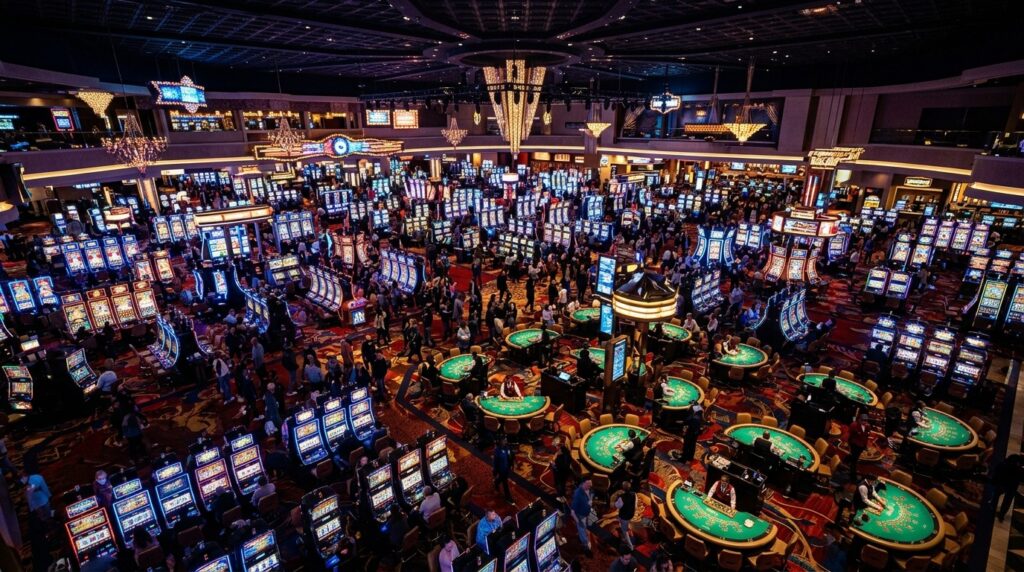
A Las Vegas casino gaming floor: bright artificial lighting without a single ray of daylight
He studied more than 80 casinos in Nevada and formulated 13 design principles, which he published in his book “Designing Casinos to Dominate the Competition.” Among them — low ceilings instead of high ones, dividing space into small, cozy zones instead of enormous open halls, and using gaming equipment as the main decorative element.
Friedman’s logic is simple: the more comfortable and “homey” a player feels, the longer they stay. And the absence of clocks is just one of many tools in this arsenal.
Why Players Themselves Want to Forget About Time in Casinos
But here’s what’s interesting. Friedman, the author of those very principles, claims that the story about clocks isn’t about manipulation by the casino. According to him, it was the players themselves who demanded that clocks be removed and blinds be lowered.
In an interview with The Hustle in 2024, Friedman explained: gamblers come to the casino for escapism — to flee from reality. They don’t want to know what time it is. They want to forget about the outside world, about tasks and responsibilities — and fully immerse themselves in the game. As Friedman himself put it, players “don’t need time — they are in a world of fantasy and escape from reality.”

A player at the blackjack table: complete concentration on the cards, no distracting factors
This flips the usual narrative. It turns out that casinos aren’t so much deceiving visitors as giving them what they themselves want — an enclosed world without reminders of time and reality beyond its walls.
Why Casinos Have No Windows and How Light Affects the Game
Some casino managers even consider the story about “losing the sense of time” something of a conspiracy theory. Dan Nita, former general manager of the Horseshoe Casino in Hammond, Indiana, offered a far more mundane explanation.
According to him, natural light cannot be controlled as precisely as artificial lighting. Sunlight creates glare on slot machine screens, reflects off cards, and prevents players from seeing results. By removing windows, the casino gains complete control over the light in the hall — without random glare, brightness fluctuations, and visual interference, especially since sunlight affects concentration and a person’s overall state.
It sounds rather boring compared to psychological theories, but there’s common sense in it. Anyone who has tried working on a laptop by a window on a sunny day will understand the problem.
No Clocks in Casinos: The Reasons and the Real Explanation
Most likely, the truth lies at the intersection of all three versions. Casinos are a business, and their owners perfectly understand that an enclosed environment without external reference points helps retain visitors. But at the same time, players themselves truly value the atmosphere of “another world” where they can forget about everyday life. And engineering considerations regarding lighting add a perfectly rational argument in favor of the same solution.
Interestingly, the same principles have long been applied outside of casinos. Shopping malls, supermarkets, and even IKEA use similar techniques: labyrinthine routes, absence of windows, and controlled lighting. The goal is the same — to make you forget about time and spend as long as possible inside. So in places without clocks and windows, it’s worth asking yourself: is it you who wants to forget about time — or are you being helped to do so? Don’t forget: behind gambling, there is almost always simple mathematics.