
Why can some people wiggle their ears while others can’t?
Some people can move their ears effortlessly on a dare, while others strain their face to the point of pain and achieve absolutely nothing. It might seem like it’s about having some special muscles, but that’s not the case. The ability to wiggle your ears is not about muscles but about how the brain is wired and which movements it keeps under conscious control. For example, we can’t move our toes one at a time (well, did you just try?).
What Determines the Ability to Wiggle Your Ears
The so-called auricular muscles are responsible for ear movement. Every one of us has them, and they are controlled by the facial nerve. It would seem like everything is in place — just go ahead and move them. But the catch is in the wiring.
The brain keeps some body movements under conscious control, while others it does not. We can easily raise an eyebrow or wrinkle our nose because these commands travel along “conscious” neural pathways. But the signal to the ear muscles in most people travels along a pathway that is not subject to conscious control. So no matter how hard you try — the ears stay put.
What Percentage of People Can Move Their Ears
There isn’t much precise data. In one small study from 1995, 204 men and 238 women participated. The results were quite interesting:
- approximately 22% of participants could wiggle one ear;
- about 18% could move both ears at once;
- men were noticeably more likely than women to be able to wiggle both ears simultaneously.
This is essentially the only notable attempt to count “ear-wigglers” — the topic hasn’t really been studied further since. So the skill is found in roughly one in five people, and why it more often appears in men is something science hasn’t yet explained.
Why Do Humans Have Ear Muscles If the Ears Don’t Move
In cats, dogs, and monkeys, ears function as locators. Dogs, for example, have more than 18 muscles in each ear, which is why they can rotate them almost like small radars. Animals swivel their ears to catch sounds, figure out where a predator is sneaking from, or where prey is hiding. A very useful thing for survival.
Humans, over millions of years, came to rely less on hearing as a means of survival. The ear muscles weakened due to disuse and turned into a vestige — an evolutionary remnant that remains but barely functions. It’s like a button on an old remote control that isn’t connected to anything: it’s there, but it’s useless.

In animals, mobile ears work as sound locators
How Ear Movement Is Connected to Brain Function
It might seem like just a fun party trick — and nothing more. But there is a hypothesis that ear wiggling could actually have practical benefits. An Australian neurobiologist suggested that training ear movement could help with recovery after strokes and brain injuries.
This is all thanks to neuroplasticity — the brain’s ability to rewire connections between nerve cells, especially after learning or damage. When a person tries to wiggle their ears, the brain has to literally feel out and forge a new “route” to muscles that normally don’t obey it. And this requires serious mental effort — greater than simple repetitive movements.
This is precisely why, according to the scientist, such unusual training could stimulate the recovery of damaged neural pathways more effectively than routine exercises. It’s important to be honest: for now, this is only a hypothesis. No ready-made rehabilitation method based on it exists yet.
Can You Learn to Wiggle Your Ears
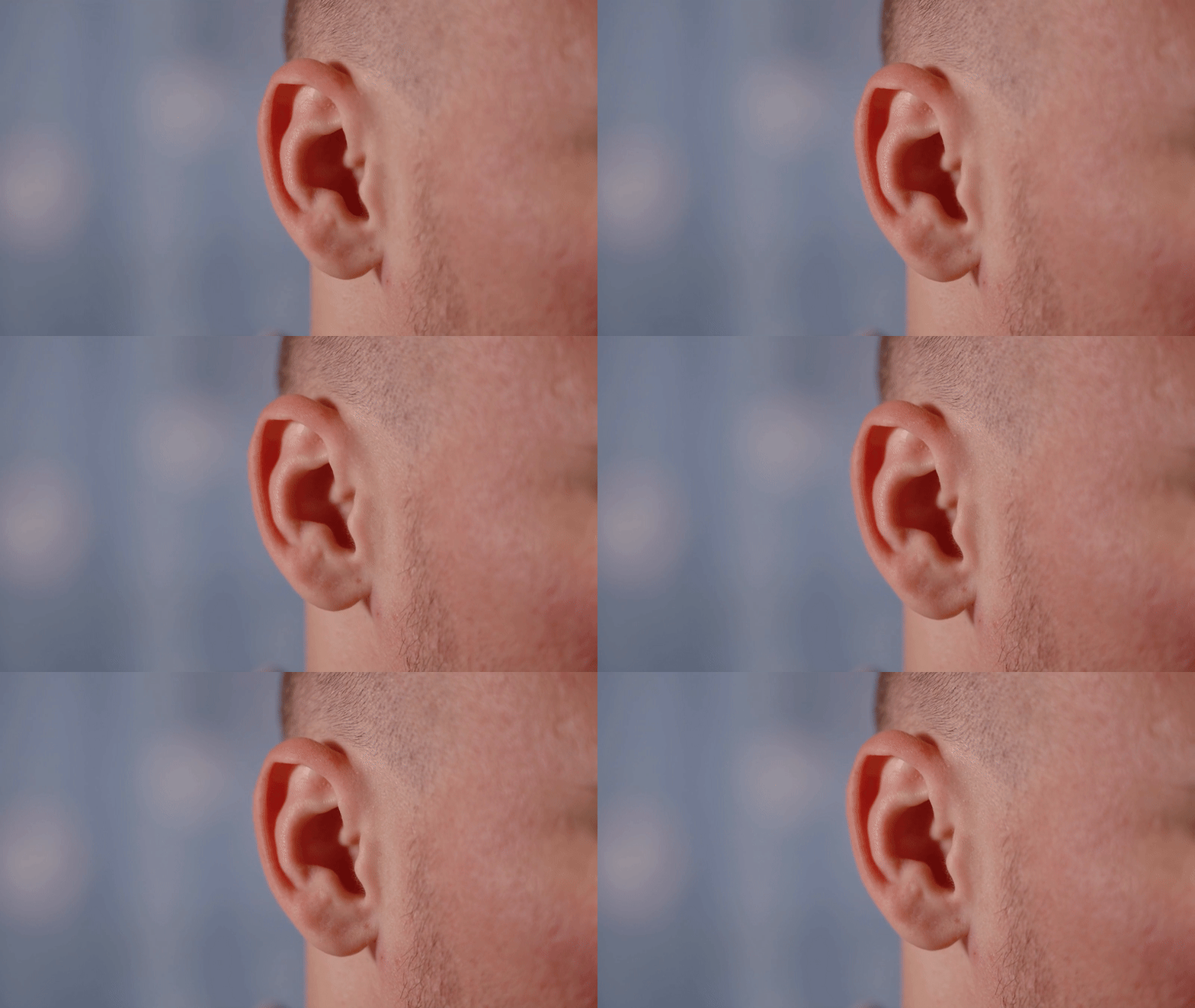
Despite the complex mechanism behind ear movement, almost anyone can learn to move their ears.
Good news for those who have always dreamed of impressing their friends: learning is most likely possible. The necessary muscles and nerves are already in our body — what’s missing is just conscious control over them, and that can be gradually developed.
The most well-known method is mirror training:
- Sit in front of a mirror and relax your face.
- Try smiling or raising your eyebrows — and catch the moment when the skin near your ears shifts slightly.
- Focus specifically on that subtle movement and try to repeat it without smiling.
- Repeat in short sessions every day — the brain gradually “finds” the right pathway.
Nobody can give guarantees, but there are plenty of stories about people who mastered this skill on their own in a couple of weeks. It turns out that the simple act of moving your ears is a small window into how our brain works and how it can rewire itself.