
Where is a cat’s withers and why you need to know this.
Every cat owner has heard this: “apply drops to the withers” or “administer the medication subcutaneously at the withers.” But as soon as you start the task, doubts creep in — where exactly is the withers? Between the ears? On the back? Somewhere on the neck? Let’s figure this out once and for all: we’ll find this spot with our hands, understand why it matters, and learn how to use it properly.
What Are the Withers and How to Find Them
The withers is the area on a cat’s body between the neck and the back, right in the shoulder blade region. If you run your hand from the back of the head toward the tail, the first noticeable “bump” where the neck transitions into the back — that’s it.
The simplest way to confirm you’ve found the right spot: try to gather the skin into a fold. The skin at the withers lifts easily with your fingers and moves freely — unlike neighboring areas where it fits more snugly. Beneath this fold are muscles connecting the neck, shoulder blades, and front legs, as well as the upper processes of the thoracic vertebrae. That’s why the withers is considered the highest point of a cat’s body — it’s where height is measured.
The withers also has one invaluable property: a cat virtually cannot reach it with its tongue. This is exactly what makes it the ideal spot for applying medications.
Where and How to Properly Apply Anti-Parasite Drops
Anti-parasite drops are applied to the withers for a good reason. If you apply the product lower on the neck or farther along the back, an agile pet can easily lick off the medication during daily grooming. But the withers is out of reach.
The procedure is simple, but there are nuances:
- Part the fur with your fingers right at the withers — between the shoulder blades.
- Make sure you can see the skin, not just the undercoat.
- Carefully squeeze the pipette contents directly onto the skin.
- Let the product absorb — don’t rub or pet the area.
The main mistake is applying drops onto the fur rather than the skin. If the medication stays on the hair, it won’t spread across the skin and won’t work as intended. After treatment, it’s advisable not to pet the cat in that area for several hours and to prevent other pets from licking the treated spot.
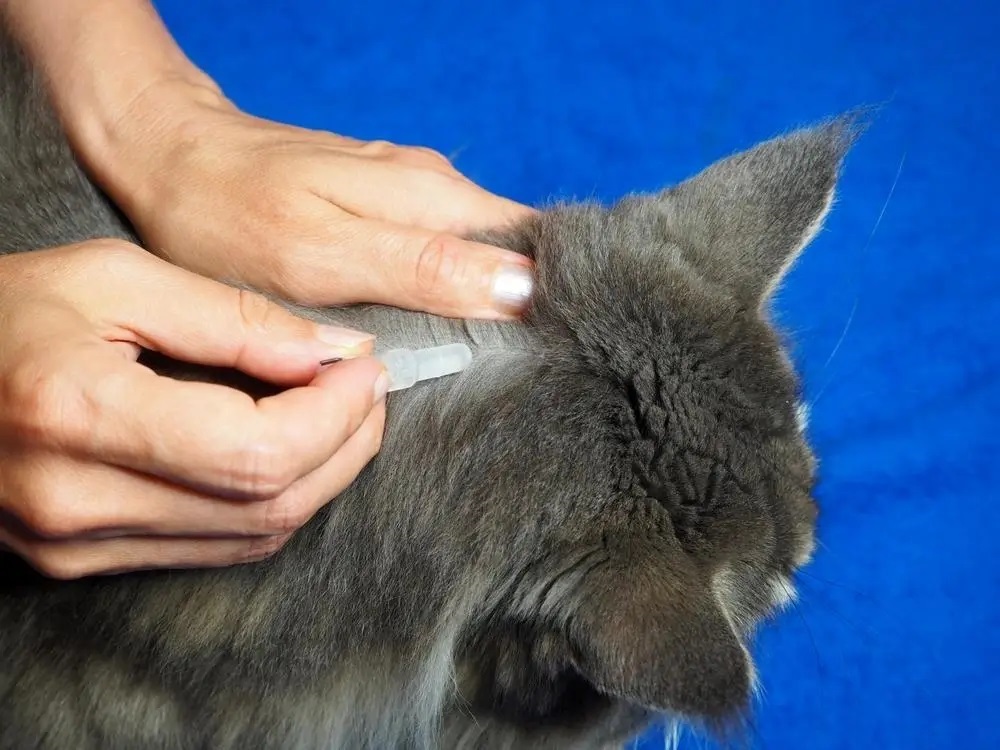
Applying drops to the withers.
Subcutaneous Injections in the Withers Area
If you’ve ever seen a veterinarian give a cat a subcutaneous injection, it most likely happened at the withers. The logic is the same: the skin here lifts easily and forms a “pocket” that’s convenient for inserting a needle.
The vet grasps the skin fold with two fingers, gently lifts it, and inserts the needle into the subcutaneous space. The skin at the withers doesn’t sit tightly against the spine, so the risk of hitting anything important is minimal, and the procedure is relatively well-tolerated by cats.
Sometimes a small lump — an infiltrate — may appear under the skin after an injection. It usually resolves on its own within a few days. But if the lump doesn’t shrink or starts growing, it’s best to show the cat to a veterinarian.
Why Mother Cats Carry Kittens by the Scruff
You’ve probably seen a cat gently grab a kitten by the scruff with her teeth and carry it to another location. This isn’t roughness — it’s an evolutionary mechanism refined over millions of years.
When a mother grasps the skin fold at the withers, the kitten’s innate reflex kicks in: it stops squirming, tucks its paws against its belly, and relaxes. This makes it easier and faster for the mother to carry the little one to a safe place. This mechanism works flawlessly.
But there’s an important point: as they grow up, this reflex disappears. In an adult cat, being grabbed by the scruff no longer causes relaxation — quite the opposite.
Can You Pick Up an Adult Cat by the Scruff?
Short answer — no. Lifting or carrying an adult cat by the scruff is not acceptable. An adult animal’s weight is too great: all the load falls on the skin and soft tissues in the neck area. It’s painful. The cat may freeze, but this isn’t a sign of calmness — it’s a stress response.
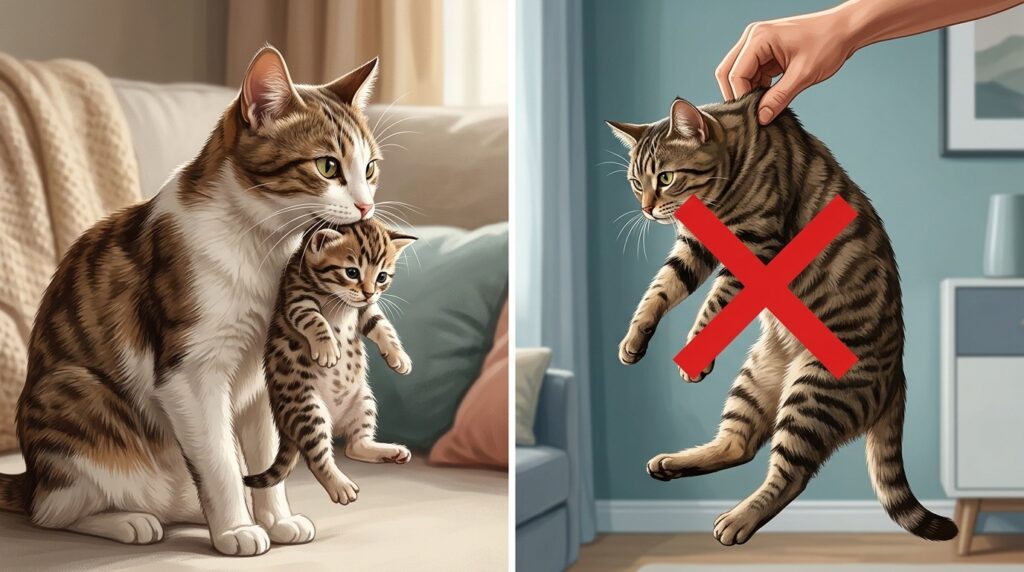
Only small kittens can be carried by the scruff — for adult cats it’s painful.
The safe way to pick up a cat is to support it with one hand under the chest and the other under the hind legs, giving the body full support. No dangling by the scruff — it causes stress, pain, and is a direct path to losing your pet’s trust.
What to Watch for When Examining a Cat’s Withers
The withers doesn’t require any special care, but it’s worth checking this area periodically. Especially after anti-parasite treatment: sometimes the skin may become red, itchy, or irritated from the medication. While this isn’t always dangerous, such changes are best not ignored.
Reasons to visit a veterinarian:
- severe redness or swelling after applying drops
- wounds, scabs, or bald patches
- lumps under the skin that aren’t getting smaller
- the cat constantly tries to scratch the area
By the way, there’s a useful trick for a quick health check: gently pull the skin at the withers and release it. If the fold smooths out within 1–2 seconds — everything is fine. If the skin returns to its place slower than three seconds — this could be a sign of dehydration, and the cat should be seen by a veterinarian.
The withers is a small but truly important area on a cat’s body. Knowing where it is, you’ll be able to properly treat your pet for parasites, avoid causing harm when picking them up, and notice skin problems in time. Sometimes the most useful knowledge about our pets is the simplest.