Space changes human blood, and it’s a serious problem
In weightlessness, the properties of human blood change, and this could become one of the main threats to astronauts on long-duration missions. On the International Space Station, the crew is studying exactly how space affects blood clotting and immunity to understand how to protect people during long expeditions to Mars and the Moon.
The Effects of Weightlessness on Human Blood
When we imagine the dangers of space, radiation, meteorites, or equipment failure come to mind. But one of the most insidious threats is hidden inside every astronaut’s own body. It’s about how blood changes when it is no longer subject to the familiar Earth gravity.
On board the station, members of Expedition 74 conducted a series of biological experiments focused on platelets and immune responses. This is the very work that will help protect people on long missions to the Moon, Mars, and beyond in the future. The results were published on NASA’s website.
The main problem is that prolonged weightlessness affects multiple body systems at once, and blood is no exception. Scientists are particularly concerned about the risk of blood clot formation during long flights, when a quick return to Earth for help is no longer possible.
Why Blood Clotting Is Being Studied on the ISS
Platelets are tiny cell fragments that help the body stop bleeding and form blood clots. On Earth, this process works like a well-tuned mechanism. Say a person gets a cut. The blood clots, and the wound heals. But in space, things may go differently.
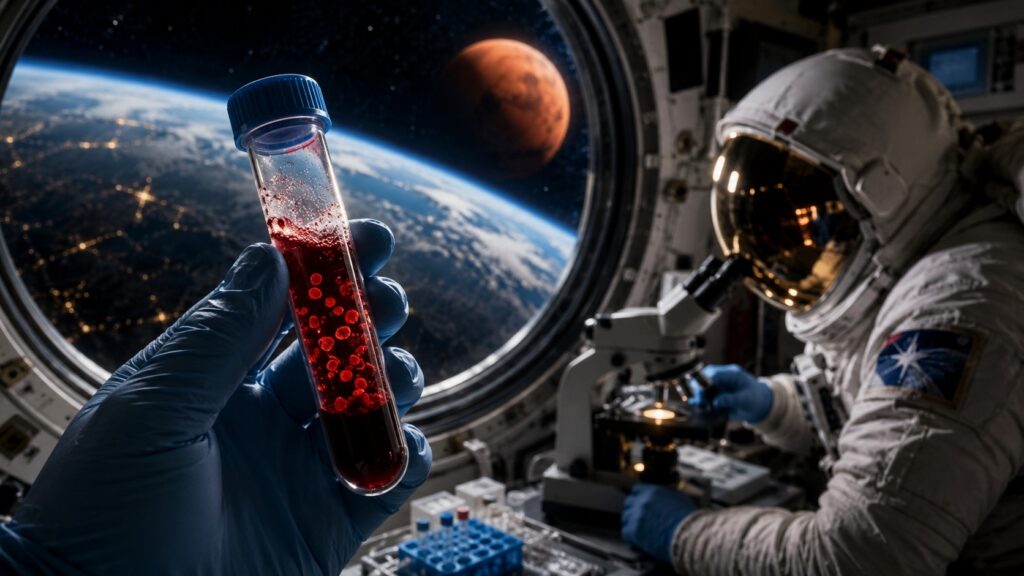
NASA astronauts processed platelet samples inside a special glovebox in the Japanese “Kibo” module. Conducting the experiment in orbit is important because the behavior of cells in actual weightlessness cannot be perfectly replicated in a laboratory on Earth.
The study aims to understand how weightlessness affects platelet function, inflammation, and immunity. Scientists want to determine whether human blood clots properly in space. There is a risk that if injured during a spaceflight, astronauts could simply bleed out.
Why Blood Clots Are Dangerous in Deep Space
Here it’s worth explaining why a blood clot is serious. On Earth, a dislodged blood clot can cause a stroke or a pulmonary artery blockage, and the person needs urgent medical attention. Now imagine the same situation on a ship flying to Mars. It’s simply terrifying.
Providing medical care in deep space is much harder than in low Earth orbit. From the ISS, an astronaut can be evacuated within a few hours if necessary. On a mission to Mars, that option doesn’t exist at all, so the crew remains alone with the problem for months.
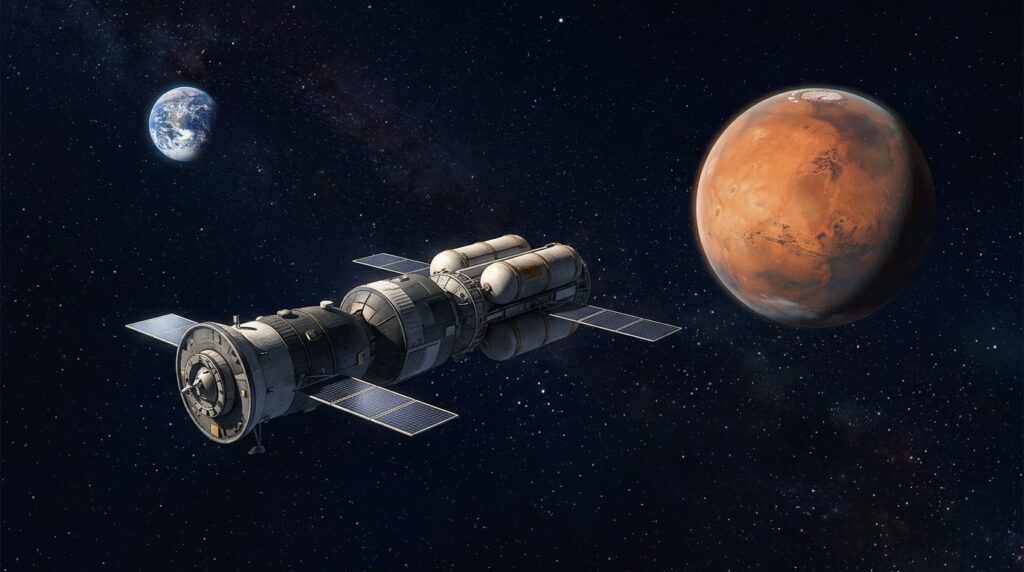
On long-duration flights, the crew won’t be able to quickly return to Earth for help
That’s why scientists are looking for ways to reduce the risks of blood clot formation in space in advance. Data from orbit will help understand what goes wrong in the human body in space, and eventually develop protections for astronauts. Interestingly, the same research could also be useful on Earth, for example, in treating patients with blood clotting disorders.
How Space Affects Astronauts’ Immunity and Heart
Blood problems are just part of the bigger picture. Accumulated data show that spaceflight affects nearly all major body systems. Among the known effects are:
- loss of bone density;
- muscle atrophy due to lack of load;
- vision changes after prolonged stays in orbit;
- disruptions to the immune system.
To examine cells in detail, NASA engineer Jack Hathaway collected platelet samples and placed them under the KERMIT fluorescence microscope — a device capable of revealing the subtlest changes in cells. With its help, scientists observe how platelets respond to prolonged stays in space and track unusual processes in blood clotting, cell communication, and immune function.
All of this is part of growing interest in how the body adapts when gravity virtually disappears.
What Other Experiments Are Being Conducted on the ISS
The ISS science program isn’t limited to blood. On the same day, Jessica Meir photographed growing microgreens and alfalfa as part of agricultural experiments. This was done because future long-duration missions will almost certainly depend on the ability to grow fresh food far from Earth.
Chris Williams participated in transferring water between American and Russian systems, and then underwent a vision check together with Meir. Such monitoring is important because some astronauts experience vision changes after long flights.
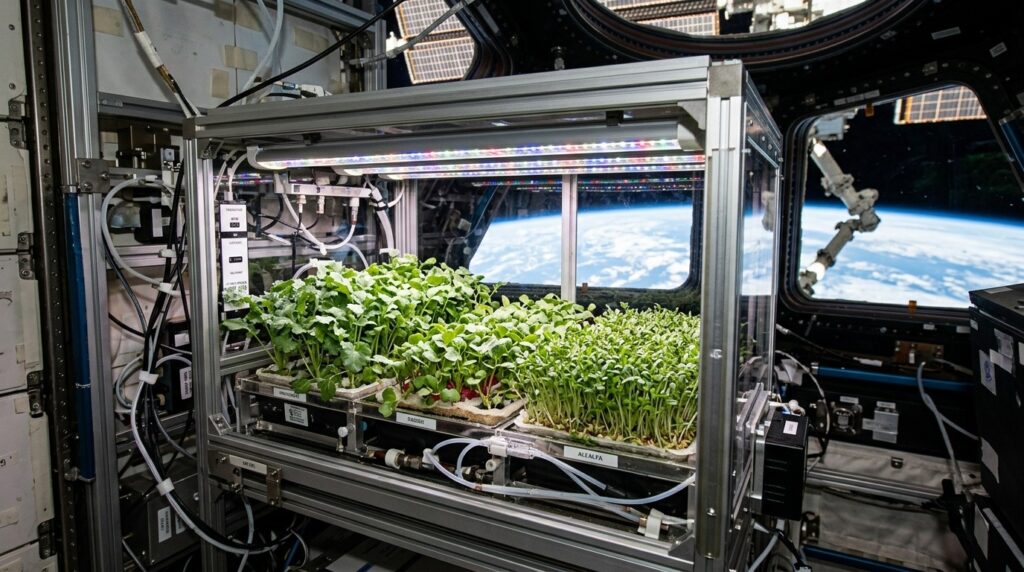
Microgreens and alfalfa in an experiment on growing food in orbit
Sophie Adenot tested an ESA prototype internal spacesuit, a new design that is easier to put on and take off inside the spacecraft. And Jack Hathaway worked with samples in a sample processing facility, studying how weightlessness affects medications. This could pave the way to new, more effective drugs.
Why This Research Matters for Space Travel
NASA emphasizes that the ISS serves as a testing ground for future expeditions. Astronaut health will be the decisive factor in the success of any missions beyond low Earth orbit. Needless to say, without a healthy crew, you can’t fly anywhere.
Research on blood clotting, immunity, vision, nutrition, and medications forms the foundation of safety for long-duration flights. Each experiment adds a piece to the big puzzle: how to keep a person healthy on a journey that could last months or even years.
It’s important to understand that this is still just research, not a ready-made solution. Scientists are still figuring out exactly which systems in the human body malfunction in weightlessness. But it is precisely from such careful observations that the road to the Moon and Mars begins, so that by the time long-duration missions launch, we will already know how to protect people from the hidden threats inside their own bodies.