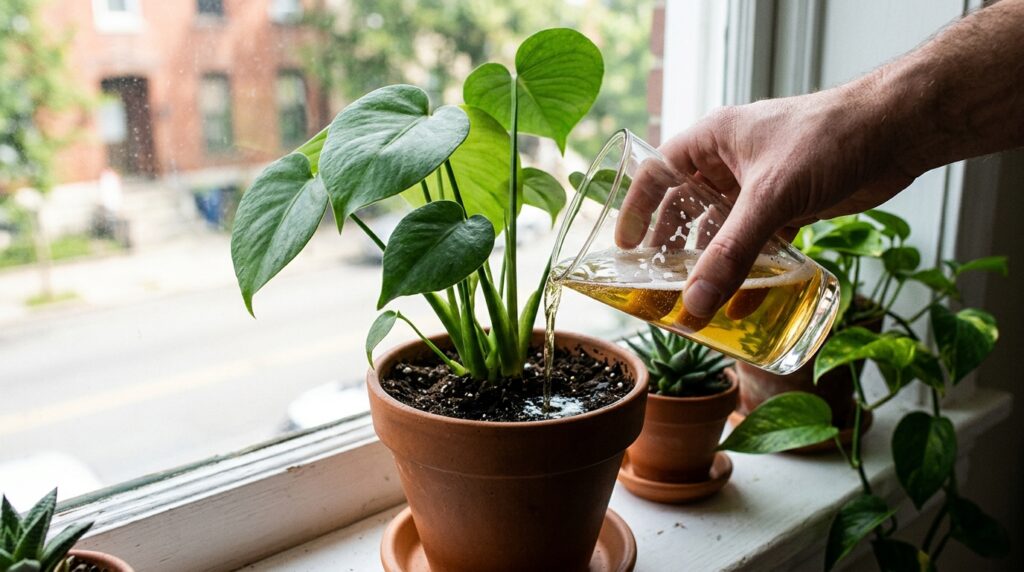
Watering plants with beer is only worth doing as an experiment
Among houseplant enthusiasts and gardeners, there’s a common tip: water your flower with leftover beer, and it will reward you with vigorous growth. The logic is that beer contains yeast, sugar, and minerals, so it should work as a fertilizer. But beer, invented by humans in very ancient times, cannot be called a fertilizer, and in reality, things are much more interesting.
Why People Water Plants With Beer
The main reason for the belief in the benefits of beer for plants is its composition. The beverage does indeed contain carbohydrates, fermentation products, and some minerals. It’s thought that all of this can slightly boost the life of plants in the soil and improve their condition. It sounds logical, but there’s a catch.
If you look at the raw numbers, the picture becomes modest. Regular beer is approximately 92% water, contains about 3.6 g of carbohydrates per 100 g, and about 3.9% alcohol — according to the American food composition database USDA FoodData Central. Essentially, you’re watering your plant with slightly sweetened water with alcohol, not a nutrient concentrate.
Can Beer Replace Fertilizer
If anyone thought about replacing plant fertilizers with beer, you shouldn’t do it. A plant needs specific nutritional elements for normal growth, and beer contains almost none of them. We’re primarily talking about nitrogen, phosphorus, potassium, magnesium, and microelements.
Each of these elements has its own function. Nitrogen is responsible for plant protein formation and participates in plant growth, phosphorus is important for roots and flowering, and potassium helps the plant withstand stress and keep tissues strong. In beer, all these elements are present in negligible amounts, so it’s impossible to replace proper fertilization with it.
So if a plant is losing its vibrancy, growing poorly, or not flowering, it needs proper fertilization with a clear composition, not random leftover beverage from a glass. Beer won’t solve this problem.
Are There Any Benefits of Beer for Plants
Theoretically, a small benefit from beer is possible, but it’s barely noticeable. Carbohydrates from beer can serve as food for microbes in the soil. If the soil is alive, well-aerated, and not overwatered, this can slightly support microbial activity.
The alcohol in beer is even more interesting. Scientists have indeed studied ethanol as a substance that helps plants cope with stress. For example, researchers at Japan’s RIKEN institute showed that low concentrations of ethanol helped rice and wheat better survive drought.
But none of this is a reason to water plants with beer. In experiments, controlled ethanol solutions with precisely specified concentrations are used. It’s worth remembering that beer is a mixture of water, alcohol, sugars, acids, and fermentation products, sometimes with additives. The effect of such a mixture is unpredictable, and the beautiful results from the laboratory don’t translate to a can of beer from the fridge.
How Beer Can Harm Plants
The main risk for plants is alcohol. In small doses, ethanol sometimes slightly helps plants cope with stress, but at increased concentrations, it inhibits growth and damages roots. In a scientific review on the effects of ethanol on plants, it’s directly noted that low doses can be beneficial, while higher doses already suppress growth. The problem is that at home, you can’t control this dose.
The second problem is sugar and organic residues. They become an excellent nutrient medium for mold, fungi, bacteria, and small insects. This is especially dangerous for potted plants, where the soil is often poorly ventilated, and excess moisture lingers longer than in open ground.
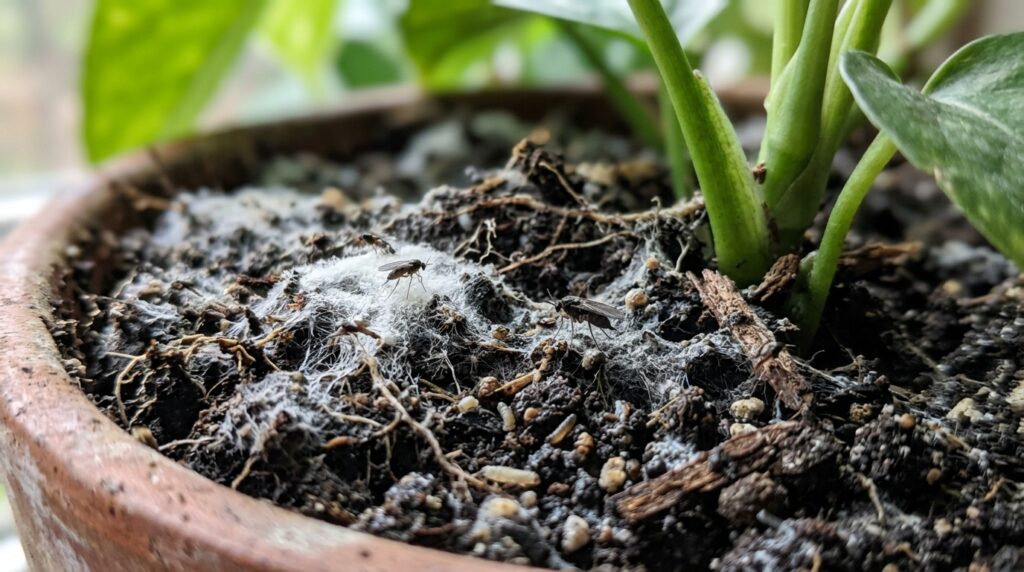
Sugar and fermentation residues can trigger mold and gnats in the pot
If you water with beer frequently, the substrate gradually deteriorates, causing the soil to become acidic, producing an unpleasant smell, white deposits, mold, or gnats. Specialists at the University of Maryland Extension note that excess soluble salts and improper fertilization lead to root burn, brown leaf edges, wilting, and a white crust on the soil surface.
Which Plants Should Never Be Watered With Beer
There are categories of plants for which an experiment with beer is almost guaranteed to end badly. They have sensitive root systems, and an extra organic solution with alcohol can easily worsen their condition. It’s best to keep beer away from the following plants:
- succulents and cacti;
- orchids;
- young seedlings;
- sick plants;
- plants immediately after transplanting.
You also shouldn’t use beer on plants that are already suffering from overwatering, mold, rot, gnats, or poor drainage. This is because under such conditions, the beverage will almost certainly make the problem worse.
IMPORTANT: strong, sweet, fruity, and sour beers are the most dangerous. The more complex the beverage's composition and the more additives it contains, the higher the risk of harming the soil and roots.
How Often Can You Water Plants With Beer
Regularly watering plants with beer is definitely not necessary. It’s not a required procedure and not a substitute for fertilizers. A healthy plant is better off receiving a regular fertilizer appropriate for its species.
But if you really want to run a careful experiment on a healthy plant, there are several safety rules:
- Take regular light beer without additives, completely flat and at room temperature;
- Dilute it heavily with water, at least in a 1:20 ratio, and safer at 1:50;
- Water only already moist soil, not dry roots;
- For a small pot, 1–2 tablespoons of the diluted solution is enough;
- Observe the plant for 2–3 weeks.
If mold, odor, gnats, yellowing leaves, darkening tips, or wilting appear, it’s time to stop the experiment. In this case, flush the soil with regular water, let the excess moisture drain, and return to normal care.
When Watering Plants With Beer Is Justified
The conclusion is honest and without sensations. Beer doesn’t replace proper fertilization because it contains too little organic matter and minerals, while alcohol, sugar, and fermentation products are quite capable of harming roots, provoking mold, gnats, and ruining the soil.
In reality, beer is appropriate only in two cases: as a heavily diluted and rare experiment on a healthy plant. In all other situations, a plant benefits much more from regular fertilizer, proper watering, good drainage, and appropriate lighting. So it’s better to keep the glass for yourself and give your flowers what they actually need.