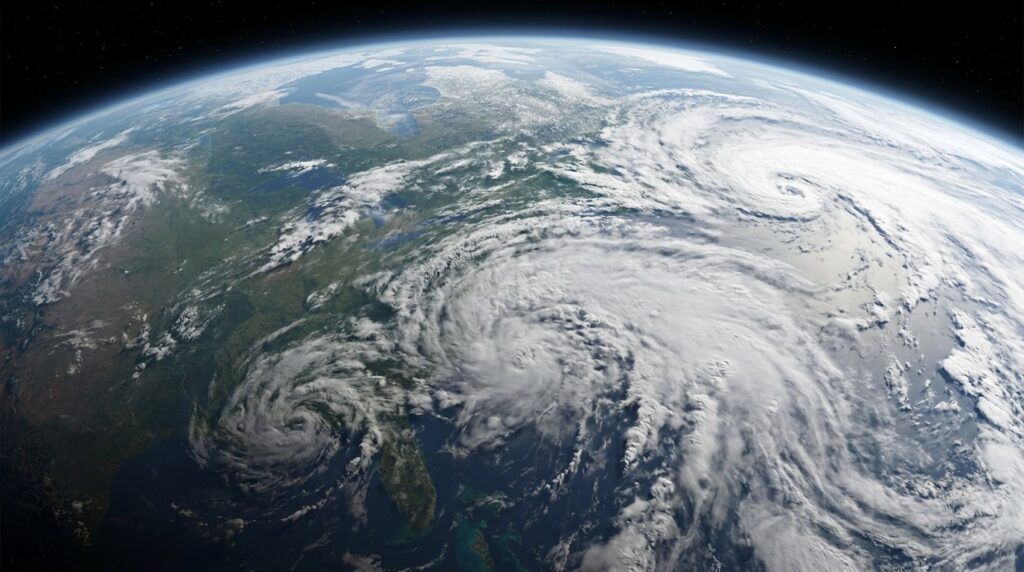
Planet Earth cannot be called sunny, and it is far from ideal
Our planet looks quite beautiful. It’s a blue ball with white swirls of clouds, spinning against the backdrop of black space. It seems like Earth is a very cozy and sunny place, but it is far from ideal. If you look at satellite images, you can see that 67% of the planet is always covered by clouds. In other words, it’s more white than blue. And what about the weather? Is it more often clear or overcast?
How many clouds does Earth have
According to NASA, decades of satellite observations show that from space we most often see clouds rather than land and oceans. According to calculations, clouds cover 67% of Earth’s surface.
If you break this number down by surface type, an interesting difference emerges. Over land, cloud cover averages about 55%, while over the oceans it’s about 72%. This means water beneath clouds is encountered noticeably more often than land.
Why oceans make the planet cloudier
The main reason for high cloud cover is water, which Earth has in abundance. According to NOAA, oceans cover more than 70% of the planet’s surface, and they produce an unimaginable amount of clouds.
Evaporation constantly occurs over the ocean. The sun heats the water, it turns into vapor, the vapor rises, cools, and turns into clouds. There’s a lot of water, a lot of evaporation, which means that there are always more clouds over the ocean than over land.
This is why the 72% cloud cover over oceans significantly pulls the overall number up. Earth is not a blue ball with occasional clouds, but rather a giant cloud generator with patches of land.
The difference between cloudy and overcast
In meteorology, there is an important nuance that often causes confusion. The thing is, “cloudy” and “overcast” are not the same thing.
The satellite cloud cover indicator, which professionals call cloud fraction, simply tells you what portion of an area is covered by clouds. This could be a solid gray blanket or sparse thin clouds through which the sun breaks through.
In the weather forecasts we’re used to, the division is different and is based on the proportion of sky covered by dense clouds. The American weather service scale looks like this:
- clear or sunny — no more than 1/8 of the sky is covered by clouds;
- mostly sunny — from 1/8 to 3/8;
- partly cloudy — from 3/8 to 5/8;
- mostly cloudy — from 5/8 to 7/8;
- overcast — from 7/8 to the entire sky.
Therefore, the honest way to put it is: on Earth, it’s more often “with clouds” than “clear”. But this doesn’t always mean a gloomy gray blanket. More often it’s partly cloudy skies, low marine clouds, thin haze, or cloud bands along the edges of cyclones.
The sunniest and cloudiest places on Earth
The sunniest places on Earth are deserts and subtropical zones. The European Space Agency (ESA) on its cloud cover maps identifies consistently clear areas over the Sahara, the Namib Desert, and the Atacama, which occasionally blooms with flowers. There the air is dry and sinks, preventing clouds from forming.

Above major deserts, the sky most often remains clear
With cloud cover, it’s the opposite. The cloudiest places are found in a narrow band along the equator and two wide bands in the mid-latitudes. At the equator, warm moist air rises and forms powerful clouds and thunderstorms. In the mid-latitudes, for example over the North Atlantic, the sky is constantly covered by storm systems and cyclones.
How much of Earth is currently lit by the Sun
If you ask how much of the planet is actually bathed in sunlight right now, the number turns out to be even more modest. The logic is simple and comes down to basic geometry.
First, half of Earth is always in nighttime — the sun simply doesn’t shine there. Second, of the illuminated daytime half, about two-thirds on average is covered by clouds. Multiply one by the other and you get that the perfectly sunny and cloudless portion of the planet is only about 16–17% of the surface at any given moment.
Is Earth a clear or cloudy planet
If you compare “sunny” versus “cloudy,” the answer is unambiguous: Earth is predominantly a cloudy planet. Clouds are present over it more often than not, and from space this is visible to the naked eye.
But if you translate the question into everyday language and compare “sunny” versus “overcast,” the wording becomes more precise. Clear sky is indeed encountered less often than we think, but complete gray overcast is not the same thing as any cloud cover. Most of the time, some kind of clouds hang over the planet — they just vary greatly in density.
So the familiar image of a blue Earth is somewhat misleading. In reality, we live on a wet, largely water-covered planet where clouds are the norm and clear sky is a pleasant exception.