7 laboratories located in the most extreme conditions on the planet
A laboratory isn’t always a clean room with instruments and proper heating. Some of them are located in places where the work itself is already a test of endurance: amid permafrost, on the ocean floor, in thin mountain air, or in the vacuum of space. Sometimes the environment itself becomes part of the experiment (as at the Concordia Station in Antarctica). And it is precisely from such places that discoveries come that help us understand the structure of the Universe, climate, and even our own bodies. Here are seven places where scientists work at the limit — and do so voluntarily.
IceCube — A Neutrino Observatory Beneath Antarctic Ice
Let’s start with the coldest physics laboratory in the world. The IceCube Neutrino Observatory is located at the Amundsen–Scott Station, right at the South Pole. But the most interesting part isn’t on the surface — it’s deep beneath it.
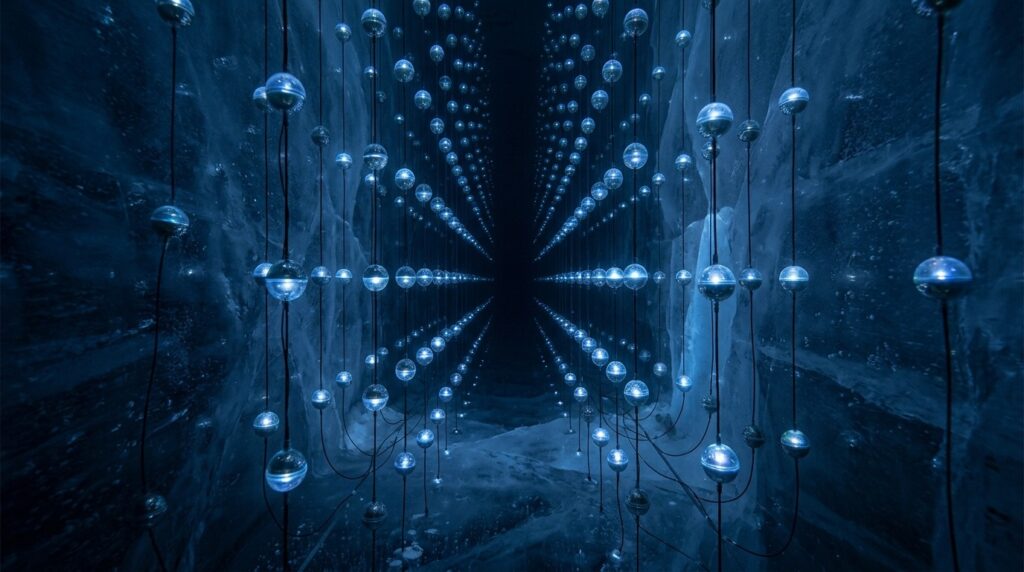
The detector consists of more than 5,000 optical sensors embedded in Antarctic ice at depths ranging from 1,450 to 2,450 meters. Together, they cover an entire cubic kilometer of ice. Their task is to catch neutrinos — nearly massless subatomic particles born during the most powerful events in the Universe: stellar explosions and galactic collisions.
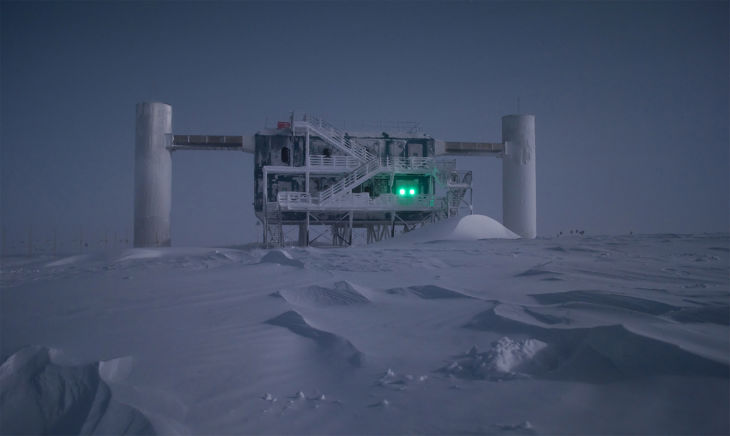
IceCube Neutrino Observatory, Antarctica
Neutrinos barely interact with matter — they fly through the planet without touching a single atom. But occasionally, one particle does collide with a water molecule in the ice and produces a flash of so-called Cherenkov radiation — a faint blue light that the sensors detect. Every day, the observatory collects about a terabyte of data. And in 2018, IceCube was the first to help link high-energy neutrinos to a specific source — a distant blazar.
Brookhaven Laboratory and the Hottest Temperature on Earth
If IceCube is about cold, then Brookhaven National Laboratory on Long Island in New York is the complete opposite. This is home to the Relativistic Heavy Ion Collider (RHIC), which in 2012 set a record: a temperature of about 4 trillion degrees Celsius. That’s 250,000 times hotter than the center of the Earth.
Such heat occurs when gold ions accelerated to nearly the speed of light collide. As a result, for a fraction of a second, a quark-gluon plasma appears — a state of matter that existed in nature only in the first moments after the Big Bang. In essence, scientists recreated the “soup” of elementary particles from which all matter in the Universe was once born.
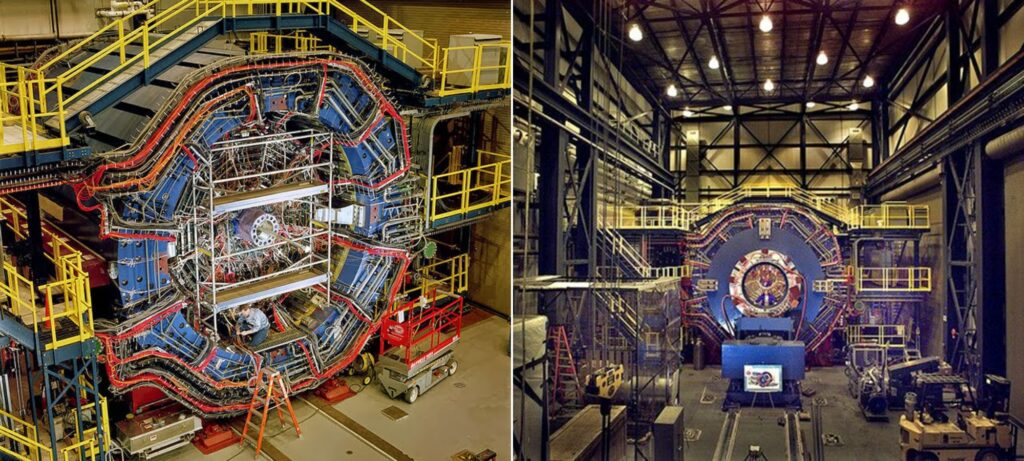
Brookhaven National Laboratory on Long Island, New York, USA
RHIC is the second most powerful heavy-ion collider after the Large Hadron Collider at CERN. But it has its own unique superpower: it is the only facility where polarized protons are collided to study how protons get their spin.
The Pyramid at the Foot of Everest — The Highest Ground-Based Laboratory
In Sagarmatha National Park in Nepal, at an altitude of 5,050 meters above sea level, stands a three-story pyramid made of steel, glass, and aluminum. It is not a temple or a monument, but the highest ground-based laboratory in the world — the Pyramid International Laboratory.
At this altitude, the oxygen in the air is roughly half of what it is at sea level, which is why climbing toward Everest is so difficult for people even with good preparation. Working physically is hard, and any cold can turn into a serious problem. But that is precisely why a laboratory is needed here: scientists study human physiology at high altitude, as well as geology, climate, and the environment.
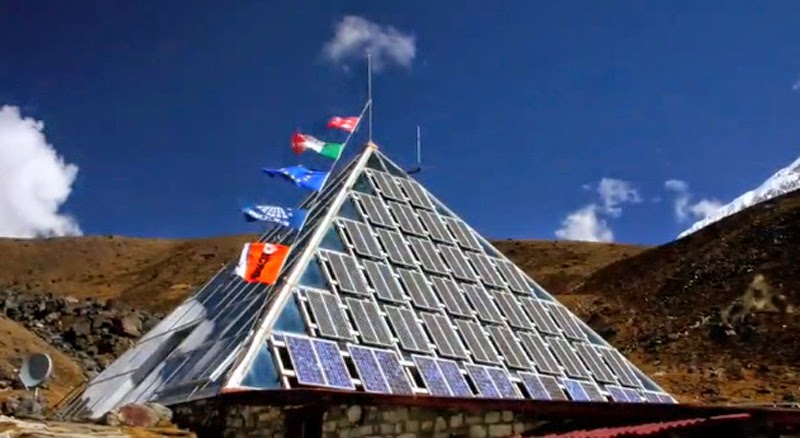
Pyramid Laboratory in Sagarmatha National Park, Nepal
The pyramid is compactly designed: the first two levels house laboratories and storage, while the third holds telecommunications equipment and data processing. Interestingly, local residents also use the laboratory’s telecom equipment — for them, it has become not only a scientific facility but also a practical landmark.
Aquarius Reef Base — The Only Underwater Laboratory in the World
In the 1960s, there were more than sixty underwater laboratories. Today, exactly one remains — Aquarius Reef Base off the coast of Key Largo in Florida. It sits at a depth of about 18 meters, next to Conch Reef, in the Florida Keys National Marine Sanctuary.
Inside, there are six sleeping berths, a shower, a toilet, computers, and even windows with a view of the underwater world. Scientists live and work here for several days or even weeks, using the technique of saturation diving — when the body fully adapts to the pressure at depth and dives can last up to 9 hours instead of the usual one or two. Aquarius is often compared to an underwater space station.
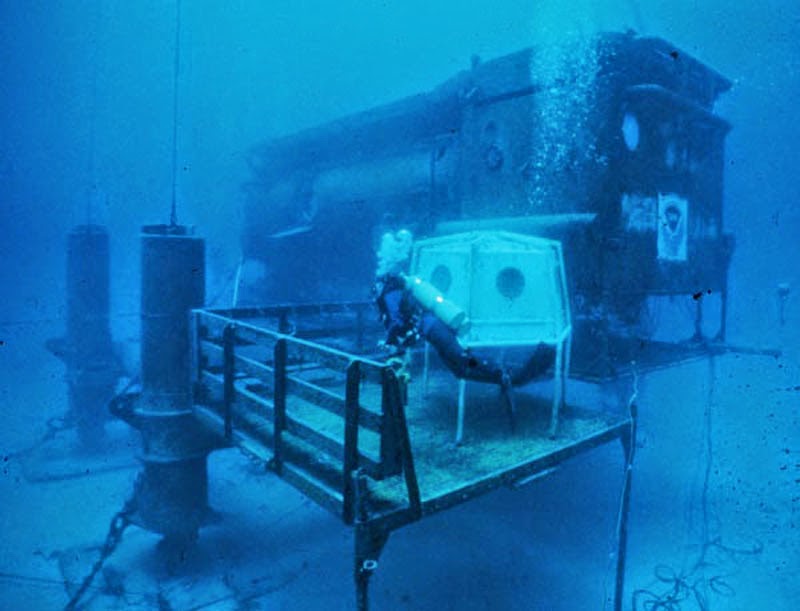
NOAA’s Aquarius Reef Base, Florida Keys National Marine Sanctuary, Florida, USA.
In 2014, oceanographer Fabien Cousteau — grandson of the legendary Jacques-Yves Cousteau — spent 31 days here with a team of five. During that time, by his estimate, the team collected a volume of data that would have taken two years to gather by conventional means. The laboratory has survived several hurricanes and even a temporary shutdown due to budget cuts, but it now belongs to Florida International University and continues to operate. NASA astronauts also train here — the underwater environment does a good job of simulating weightlessness conditions.
CERN — A Laboratory in Underground Tunnels at a Depth of 175 Meters
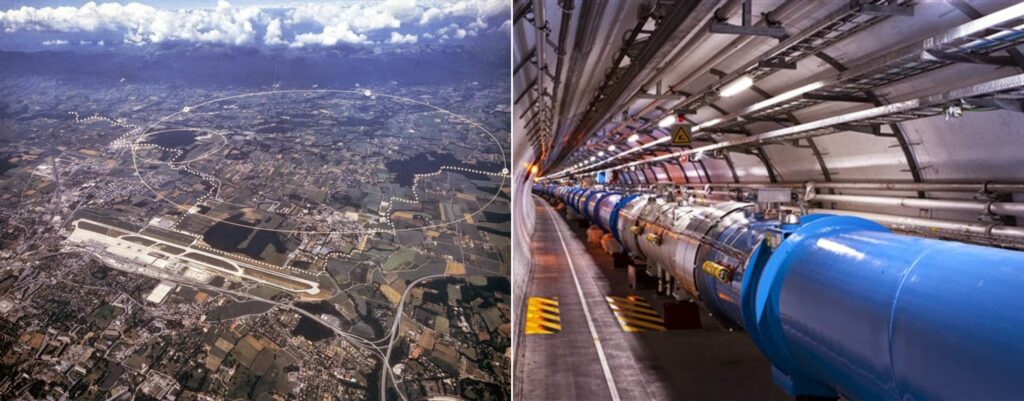
The European Organization for Nuclear Research (CERN), located on the border of Switzerland and France near Geneva, covers more than 550 hectares. The Large Hadron Collider (LHC) — CERN’s main facility — is housed in a tunnel at a depth of 150 meters and stretching 27 kilometers in length.
More than 10,000 scientists and engineers from 113 countries work here. It was at CERN that a particle predicted half a century earlier was discovered — the Higgs boson — and even earlier, this is where the World Wide Web was invented. Incidentally, the Large Hadron Collider is not only used for fundamental physics: the LHC has become a heater for thousands of homes near CERN.