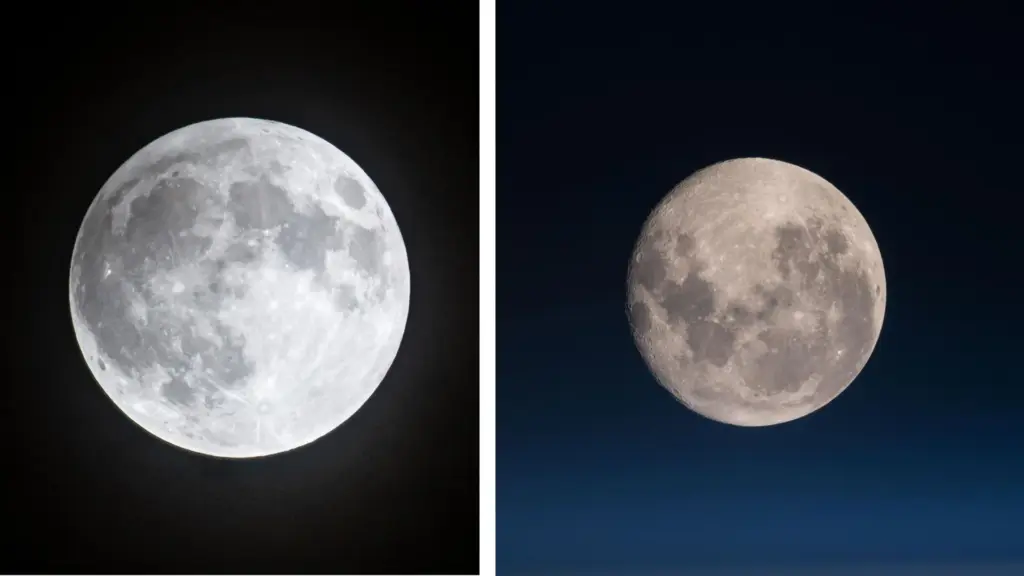
Full Moon from the Northern Hemisphere (left) and from the Southern
If you think the Moon looks the same everywhere on Earth, it doesn’t. Depending on where you’re standing — in Moscow, Sydney, or Bali — the familiar lunar disk may appear flipped, tilted, or even turned on its side. This isn’t about optical illusions but simple geometry: our planet is a sphere, and observers at different latitudes view the same Moon from different angles.
How the Moon Looks from the Northern and Southern Hemispheres
Imagine you’re standing in Moscow looking at the full Moon. Now mentally transport yourself to Melbourne. The same lunar disk, the same craters and dark “seas” — but the entire picture is flipped 180 degrees. What was the “top” of the Moon for a Northern Hemisphere resident becomes the “bottom” for an Australian.
The reason is that people in different hemispheres are, figuratively speaking, standing “upside down” relative to each other. When you look at the Moon from the Northern Hemisphere, your head points toward the North Celestial Pole. An observer from the Southern Hemisphere is turned exactly the opposite way. Because of this, the same object appears rotated by half a turn.
This applies not only to the Moon. Jupiter, for example, is shown in most photographs from the Northern Hemisphere’s perspective, and its famous Great Red Spot is located south of the planet’s equator. But if you look at Jupiter from Chile through a European Southern Observatory telescope, the spot appears above the equator. Same object, different perspective.
Near the Equator, the Lunar Crescent Looks Like a Boat
An even more unusual effect awaits those who find themselves near the equator. The crescent familiar to residents of temperate latitudes — a vertical “letter C” or its mirror image — here lies on its side and looks like a smile or a little boat.
Katherine Miller, a specialist at the Mittelman Observatory at Middlebury College, explains this by the orientation of the observer’s horizon plane relative to the Earth, Moon, and Sun. Far from the equator, the boundary between the illuminated and dark parts of the Moon is nearly vertical, and the phases change “horizontally” — from right to left or left to right. Near the equator, this boundary lies horizontally, and the Moon grows “from bottom to top.”
By the way, this effect is clearly visible in photographs from Indonesia, Kenya, or Brazil. If you’ve ever seen a photo of a “lying” crescent and thought it was Photoshop — no, it’s geometry.
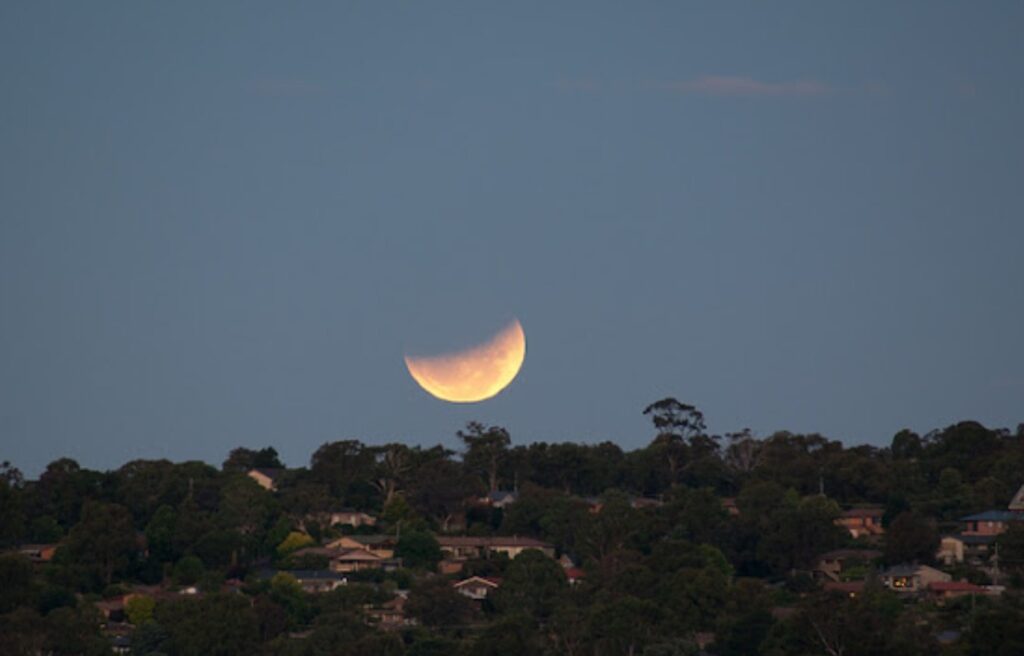
Boat-shaped Moon near the equator. Image source: the-riotact.com
Why the Moon Changes Its Tilt in the Sky
There’s a third effect that surprises even people accustomed to observing the night sky. Over the course of a single night, the Moon’s orientation can noticeably change — it seems to rotate around its center as it moves across the sky.
At the equator, this rotation reaches approximately 180 degrees over the course of a night. The Moon that rose in the east in one position ends up essentially flipped by the time it sets in the west. It sounds like a magic trick, but the explanation is surprisingly down-to-earth.
The Moon’s orbit nearly coincides with the plane in which the Earth orbits the Sun. At the equator, the Moon often passes almost through the zenith — the point directly overhead. To follow it from rise to set, the observer turns 180 degrees. It’s not the Moon “spinning” — it’s you turning your body and head to follow it.
At mid-latitudes, say in Moscow or New York, this effect is weaker because the Moon travels across the sky in a shallower arc and doesn’t rise as high. But it’s still noticeable, especially if you compare photographs of the Moon at moonrise and moonset on the same night.
How Lunar Phases Differ in Different Hemispheres
The difference between hemispheres affects not only the orientation of the disk but also the habitual perception of phases. In the Northern Hemisphere, the Moon “grows” from the right: first the right edge is illuminated, then the entire disk, then the light “recedes” from right to left. In the Southern Hemisphere, it’s the opposite — the Moon grows from the left.
This difference is so well-established that it has even created a problem in the digital world. Moon phase emojis on smartphones — first and last quarter — are drawn from the Northern Hemisphere’s perspective. For residents of Australia, Argentina, or South Africa, these symbols show the phases “mirror” incorrectly. This issue was documented as early as 2017 in a Unicode Consortium technical document, but no universal solution has been proposed.
Additionally, throughout the year at the same point on Earth, the tilt of the crescent also changes — depending on the season, the Moon travels higher or lower across the sky, and its phases look sometimes more vertical, sometimes more horizontal. So even without leaving your city, with careful observation you can notice how the “behavior” of the lunar crescent changes from summer to winter.
Why the Moon Appears Large
One of the most common questions is whether there’s a place from which the Moon looks bigger. Strictly speaking, the apparent size of the Moon depends not on the observer’s latitude but on the distance to it. The Moon travels in an elliptical orbit, and at perigee (the closest point) it is approximately 14% larger in diameter than at apogee (the farthest point). This phenomenon is called a supermoon, and some believe it can affect a person’s well-being.
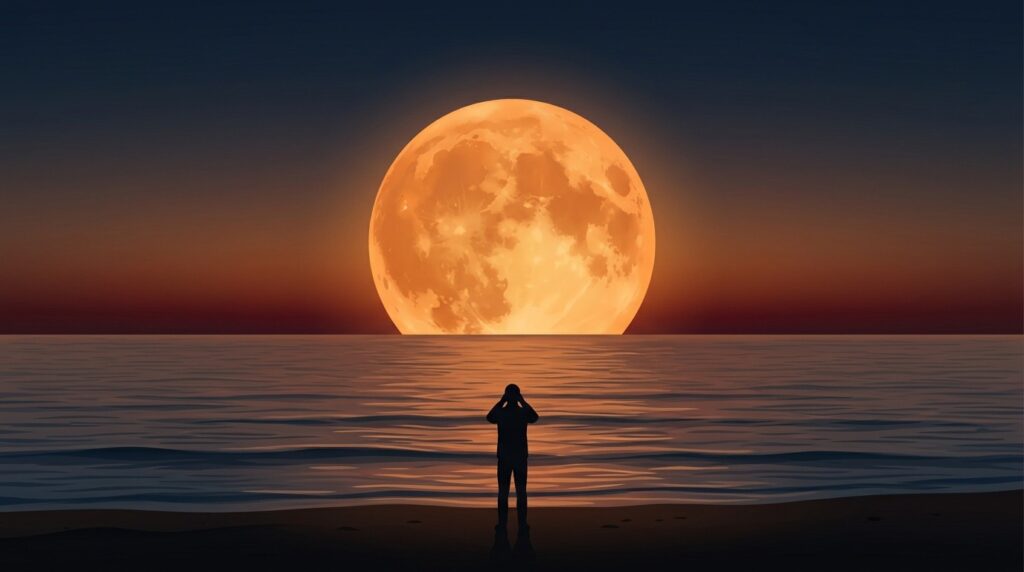
Near the horizon, the Moon appears enormous, but this is an optical illusion, not an actual increase in size
However, near the horizon the Moon appears enormous due to the so-called Moon illusion — a well-known but not fully explained optical trick. The brain compares the Moon with objects on the horizon — buildings, trees, mountains — and “enlarges” it. This effect works everywhere but is especially impressive where the horizon is open: on coastlines, in steppes, or deserts. So the sensation of the biggest Moon is not a matter of geography but of landscape and perception.
All the effects described — the flip, the crescent tilt, the rotation over the course of a night — are not exotic or astronomical curiosities. This is everyday reality noticed by every attentive observer who has moved from one hemisphere to another or simply found themselves in the tropics. The Moon is one and the same object for the entire planet, but our view of it literally depends on where we stand. And perhaps this is one of the most vivid ways to feel that the Earth is truly round — without any space photographs.