They don’t tell you about this: the first victims of space flight.
Many believe that the first victim of space was Laika. Her name is known even by those who have never been interested in space exploration. But the tragedies began much earlier. Before the famous dog, there were other animals, and later people also perished — people who are almost forgotten today. Some of these events remained classified for decades, and official information was misleading.
Laika — the First Orbital Victim of Space
Let’s start with the one who is still remembered. On November 3, 1957, a mongrel Moscow dog named Laika was sent into orbit aboard the Sputnik-2 spacecraft. She was about two years old and weighed approximately six kilograms. Soviet engineers knew in advance: Laika’s return to Earth was never planned. The technology for a safe descent from orbit simply did not exist at the time.
For many years, the official story claimed that Laika survived about a week in orbit before being euthanized. The truth turned out to be harsher: the dog died just 5–7 hours after launch from overheating and stress. The cabin’s thermal regulation system failed almost immediately. This was only publicly revealed in 2002.
Laika became the first living creature in Earth’s orbit — and the first known victim of orbital flight. But she was far from the first victim of the space program in general.
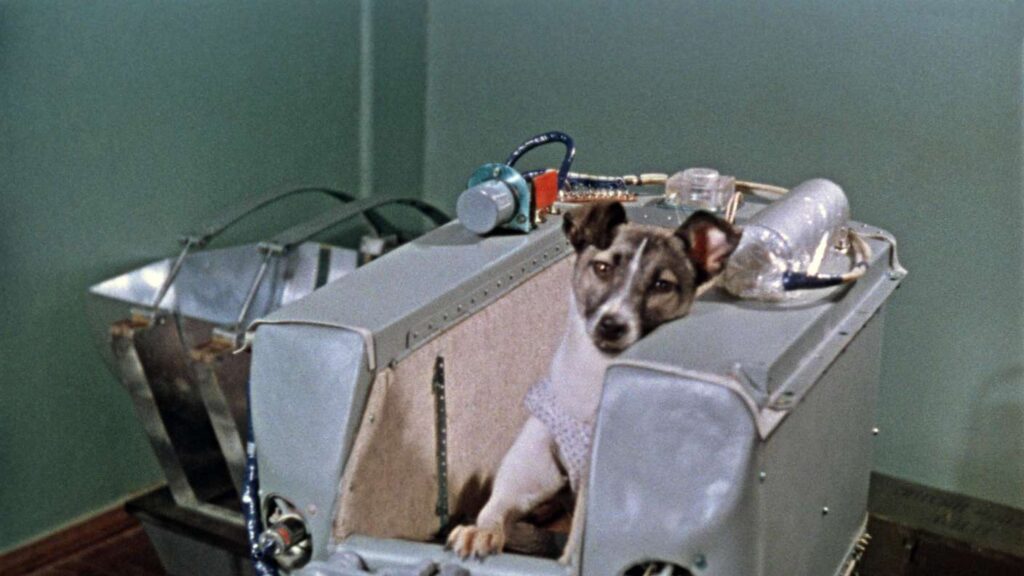
Mongrel dog Laika — the first living creature in orbit.
Victims of Rocket Tests: Deaths Before the First Flight
Long before space flights, rockets were killing people right on the ground. One of the most horrific and little-known disasters occurred on October 24, 1960, at the Baikonur Cosmodrome. During preparations for the launch of the R-16 intercontinental ballistic missile, an unauthorized ignition of the second-stage engines occurred. The rocket was still on the launch pad.
A fiery blast engulfed the launch pad. According to various estimates, between 74 and 126 people were killed — among them the Commander-in-Chief of the Strategic Rocket Forces, Marshal Mitrofan Nedelin. The disaster was classified for decades, and Nedelin, according to the official version, “died in a plane crash.”
This tragedy is sometimes called the “Nedelin Catastrophe.” It was not related to a crewed flight — but it was precisely rocket technologies developed for space that caused the mass deaths six months before Gagarin’s flight.
Vladimir Komarov — the First Person to Die During a Space Flight
If we’re talking about the first human death during an actual space mission, that person was Soviet cosmonaut Vladimir Komarov — an experienced pilot and twice Hero of the Soviet Union. On April 23, 1967, he went into orbit aboard the Soyuz-1 spacecraft. It was the first crewed flight of the new spacecraft.
The plan was grand: docking with Soyuz-2, crew transfer in open space, and the return of three people. But problems began almost immediately after reaching orbit. One of the solar panels failed to deploy, causing an energy deficit on the spacecraft. Some sensors and orientation systems were not working. After numerous malfunctions, the decision was made to cancel the Soyuz-2 launch, and Komarov was ordered to end the flight early.
On April 24, during reentry, disaster struck. The main parachute failed to deploy properly, and the reserve parachute became tangled in its lines. The descent module hit the ground at a speed of about 140 km/h in the Orenburg region. Vladimir Komarov was killed.
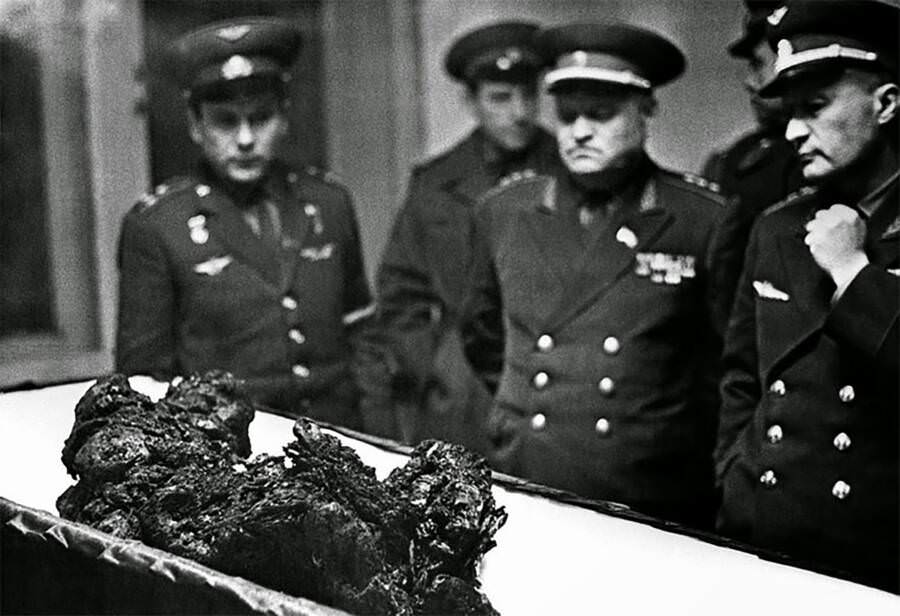
What remained of the descent module and Vladimir Komarov after the impact and fire.
His flight lasted 26 hours, 47 minutes, and 52 seconds. Vladimir Komarov became the first person in history to die during a space flight. After the disaster, the Soyuz program was significantly reworked, and many technical solutions were reconsidered.
Timeline of the First Space and Orbital Flights
To understand the context, it’s worth laying out who first made it “up there” and when.
- 1947 — the first living creatures in space. The USA launched fruit flies on a captured V-2 rocket to an altitude of 109 km. The flies returned alive.
- 1949 — the first primate in space. A rhesus monkey named Albert II ascended to an altitude of 134 km on an American rocket. He died upon landing due to parachute system failure.
- 1951 — the first dogs in space and back. Soviet dogs Dezik and Tsygan made a suborbital flight to an altitude of 87 km and returned safely. A week later, Dezik flew again with a dog named Lisa, but both perished during landing.
- 1957 — Laika, the first living creature in orbit. She died during the flight.
- 1959 — rhesus monkey Able and squirrel monkey Miss Baker became the first primates to fly to space and return alive.
- 1960 — dogs Belka and Strelka spent a day in orbit and returned alive. The first “orbital tourists,” if you will. This was an important step before human spaceflight.
- 1961 — Yuri Gagarin became the first human in space and in Earth orbit. One orbit around the Earth in 108 minutes. Meanwhile, chimpanzee Ham made a suborbital flight as part of the American Mercury program.
- 1963 — Valentina Tereshkova became the first woman in space, spending nearly three days in orbit. And the French cat Félicette became the first and only cat to travel to space: she returned to Earth, and the flight lasted only 15 minutes.
- 1965 — Alexei Leonov became the first person in history to perform a spacewalk.
- 1966 — dogs Veterok and Ugolyok spent nearly 22 days in orbit and returned alive. This flight helped determine whether humans could endure long orbital missions. China also launched dogs Xiao Bao and Shanshan on biological rockets (as far as is known, these dogs also returned alive).
- 1967 — Vladimir Komarov died during the reentry of the Soyuz-1 spacecraft and became the first person to die during a space flight.
- 1969 — Neil Armstrong and Buzz Aldrin became the first people to land on the Moon.
As you can see, before Gagarin, dozens of animal cosmonauts flew into space, and far from all of them returned.
Albert II and Other Forgotten Pioneers
If we’re talking about the very first victim of an actual space flight, it was the rhesus monkey Albert II. On June 14, 1949, he ascended to an altitude of 134 km — this is fully recognized as space by any standard (the Kármán line is at 100 km). The flight went normally, but upon return to Earth, the parachute failed to deploy, and the capsule crashed.
Before him there was Albert I — but his rocket probably did not cross the boundary of space (it only reached 62 km), and he reportedly suffocated before the rocket even gained altitude.
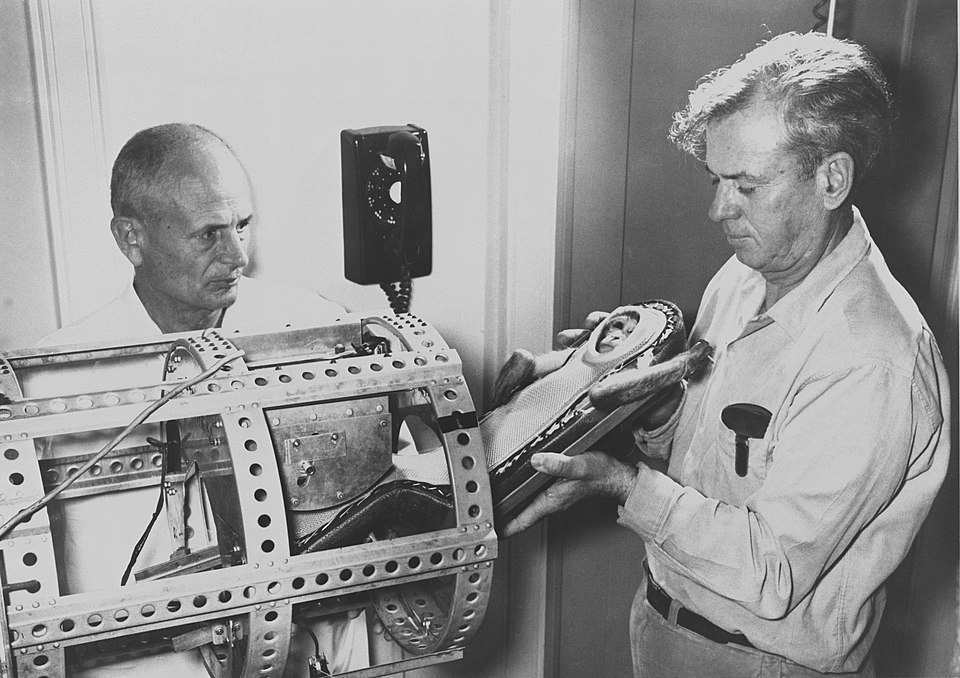
Preparing a primate for flight.
After Albert II came Alberts III, IV, and V — all perished. The American program of high-altitude animal launches on V-2 rockets was, to put it mildly, brutal. Monkeys, mice, and apes died by the dozens, and each death provided engineers with data for creating safer descent systems.
Losses in the Soviet program were also significant. Of the first 18 suborbital flights with dogs, far from all ended successfully. Some dogs flew multiple times; some perished on their very first launch.
Why the Forgotten Victims of Space Flights Are Not Talked About
There are several reasons. The Soviet space program was classified — failed launches were simply not reported. The American military was also not eager to publicize their failures.