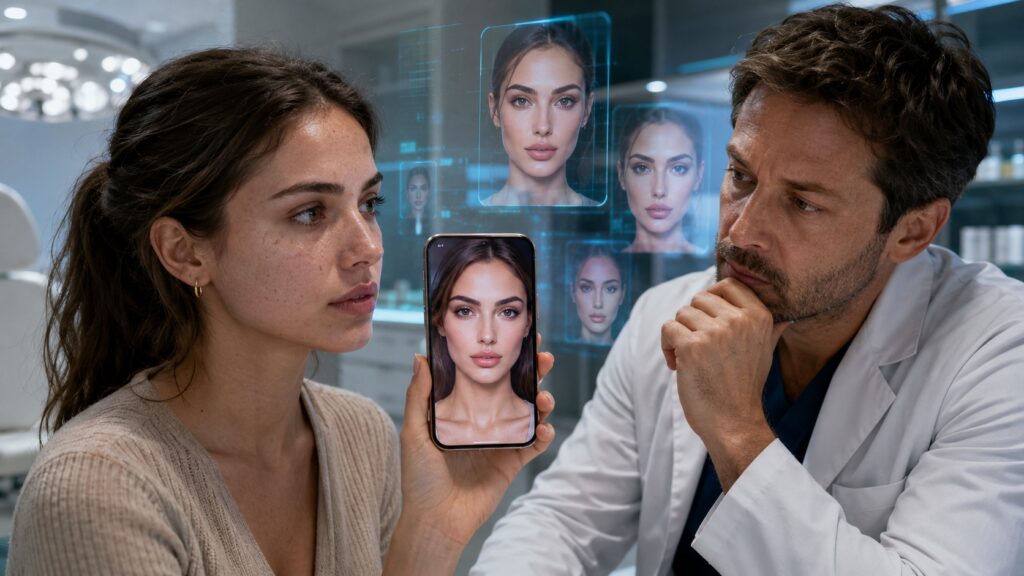
People are increasingly coming to plastic surgeons with AI portraits, and it’s raising concerns
Plastic surgeons and cosmetologists in the USA report that patients are increasingly coming to them with their own photos generated by neural networks. They ask for smoother skin, a sharper chin, bigger eyes, and so on. In short, people increasingly want to turn their face into an ideal created by artificial intelligence. But the problem is that a person’s face and body can’t simply be edited like a picture in an app.
What Is AI Dysmorphia in Simple Terms
Plastic surgery has always helped people achieve a younger face, a flat stomach, or a different appearance. Previously, this ideal image was set by movie stars, magazine covers, and later — Instagram filters. In 2019, the American Academy of Facial Plastic Surgery reported that 72% of surgeons had encountered patients who wanted to look like their selfies, and this phenomenon was dubbed selfie dysmorphia.
Now we’re dealing with a phenomenon known as AI dysmorphia. Instead of asking to look like a celebrity, patients bring their own photos generated by a neural network. In these images, people look like themselves, but certain details have been perfected to an ideal.
For example, a dermatologist from New York described how one woman brought a caricature-like image with huge doll-like eyes, created using ChatGPT. The dermatologist described this style as the Bratz doll look: big lips, big eyes, and a defined jawline. According to the doctor, such a request sounds roughly like “I want to look like Ariel from The Little Mermaid.”
The Danger of Neural Networks for Photo Editing
You might ask — what’s the difference? People used to ask to look like a star, now they ask to look like a picture. But that’s exactly where the trap lies. Since the image still recognizably resembles the patient, it seems more achievable than a celebrity’s appearance. And this only makes the fantasy stronger.
According to ZME Science, a person no longer thinks they want to become someone else. They think this is their best version that already exists somewhere. However, even plastic surgery cannot achieve the beauty that a neural network draws.
The danger is that people can draw any version of themselves, and artificial intelligence seems to understand them perfectly. The system responds to requests, reworks the image, and produces multiple versions of their appearance. It doesn’t feel like a funhouse mirror — it’s more like an advisor who responds to every request by saying it’s a great idea.
Why People Are Dissatisfied with Plastic Surgery
It turns out that the problem isn’t vanity, but expectations. When artificial intelligence readily produces an “improved” version of a face, it becomes very difficult for surgeons to achieve the result the patient expects.
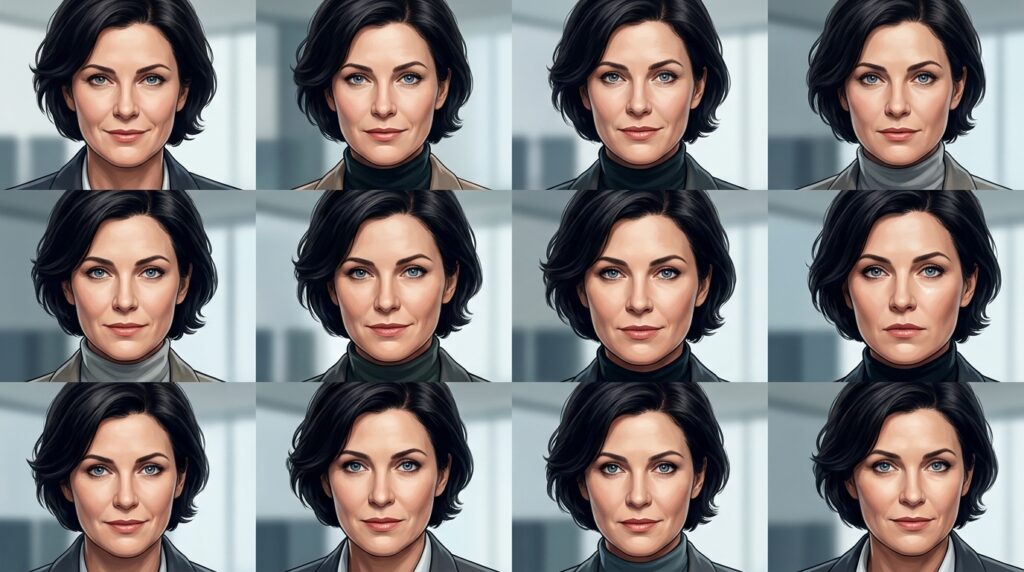
A neural network produces multiple variants of the “ideal” face
And this isn’t something I made up — there’s scientific evidence. A 2025 study on photo enhancement using neural networks showed that using AI significantly inflates patients’ expectations from plastic surgery.
In other words, the more beautiful the picture before the surgery, the higher the risk of disappointment after it. This is because artificial intelligence changes our perception of reality as a whole, not just in cosmetology.
Where AI in Plastic Surgery Is Actually Useful
To be fair, artificial intelligence in plastic surgery is indeed used and provides benefits. For example, specialized AI-based tools help doctors visualize what results can be achieved after surgery. But this is specifically a professional task, not a patient’s whim.
Artificial intelligence can create a portrait of a person after plastic surgery with all possible nuances. For example, it can account for a person’s anatomy and age, and show what could go wrong. But if a doctor uses the neural network poorly, they might end up with yet another unrealistic portrait, just like the patient’s.
Why “Improved” Faces Are Becoming Identical
Finally, it’s worth discussing how neural networks often push people’s faces toward identical beauty standards. For example, skin becomes lighter, smoother, thinner, younger, and faces become more symmetrical.
The reason lies in how neural networks work. They’re trained on enormous quantities of images from the internet, many of which are Photoshopped celebrities and faces from glossy magazine pages. Many neural networks may not account for nationality, age, and individual facial features.
As a result, when we edit photos through AI, we most often get an overly idealized version. And if everyone takes these photos to surgeons, in the future we could all end up looking the same.
Ultimately, the danger of AI-generated images lies not in the desire to look better, but in the false sense that the ideal is already achievable and exists somewhere nearby. And when people see a result after surgery that isn’t quite what they wanted, they become disappointed. How neural networks influence our perception of our own appearance is something worth watching closely. And this is no longer a question of technology — it’s a question of mental health and self-esteem.