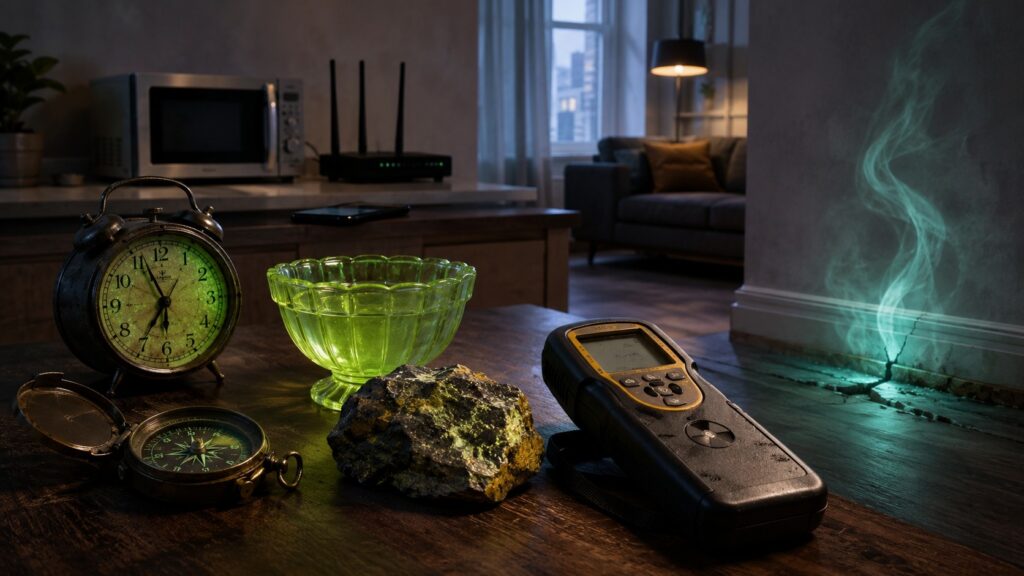
Surprisingly unexpected items in our apartments emit radiation
Our grandmothers still say that routers, phones, and microwaves can emit radiation. But they’re wrong, because these devices don’t produce ionizing radiation. The real sources of radiation in apartments are far more mundane. So what actually emits radiation, how strong is it, and should you be worried about radiation sickness?
Radon — the Main Household Source of Radiation at Home
The most alarming thing in your home isn’t an old alarm clock with phosphorus — it’s radon. This is a radioactive gas with no color or odor, formed by the decay of uranium and radium in the soil. It seeps into homes through cracks in the foundation, basements, joints between slabs, and spots where pipes enter walls.
The danger is that people inhale this gas without even knowing it. Radon decay products settle in the lungs and irradiate tissue from the inside. According to WHO data, radon is one of the leading causes of lung cancer after smoking.
In Russia, radiation standards have been established for residential buildings. According to Rospotrebnadzor data, the limit is no more than 100 Bq/m³ for new buildings and 200 Bq/m³ for existing buildings. A regular household dosimeter won’t detect radon — you need a special radon meter or laboratory measurement.
What actually helps reduce radon levels indoors:
- Ventilating the basement and ground floor;
- Sealing cracks in the foundation and utility entry points;
- Proper exhaust ventilation in rooms;
- Anti-radon membranes during construction;
- A sub-slab gas extraction system.
No aromatic sticks or other “home magic” will protect you from radon.
Can Walls, Granite, and Tiles Emit Radiation
Some building materials contain natural radionuclides: potassium-40, uranium, thorium, and their decay products. This doesn’t mean every granite countertop is trying to irradiate you. But granite, tuff, pumice, cinder blocks, ash-based materials, and decorative stone can produce elevated background radiation if the raw materials weren’t properly tested.
Under Russian regulations, building materials are evaluated by the specific effective activity of natural radionuclides. First-class materials are approved for residential buildings, while those with higher radioactivity have restricted use. Rospotrebnadzor separately notes that when buildings are commissioned, inspections for local radiation anomalies are conducted, and the cause of problems can be materials without a radiation safety certificate.
So when buying granite, stone, tiles, bricks, and blocks, ask for a radiation safety certificate. If you’re renovating and have doubts, you can check the gamma background on the material’s surface with a dosimeter and at a distance of one meter. Noticeably above the general background for your apartment — that’s already reason not to put it in the bedroom.
Why Old Watches, Compasses, and Military Instruments Are Dangerous
Old watches, compasses, scopes, aviation scales, and panels from military equipment are among the most common real household finds with radiation. They often used luminous paint based on radium so that hands and dials would be visible in the dark. Later, tritium and promethium-147 were used, but radium items are the most dangerous.

Old military instruments and watches with radium paint — one of the most common household “radioactive finds”
The main problem isn’t always external radiation — it’s dust. Radium paint over time crumbles and flakes off. If you open a device, clean a dial, sand it, or just pick at the hands, you can inhale or swallow radioactive particles. Internal exposure is far more dangerous than external, because the source is working right inside the body.
What to do with radioactive items from the USSR:
- Don’t open or clean them;
- Don’t give them to children;
- Don’t store them near a bed or desk;
- If a dosimeter shows a significant excess, place them in a sealed bag or container;
- Contact Rospotrebnadzor or call 112.
The Danger of Uranium Glass and Old Ceramics
Uranium salts, also known as uranates, were previously used to color glass and ceramics. Uranium glass is usually yellow-green and glows beautifully under ultraviolet light. It looks impressive, but drinking juice from it isn’t the best idea.
According to the Finnish radiation authority STUK, uranium glass is usually not highly radioactive, however using such dishes for food storage is not recommended. Extra caution should be taken with old bright ceramic glaze, because if the coating is damaged, radioactive substances can leach into food.
Can Minerals and Stones Be Radioactive
Collectible minerals are another real household source of radiation. Uraninite, torbernite, monazite, certain specimens of granite, pegmatites, and ores can be noticeably radioactive. The problem isn’t that a beautiful stone “radiates evil” across the entire room. The problem lies in dust, radon emission, and prolonged storage near people.
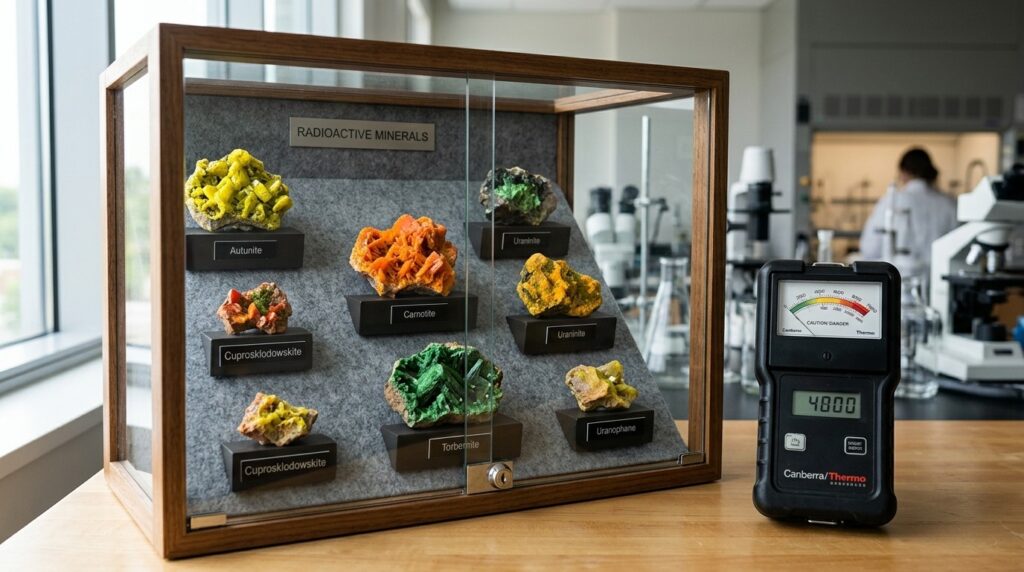
Some collectible minerals can produce noticeably elevated radiation levels
Rules for mineral collectors:
- Store radioactive minerals in a sealed box or display case;
- Don’t place them in the bedroom, children’s room, or on your desk;
- Don’t saw, sand, or scrub them with a brush in the sink;
- If your collection is large, be sure to have a dosimeter and know exactly what you’re storing.
What at Home Definitely Doesn’t Emit Dangerous Radiation
A working microwave with an intact door, hinges, and seals is safe. As the FDA states, microwave energy does not make food radioactive and does not contaminate it. Routers, phones, televisions, and light bulbs are also not sources of ionizing radiation — that’s an entirely different type of emission.
Potassium-40 is found in bananas, potassium salt, fertilizers, and in the human body itself. This is real radioactivity, but the everyday risk from it is negligible. There’s no need to carry bananas out to the balcony with tongs.
Most homes in Russia are absolutely safe. But if you live in a private home on the ground floor with a basement, in an area with granite bedrock, or you keep a collection of old military instruments, it’s better to have your space tested for radiation.