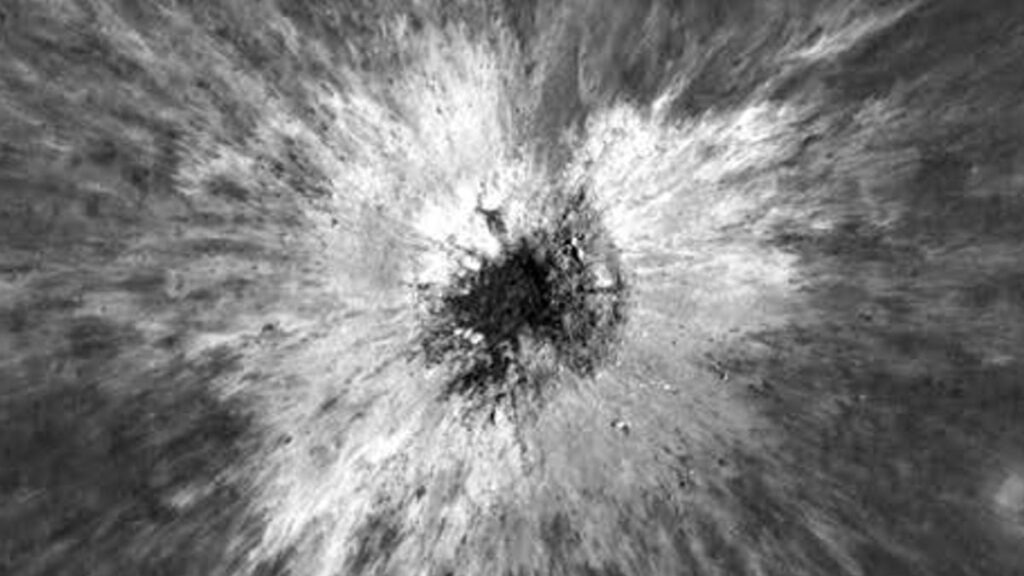
New crater on the Moon with bright rays of ejected soil — view from the orbit of the LRO spacecraft. Image source: sciencealert.com
In the spring of 2024, something slammed into the Moon and left a crater 225 meters in diameter — the size of two football fields. It is the largest fresh impact scar discovered during the entire operational life of NASA’s orbital spacecraft. And compared to other craters on the Moon, according to models, collisions of this scale occur approximately once every 139 years. But the most valuable aspect of this discovery is not the size itself, but the fact that scientists obtained detailed images of the surface both “before” and “after” the impact for the first time.
New crater on the Moon: where and when it was found
The discovery was announced by planetary scientist Mark Robinson on March 17, 2026, at the 57th Lunar and Planetary Science Conference (LPSC) in Texas. The crater was found during routine comparison of images taken by the camera of the Lunar Reconnaissance Orbiter (LRO) — the longest-lived probe in lunar orbit, operating since 2009.
The collision occurred in April or May 2024, but it was only noticed nearly two years later — and this is not surprising. The LRO camera photographs the lunar surface constantly, and among thousands of images it was necessary to manually compare “before and after.” No one recorded in real time when exactly the rock struck the surface.
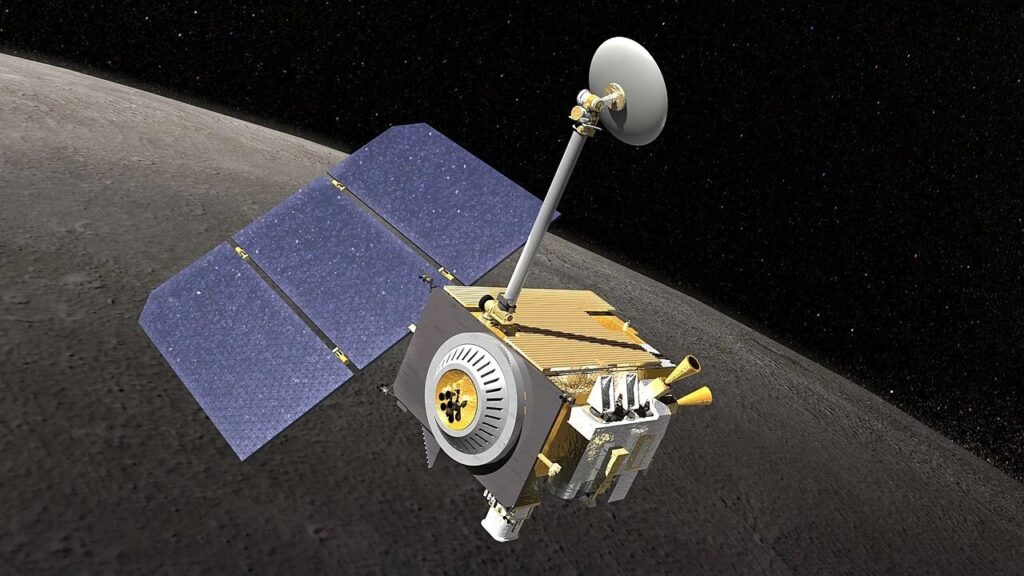
Lunar Reconnaissance Orbiter in lunar orbit — NASA artistic illustration. Image source: universetoday.com
Before this, the largest fresh crater recorded during the entire LRO mission had a diameter of just 70 meters. The new crater turned out to be more than three times larger. Robinson noted that previously, the task of finding even a 100-meter fresh crater seemed ambitious — and here it was 225 meters right away.
What a 225-meter lunar crater looks like
The crater has a funnel-shaped form. Its average depth is 43 meters, and the walls are so steep (slope exceeding 25°) that standing on them would be virtually impossible. At the bottom there is a small bumpy platform approximately 15 by 30 meters in size.
The crater is located on the boundary of two lunar landscapes: uneven, crater-covered highlands and a flat dark plain — a so-called “mare” formed by solidified lava. Its depth and steep edges indicate that the impact struck hard material such as solidified magma. However, the shape of the crater is slightly elongated — meaning the subsurface material is heterogeneous.
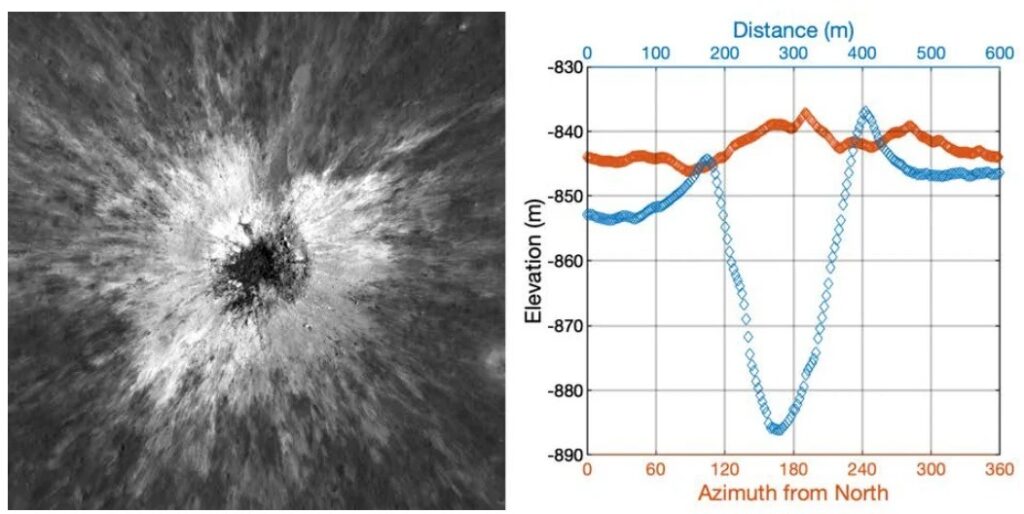
New crater 225 m in diameter. The red line (right) shows the height of the crater rim, and the blue line shows the funnel shape. Image source: sciencealert.com
Around the crater, a bright “blanket” of ejected rocks is scattered — the so-called ejecta. This layer of rocks and dust extends hundreds of meters from the edge of the funnel. The largest fragments reach 13 meters across. By the characteristic “tongue” of ejected soil directed to the north, scientists determined that the space rock came from the south-southwest.
Why a crater of this size on the Moon is a rarity
The Moon is bombarded by space debris every day: small rocks and dust particles continuously slam into its surface. But the vast majority of them leave tiny traces invisible from orbit. A 225-meter crater is an entirely different scale.
According to the Neukum cratering model, which planetary scientists use as a standard, a crater of this diameter should appear on the lunar surface approximately once every 139 years. That is, catching it “fresh” is simply great luck.
For comparison: the LRO spacecraft has been operating in lunar orbit since June 2009, that is, just over 16 years. During all this time, it has recorded many small new craters, but nothing larger than 70 meters. And suddenly — a funnel three times larger than the previous record. By cosmic standards, this is like winning the lottery.
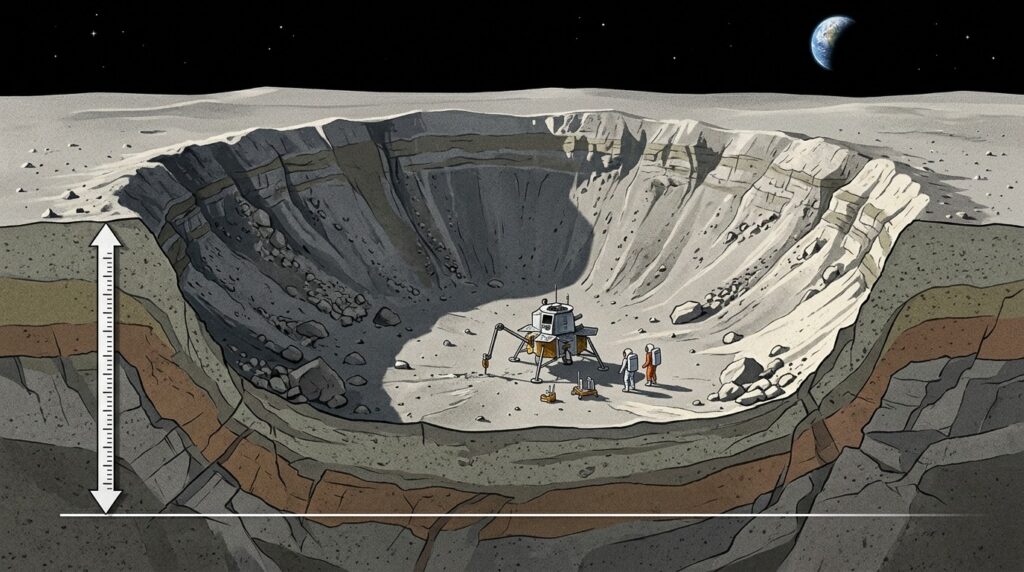
Schematic cross-section of a funnel-shaped crater with steep walls
Before and after photos of the lunar crater: what this gives astronomers
The main scientific value of the discovery lies not in the size of the crater, but in the fact that scientists obtained images of the same area of the surface before and after the impact with meter-level resolution. This is the first case where such detailed paired photographs exist for a crater of this scale.
Why does this matter? Cratering models are the foundation on which the understanding of impact processes across the entire Solar System is built. Scientists study craters on Mars, Mercury, and Jupiter’s moons — but almost always work with finished craters without knowing exactly what the surface looked like before the collision. Now there is a “control experiment”: a real impact with a known result, against which theoretical models can be tested and refined.
Inside the crater, areas of unusually dark material were discovered — almost certainly glassy rocks instantly melted by the colossal temperature of the impact and immediately solidified. This is another “fingerprint” of the collision, allowing scientists to estimate the amount of energy released during the impact.
Why new craters on the Moon are dangerous for future bases
The discovery also has practical significance — especially in the context of NASA’s Artemis program plans and the construction of habitable bases on the lunar surface. The point is that the consequences of the impact were not limited to the crater itself: scientists recorded signs of disturbances at distances up to 120 kilometers from the impact site.
This means that rock fragments ejected during the impact can fly at speeds of about a kilometer per second and threaten objects far beyond the crater. On Earth, the atmosphere absorbs or slows down most small meteoroids. But the Moon has neither an atmosphere nor a magnetic field — there, every rock hits the surface at full speed, and its fragments scatter without any resistance.
Mark Robinson emphasized that any structures on the lunar surface must be designed to withstand impacts from small particles traveling at speeds of about a kilometer per second — even if the impact itself occurred tens of kilometers from the base.
Of course, a collision on the scale of a 225-meter crater is rare. But smaller impacts occur much more frequently, and each of them also creates a cloud of high-speed debris. For engineers designing lunar modules and spacesuits, this is a serious factor that must be taken into account.
The discovery of the new crater is simultaneously a scientific tool and a reminder: the Moon is far from a quiet place. It continues to change right now, and each collision leaves a trace that will never disappear. For researchers, this crater will become a benchmark against which impact process models will be calibrated for years to come. And for engineers — an argument in favor of more robust protection for future lunar bases.