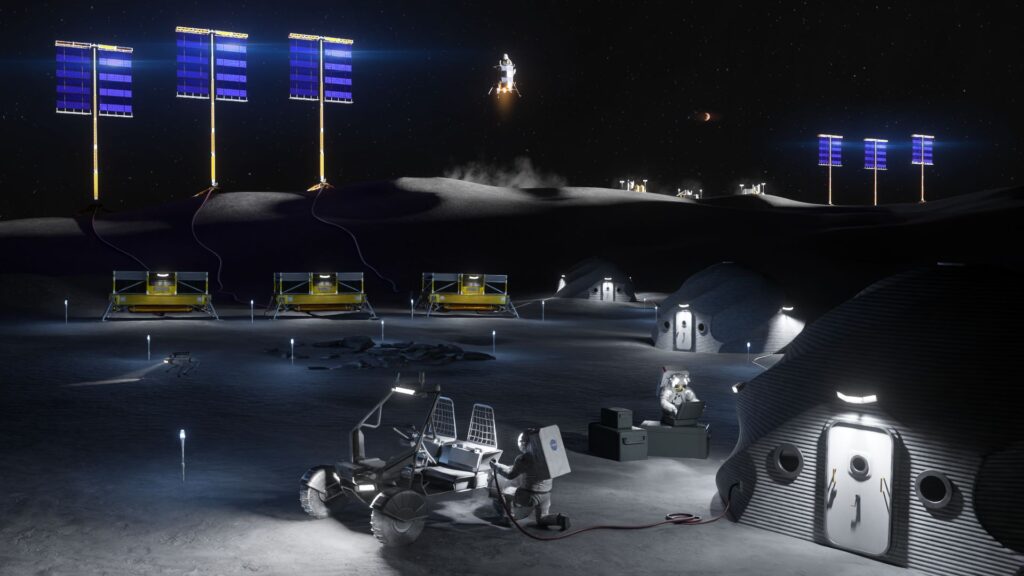
NASA promised to build a lunar city by 2032 — the first permanent settlement on the Moon
NASA has unveiled an updated plan to build a permanent settlement on the Moon. And this time it’s not about flags and footprints in the dust, but about a full-fledged base the size of a large city. The agency expects people to begin living and working on the lunar surface as early as 2032. Think it’s science fiction? Not so fast: after the Artemis II mission, NASA already has specific contracts, a schedule, and the first steps toward building the base.
A Lunar Base the Size of a City at the South Pole
After the successful Artemis II mission, which took place last month, NASA moved from words to action. The agency announced that the future base will be located near the Moon’s south pole — farther than Apollo astronauts ever ventured. According to project lead Carlos Garcia-Galan, the settlement could cover an area of hundreds of square kilometers — comparable to the area of a large city.
Why the south pole specifically? It contains craters where sunlight never reaches. Scientists believe that these permanently shadowed zones hide deposits of water ice and other valuable resources, untouched for billions of years. Water is not just for drinking — it’s also potential fuel: it can be split into hydrogen and oxygen.
NASA Administrator Jared Isaacman called what is happening a “grand return” to lunar exploration and emphasized that engineers are now focused on understanding how people and equipment can survive on the Moon for extended periods.
Why Building a Permanent Settlement on the Moon Is So Difficult
The Moon is not the most hospitable place. During the day, the surface heats up above 250 °C, and at night the temperature drops below minus 200 °C. There is no atmosphere that could smooth out these fluctuations — the Moon has only the thinnest exosphere. Add cosmic radiation, solar flares, and the constant threat of micrometeorite impacts, and it becomes clear why building housing on the Moon is harder than at the bottom of the ocean.
But it is precisely this harshness that makes the Moon an ideal training ground. If technologies can withstand lunar conditions, they can handle Mars too. NASA says it directly: a base on the Moon is a stepping stone to Martian missions planned for the end of the decade.
Blue Origin and the First Missions to the Lunar Base
NASA has signed a major contract with Blue Origin — Jeff Bezos’s space company. It will provide landing modules for delivering cargo to the Moon. This is the first procurement agreement directly linked to the lunar base program.
The plan is laid out by missions:
- Moonbase 1 (fall 2026) — Blue Origin’s Mark I Endurance landing module will deliver scientific instruments and technologies to the Shackleton Ridge area. The main goal is to reduce risks for future crewed landings.
- Moonbase 2 — Astrobotic’s Griffin landing module will deliver more than 500 kg of cargo, including the FLIP rover from Astrolab. The mission will test autonomous logistics systems and astronaut mobility.
- Moonbase 3 — will focus on scientific research and will be the first mission with a payload selected through the PRISM program.
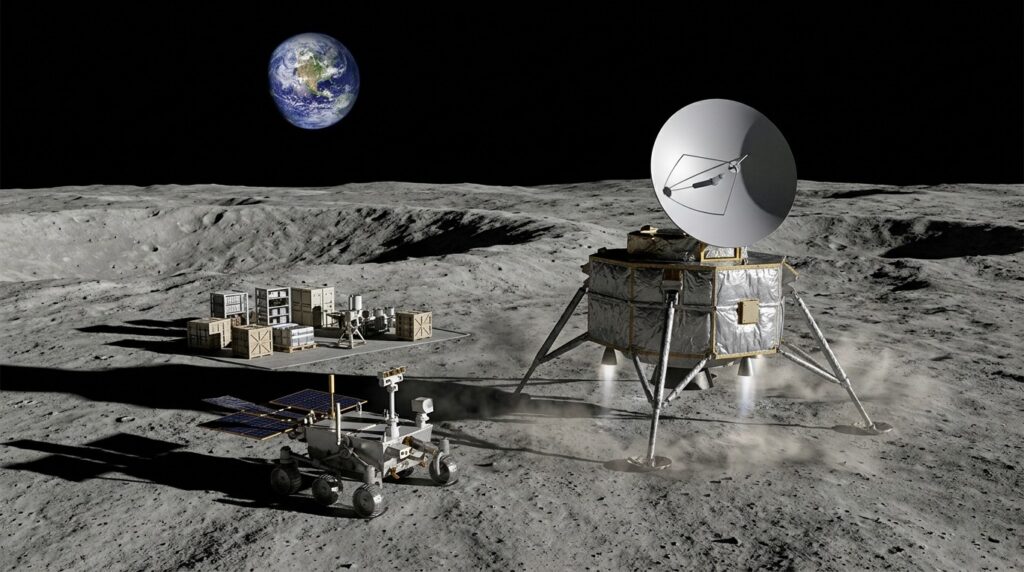
A landing module delivers equipment to the lunar surface
In parallel, NASA is preparing the Artemis III mission — it is scheduled for mid-2027 and is expected to return astronauts to the lunar surface for the first time since 1972. This will be the first human landing in more than half a century.
How Much Does a Lunar Settlement Cost
According to NASA’s preliminary estimates, the entire lunar base construction program will cost approximately 20 billion dollars. For comparison, that’s less than the cost of a single next-generation aircraft carrier. However, space projects of this scale tend to become more expensive, so the final amount could grow.
Interestingly, alongside habitation modules, the agency is also developing infrastructure: if depots, landing pads, and rovers appear on the surface, the idea of building roads on the Moon becomes unavoidable. It sounds crazy, but for regular transit between base facilities, it’s a necessity.
Each mission, according to Isaacman, helps “learn and reduce risks.” The approach is cautious: first robots and cargo, then short astronaut visits, and only then — permanent presence.
What NASA’s Lunar City Means for the Future of Space Colonization
If NASA’s plans come true, by 2032 the Moon will have the first ever permanent human settlement beyond Earth. Not just a temporary base for short expeditions, but a place where astronauts can live, work, and conduct experiments for months. That’s why NASA is already thinking not only about modules but also about how to power future lunar bases.
Of course, such promises should be taken with a grain of skepticism — timelines for space programs shift constantly. But the specifics are impressive: there are contracts, a mission schedule, and partners with real equipment. For the first time in decades, a lunar base looks not like a distant dream, but like an engineering project with deadlines and a budget.