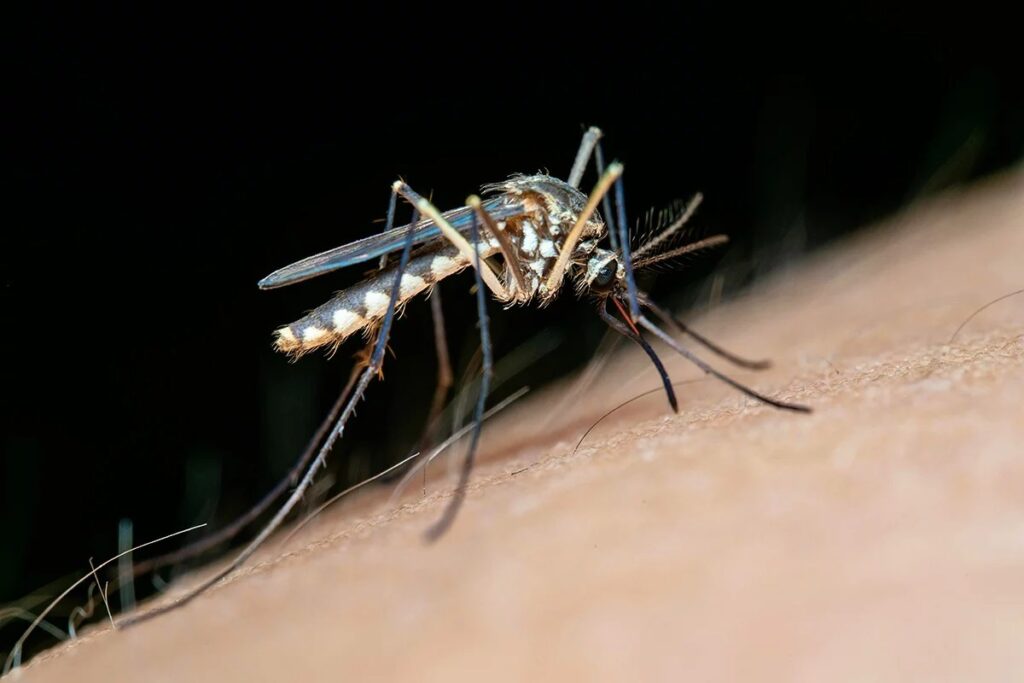
An Aedes mosquito preparing to bite a human. This species can carry numerous diseases. Image source: refractor.io
Different mosquito species choose their victims differently — and a person adored by one species may be completely uninteresting to another. This is the conclusion reached by scientists from Florida International University, who tested the reactions of three mosquito species to 119 volunteers. The study has already sparked lively discussion among specialists and yielded fascinating results.
Why Mosquitoes Bite Some People More Than Others
If you feel like mosquitoes “love” you more than the person next to you at a picnic — you’re not imagining it. Scientists have long known that people truly differ in their attractiveness to blood-sucking insects. But until now, no one had compared how different mosquito species react to the same people.
A team led by Matthew DeGennaro decided to fill this gap. Using a device called a uniport olfactometer, they measured the attractiveness of each of the 119 participants to three mosquito species: Aedes aegypti, Aedes albopictus, and Culex quinquefasciatus.
All three species are carriers of dangerous diseases: the first two spread dengue fever, Zika virus, and chikungunya, while the third carries West Nile fever.
Experiment participants placed their hand into a special device so that mosquitoes would react only to scent — without visual or temperature cues. This made it possible to isolate specifically the olfactory signal.
How Mosquitoes Choose Victims by Skin Odor
Mosquitoes rely on a combination of signals: carbon dioxide from exhalation, body heat, and skin odor. But scent is the most complex and informative channel for them. Human odor is a complex space of more than 1,000 volatile organic compounds, many of which have not yet been studied. Moreover, these compounds are largely produced not by the skin cells themselves, but by bacteria living on the skin’s surface.
Human body odor is largely formed through the processing by skin microbiome bacteria of initially nearly odorless skin secretions — sweat and sebum — into volatile compounds. Imagine that every person carries an invisible cloud of hundreds of different molecules, and the composition of this cloud is unique — almost like a fingerprint. A mosquito picks up this cloud and decides whether it’s worth flying toward you.
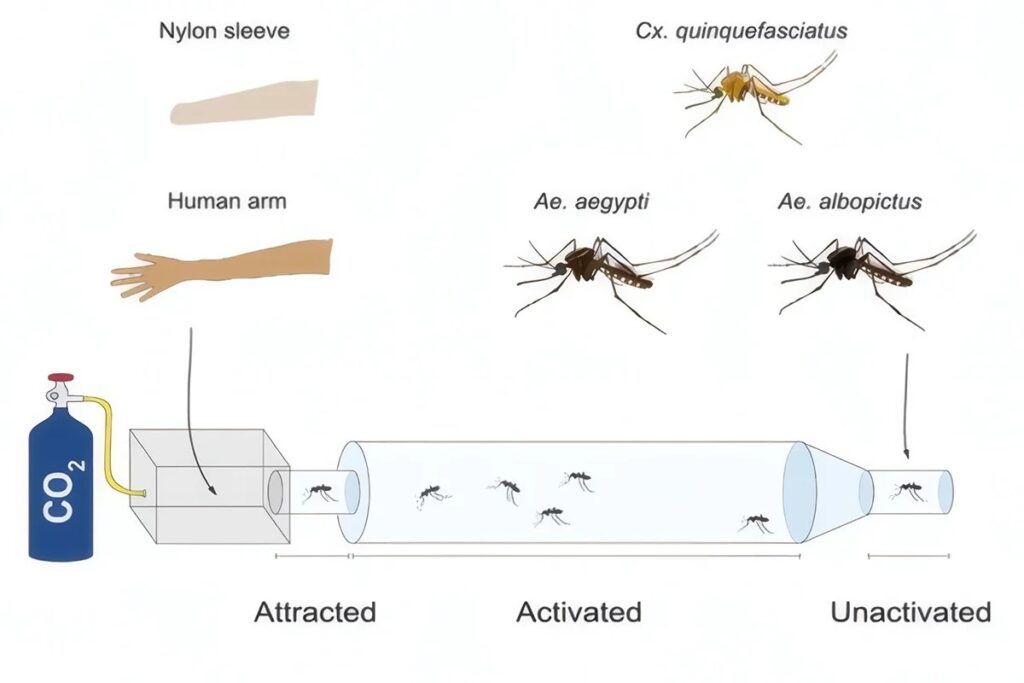
Diagram of a uniport olfactometer. Image source: refractor.io
Why Mosquitoes Bite Men More Often and What It Depends On
One of the most curious findings: the species Aedes aegypti — and only this species — showed a significant preference for men over women. No such sex-based difference was found for the other two species. At the same time, Aedes aegypti proved to be the most “specialized” in humans — on average, 89% of released mosquitoes of this species flew toward human scent.
Why men are more attractive to this particular species remains an open question. The authors emphasize that additional research is needed to confirm the link between sex and attractiveness. It’s also worth remembering that differences in skin odor between specific individuals may be more important than differences between sexes overall.
Why Different Mosquitoes Choose Different People
The main surprise of the study is that different mosquito species generally did not choose the same participants. People who were magnets for Culex quinquefasciatus were often completely ignored by Aedes mosquitoes. Each of the three species essentially created its own attractiveness ranking among participants.

An olfactometer — a device that measures how attractive a specific person’s scent is to mosquitoes
Attractiveness to Aedes aegypti and Culex quinquefasciatus was linked to the absence of certain odors — cyclic alcohols and monoterpenes — while Aedes albopictus, on the contrary, was attracted to people with elevated levels of ketones on their skin. In other words, one species flies toward where certain substances are “missing,” while another flies toward where specific “attractive” molecules are present.
There is a biological explanation for this. As mosquito expert Jerônimo Alencar from the Oswaldo Cruz Institute in Brazil, who was not involved in this study, explained, Aedes aegypti is a species adapted to urban environments, while Aedes albopictus originally inhabited forest edges. If two closely related species use different chemical signals to find hosts, they can coexist without competing with each other for the same people.
Who Gets Bitten by Mosquitoes Most Often and Does Blood Type Matter
A common claim on the internet is that mosquitoes bite people with type O blood more often. However, in this study, blood type was not examined as a factor — the scientists focused on skin odor and microbiome composition. The key takeaway of the work: attractiveness to mosquitoes is determined not by one simple trait, but by a complex cocktail of volatile compounds that is unique to each person.
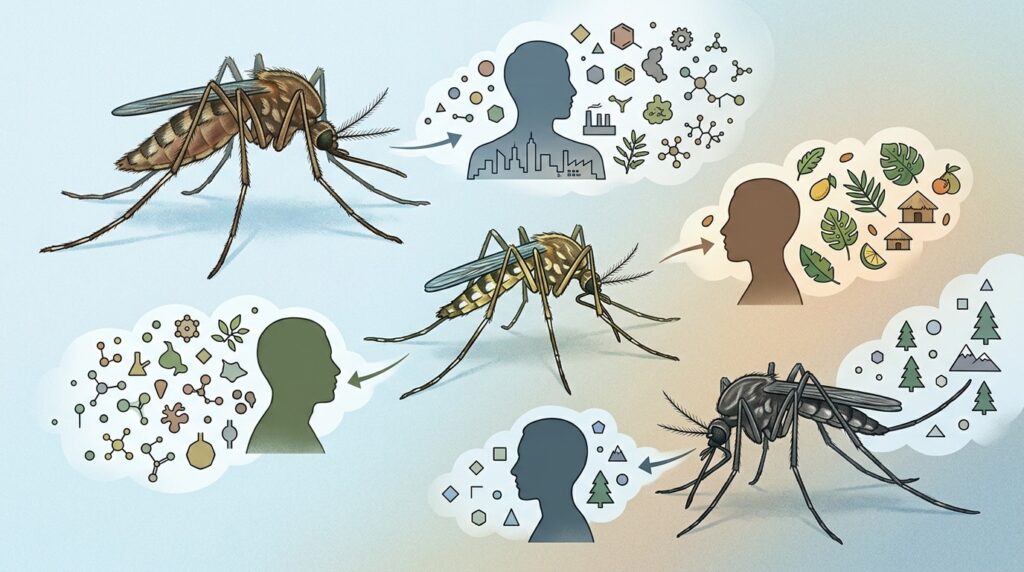
Different mosquito species choose different people based on skin odor
An individual’s skin microbiome is stable over time, and its diversity is linked to health and immune system function. Attractiveness to mosquitoes is thus directly connected to our skin microbiome. This means that in theory, changing the composition of bacteria on the skin could affect how aggressively insects attack you — but for now, this is only a hypothesis, not a ready-made solution.
Why Lab Experiments Don’t Fully Explain Mosquito Bites
Despite the interesting results, several independent experts approached the conclusions with caution. The main caveat: the experiment was conducted under laboratory conditions, and the olfactometer accounts only for scent. In real life, mosquitoes also rely on:
- carbon dioxide that we exhale;
- body heat and skin moisture;
- visual cues — for example, dark clothing;
- movement of the potential victim.
Richard Wall from the University of Bristol noted that individual differences in attractiveness to mosquitoes are well documented and are driven by differences in body temperature and odor. According to him, this work is a correlational study, not an experimental one, meaning it shows associations but does not prove a cause-and-effect mechanism.
Other scientists emphasized that mosquito preferences may vary depending on geography: local mosquito lineages and the genetic background of the population can influence results. What works in Miami (where the study was conducted) may not be replicated in Southeast Asia or Africa.
Nevertheless, the very idea — that the question “why do mosquitoes bite me specifically?” needs to be asked separately for each mosquito species — opens a new direction in the study of disease vectors. Molecular “signatures” of attractiveness to different mosquito species could help in creating next-generation repellents and serve as indicators of bite risk. For now, this is a prospect rather than a finished product, but the direction looks promising — especially for regions where dengue, Zika, and West Nile fever remain serious threats.