The Hubble Telescope could fall to Earth sooner, and in theory, hit people
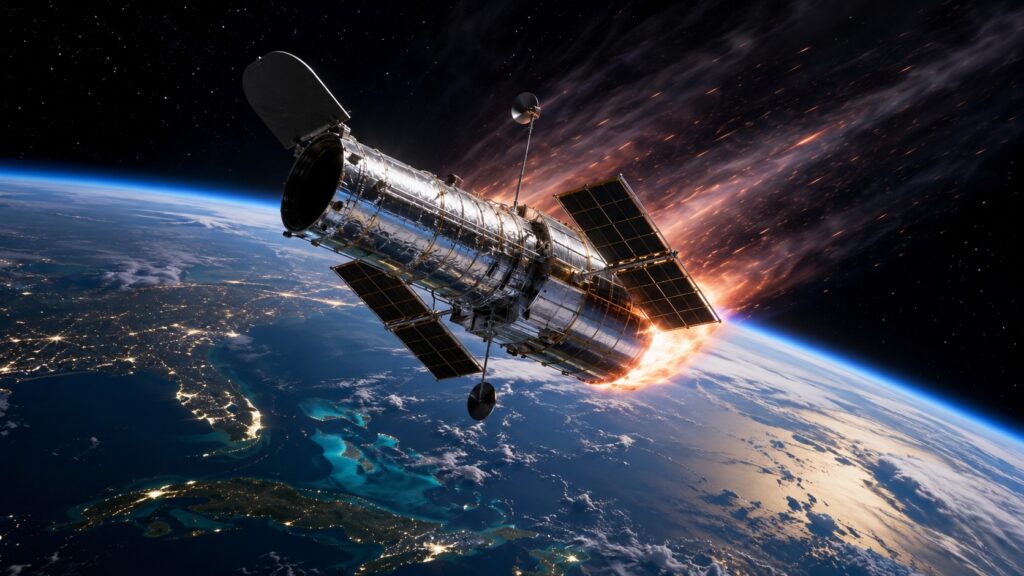
The Hubble Space Telescope, which has been operating in orbit for over 35 years, is slowly descending and will eventually fall to Earth. A new study shows that the fall could happen as early as the end of this decade, much sooner than previously expected. NASA warns that the risk to people is small but cannot be entirely ruled out.
Why Hubble Is Gradually Losing Orbit
The Hubble Telescope orbits at an altitude of approximately 535 kilometers above Earth. It might seem like there’s no air up there, but in reality, extremely thin remnants of the atmosphere still exist at that height. They create a weak but constant drag — somewhat like a light headwind that gradually slows the telescope down. Each year, Hubble loses speed and drops a little lower. And the lower it gets, the denser the atmosphere and the faster the deceleration. The process accelerates on its own.
Previously, this problem was solved by sending astronauts to Hubble aboard space shuttles. They repaired equipment and sometimes “boosted” the telescope higher using the shuttle’s engines. The last such visit took place in 2009, and since then Hubble has been slowly but steadily descending. The telescope has no engines of its own, so it simply wasn’t designed for this.
When Could the Hubble Telescope Fall to Earth
A recent study modeled how Hubble’s orbit will decline in the coming years. According to Daily Galaxy, under average solar activity, the most likely date for Hubble’s atmospheric reentry is 2033. But under unfavorable conditions, when the Sun is particularly active and “inflates” the upper layers of the atmosphere, the timeline accelerates. The telescope could begin its descent as early as 2029.
When powerful solar flares occur, Earth’s atmosphere heats up and expands. Even at an altitude of over 500 kilometers, air density noticeably increases, and Hubble’s deceleration intensifies. Predicting solar activity years in advance is very difficult, so an exact date for the fall cannot yet be determined.
Where Could Hubble’s Debris Fall
The Hubble Telescope weighs about 11 tons — roughly equivalent to two large SUVs. Upon atmospheric reentry, most of the structure will burn up from friction, but some components like mirrors could survive and reach the surface.
According to calculations, debris could be scattered across 350–800 kilometers. Since Hubble flies in an orbit with an inclination of about 28.5 degrees, its trajectory passes over tropical and subtropical regions such as South Asia, Central America, North Africa, and Southern China. Debris could fall on densely populated cities like Macau, Hong Kong, and Singapore.
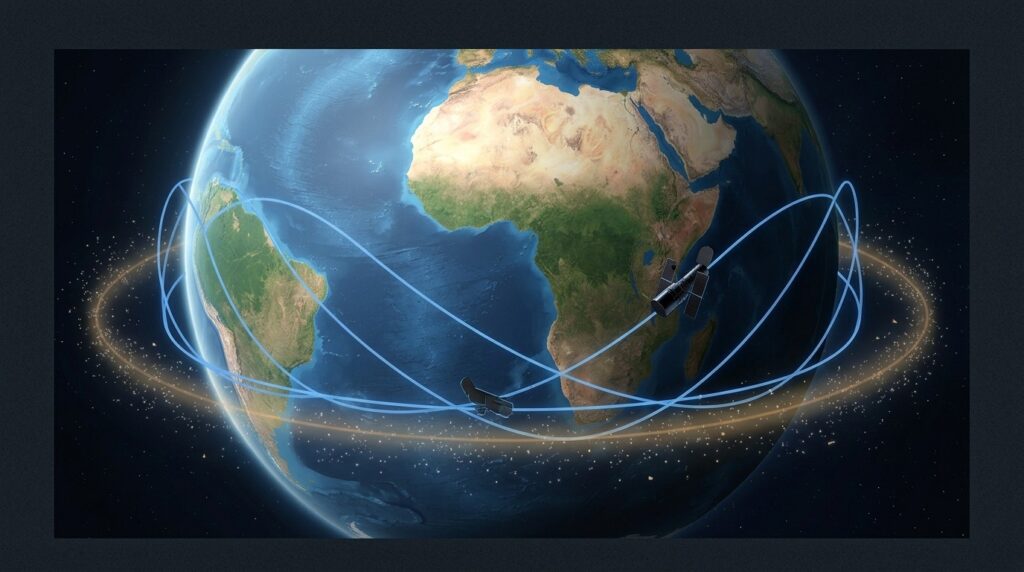
Hubble’s orbit passes over tropical regions — that’s exactly where debris could land
Most of this zone falls over oceans and sparsely populated areas. However, the study estimates the average risk to people living along the orbit at 1 in 330. This is significantly worse than NASA’s safety standard, which requires a ratio of no more than 1 in 10,000.
For readers in Russia, it’s worth noting that Hubble’s orbit does not pass over the country’s territory — it is located too far to the north.
Why NASA Can’t Save Hubble
After the Space Shuttle program ended in 2011, NASA no longer had a suitable vehicle to reach Hubble. Spacecraft like SpaceX’s Crew Dragon or Boeing’s Starliner fly to the International Space Station, which orbits at about 420 kilometers. Hubble is located higher and on a different orbit, and docking with it would require a special adapter that the telescope doesn’t have.
In 2022, NASA and SpaceX discussed the possibility of sending a Dragon spacecraft mission to Hubble to raise the telescope’s orbit. But progress hasn’t moved beyond preliminary study so far. Developing such a mission requires time, money, and solving numerous technical challenges. And this is while the window of opportunity narrows each year as Hubble continues to descend.
Another option is to send an automated spacecraft that would push it into the ocean. But such a spacecraft doesn’t exist yet either.
Which Telescopes Will Succeed Hubble
Hubble continues to operate and make scientific discoveries right now, despite its age and occasional equipment failures.
Its successor is the James Webb Space Telescope, which was launched in late 2021 and operates in infrared light. Webb can see things that are inaccessible to Hubble, but Hubble observes in ultraviolet and visible light in ways that Webb cannot. They complement each other, and the loss of Hubble will be a significant blow to astronomy.
Researchers recommend preparing in advance for the moment of Hubble’s atmospheric reentry. This requires more accurate forecasting of solar cycles and accounting for population growth in regions beneath the telescope’s orbit.
Hubble’s story will most likely end as a bright streak across the sky over the tropics. But the data it has collected will be used by scientists for many decades to come.