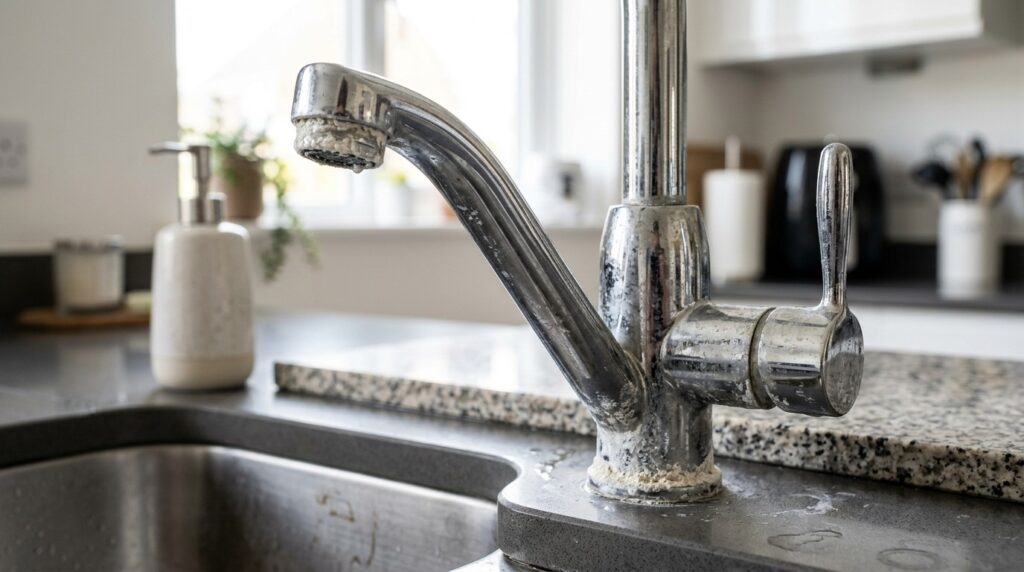
You don’t need a lot of time or money to clean limescale off a faucet
White buildup on a faucet might seem like a curse from your water utility. But in reality, it’s the result of a simple chemical process. Throughout the day, water evaporates, and the minerals dissolved in it remain on the surface. The good news is that the main secret to faucet care isn’t an expensive product or a fierce battle with a sponge, but an ordinary dry cloth.
Why Buildup Appears on a Faucet
The white or grayish crust on a faucet is made up of mineral salts from tap water, mainly calcium and magnesium compounds. When we wash our hands, water lands on the faucet surface, evaporates, and the minerals stay behind. Over time, they turn into a dense limescale deposit, especially noticeable around the base of the faucet, on the spout, and on the handle.
If the buildup isn’t white but sticky and cloudy, it’s most likely a mixture of minerals and soap residue. In hard water, soap doesn’t lather well and leaves an unpleasant film that clings to everything around it.
Yellow stains on a faucet usually indicate iron in the water or rust from old pipes. And blue and green streaks on a faucet may point to corrosion of copper components. In that case, it’s worth checking for leaks or constant moisture at the base.
In short, buildup on plumbing fixtures appears not because you clean poorly, but because water dries on the surface. This means you need to fight the cause, not the consequences.
How to Care for Your Bathroom and Kitchen Faucet
Want to keep your faucet free of buildup? After each use, wipe the faucet with a dry, soft microfiber cloth. Major faucet manufacturers in their care instructions recommend daily drying with a soft towel as the primary defense against stubborn stains.
It’s especially important to wipe the base of the faucet — the spot where it meets the sink. Water sits there the longest, mixes with soap, toothpaste, and oils from your hands, and then turns into that stone-like ring you end up having to chip away at.
For regular weekly cleaning, warm water, a drop of mild dish soap, and a soft cloth are enough. Then rinse everything with clean water and wipe dry. No special chemicals needed.
How to Remove Limescale from a Faucet
If the buildup is fresh and light, start without harsh cleaning agents. Wet a soft cloth with warm water, add a drop of dish soap, and wipe the faucet, especially around the base, handle, and spout. A soft toothbrush works well for seams and hard-to-reach spots. Then rinse and wipe dry.
If stains remain, you can use a white vinegar solution. But there’s an important note for Russia: stores here usually sell 9% vinegar, while Western household tips typically assume 5%. So it’s safer to dilute one part 9% vinegar with two to three parts water.
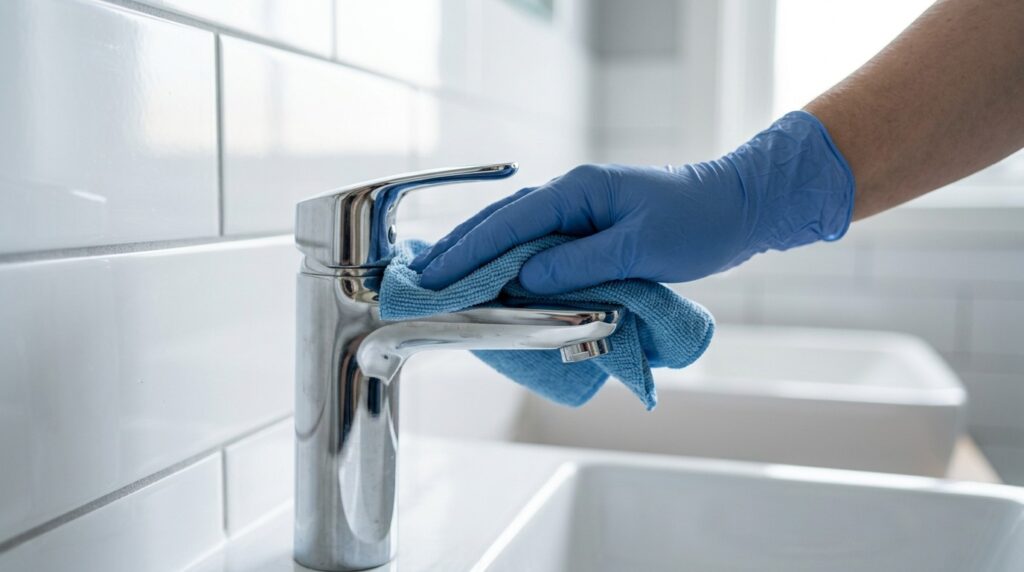
Soft microfiber is the main tool for faucet care
For stubborn limescale, follow these steps:
- Wash the faucet with soapy water and wipe it dry;
- Soak a soft cloth in diluted vinegar or a weak citric acid solution;
- Press the cloth against the affected area for 5–15 minutes. Don’t pour acid directly on the faucet;
- Wipe off the softened buildup with a soft cloth or brush;
- Rinse thoroughly with clean water and wipe dry.
It’s recommended to apply the solution to the cloth rather than spraying it on the faucet. And under no circumstances should you leave vinegar or citric acid on overnight. The buildup may come off, but so will the finish’s shine.
What You Should Never Use to Clean Chrome and Matte Faucets
The list of prohibited cleaning agents for faucets is longer than you might think:
- Metal scouring pads;
- Harsh abrasive powders;
- The green rough side of regular sponges;
- Melamine sponges on delicate finishes;
- Toilet bowl cleaners, bleach, ammonia;
- Acetone, alcohol, solvents;
- Concentrated acidic products “for rust and limescale”
You should absolutely never mix vinegar with bleach — this produces chlorine gas, which is hazardous to your health. In general, it’s best not to mix bleach with anything.
How to Clean a Faucet Aerator
An aerator is the small screen at the tip of the faucet spout. It mixes water with air, making the stream soft and water-efficient. Over time, the aerator gets clogged with sand particles, rust, and limescale. If the stream becomes uneven, weak, or starts spraying sideways, it’s time to clean the aerator.
Cleaning the faucet screen takes five minutes:
- Close the drain with a plug or towel so small parts don’t fall down the pipe;
- Unscrew the aerator by hand. If it won’t budge, wrap it with a cloth and carefully use pliers;
- Disassemble and photograph the order of the parts so you don’t have to guess during reassembly;
- Rinse off large debris with water;
- Soak the parts in white vinegar for 5–30 minutes;
- Scrub with a soft brush, rinse, and reassemble.
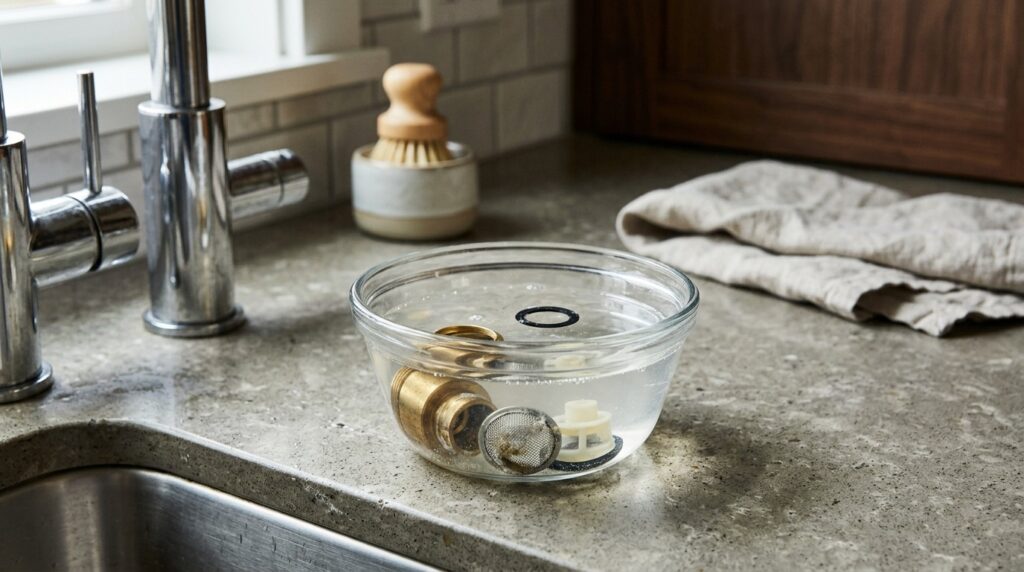
Aerator parts are soaked in vinegar for 5–30 minutes
If the aerator clogs every couple of weeks, the problem isn’t your cleaning routine but the water quality or condition of the pipes. In this case, a sediment filter on the main water inlet to your apartment or regular aerator replacement will help. Fortunately, they’re inexpensive.
How to Keep Your Faucet Shiny
All the preventive care fits into a simple schedule:
- Every day, at least in the evening, wipe the faucet with a dry microfiber cloth — the body, handle, spout, and especially the base;
- Once a week: wash with warm water and a drop of dish soap, go around the base with a soft brush, rinse, and wipe dry;
- Once a month: inspect the aerator, spout, and joints. If there’s buildup, give it a brief treatment with a weak vinegar or citric acid solution;
- Every 3–6 months: remove and rinse the aerator. With hard water, do this more often.
After using any chemicals, always rinse the faucet with water and dry it. Every manufacturer emphasizes this without exception.
If buildup appears very quickly and in large amounts, it’s worth considering water treatment. For an apartment, this could be a whole-house filter or a water softener at the main inlet. A pitcher filter for drinking water won’t help here because it only purifies the water you pour through it, not the water that flows from the tap onto the faucet.
In the end, it turns out that a dry cloth costing a dollar is more effective than any expensive product if you use it every day. Faucet care isn’t about a heroic deep clean once every six months — it’s about thirty seconds each evening. Boring, perhaps, but the faucet truly looks brand new, even after a year, even after five.