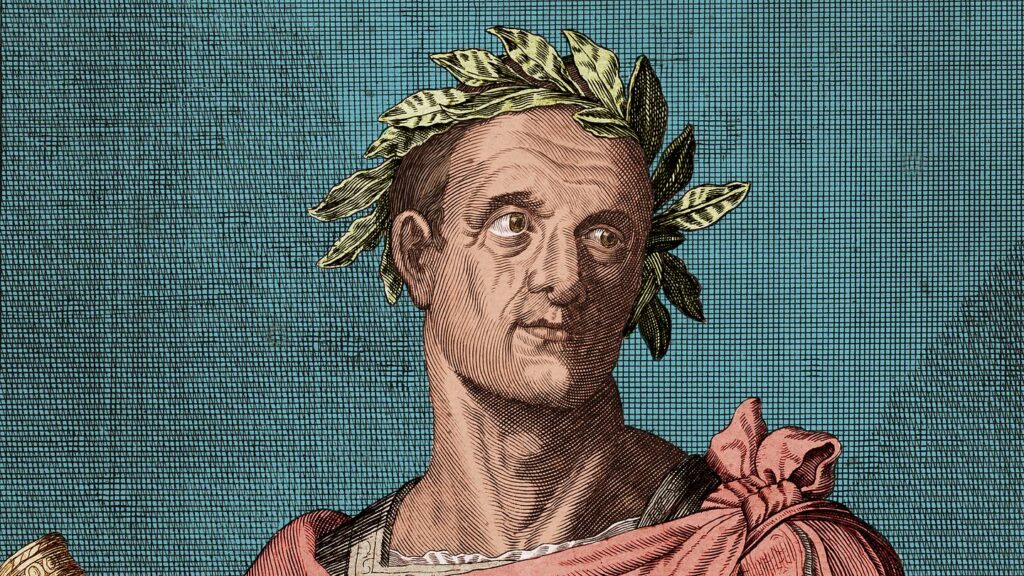
How One Awkward Incident Nearly Ruined Julius Caesar’s Career
Julius Caesar stumbled and fell face-first into the sand on the African shore — right in front of his own soldiers. At any other time, this would have looked like a simple embarrassing accident. But in Ancient Rome, where belief in omens decided the fate of wars, one unfortunate fall could turn into a catastrophe.
Why Julius Caesar Went to Africa
By 47 BC, Caesar was already nearly at the pinnacle of power. His main rival — Pompey the Great — had perished a year earlier in Egypt, betrayed by the courtiers of Pharaoh Ptolemy XIII, who hoped to curry favor with the new master of Rome.
But the war was not yet over. In North Africa, the remnants of the senatorial opposition had gathered — those who had no intention of surrendering without a fight. Caesar sailed for the shores of Tunisia to finish off his last opponents and definitively secure his hold on power. It was here, during the landing, that an incident occurred that could have derailed the entire campaign.
How Caesar’s Fall Nearly Sabotaged the Campaign
When the ships reached the coast, Caesar lost his balance while disembarking and fell face-first right into the sand. In full view of the entire army.
Today, we would simply laugh it off. But for the superstitious Romans, this was no laughing matter — it was a sinister omen, a sign that the gods did not approve of the campaign. The soldiers were ready to turn around and sail home.
The thing is, in the Roman army, divination and omens were part of military discipline. Before battle, commanders observed the flight of birds, lightning, and even the way sacred chickens ate. If the soldiers believed the gods were not on their side, the army could simply refuse to fight. Roman superstitions permeated everyday life as well.
How Superstitions Influenced the Roman Army: Sacred Chickens and a Naval Battle
How seriously did the Romans take omens? There is a famous story retold by Cicero himself. During the First Punic War, the consul Publius Claudius Pulcher was preparing a surprise attack on the Carthaginian fleet in the harbor of Drepana.
Before battle, as was tradition, the sacred chickens were brought out. If the chickens pecked at the grain, the gods gave their blessing for battle. But the chickens refused to eat.
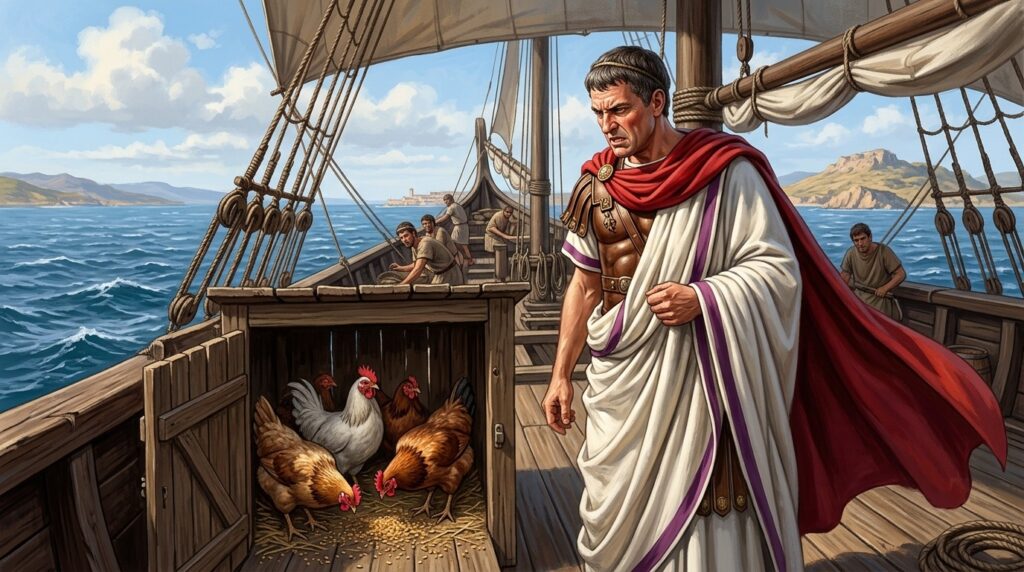
A Roman consul and the sacred chickens that refused to eat before battle
Pulcher would not wait. He ordered the chickens thrown overboard, saying: “If they won’t eat, let them drink!” Then he attacked. The result was catastrophic: out of 123 Roman ships, only about thirty survived. Upon his return to Rome, Pulcher was tried for sacrilege, and his career was over.
For the Roman soldier, the moral was simple: don’t argue with the gods. And in such a culture, Caesar was lying face-down in the sand.
How Caesar Turned Shame into Triumph
Caesar instantly understood the danger of the situation. And, as the Roman historian Suetonius describes, he decided to “give a favorable turn to a bad omen.” The moment he touched the ground, he thrust his hands into the sand and, according to one version, exclaimed: “I hold you, Africa!”
To the soldiers watching from the side, it looked as though the commander had deliberately fallen to his knees and embraced the earth — as a symbolic gesture of possession.
Of course, today it is impossible to verify whether this actually happened. Historians note that this episode may have been embellished or even fabricated. But it fits perfectly with what we know about Caesar: a man who knew how to turn any situation to his advantage.
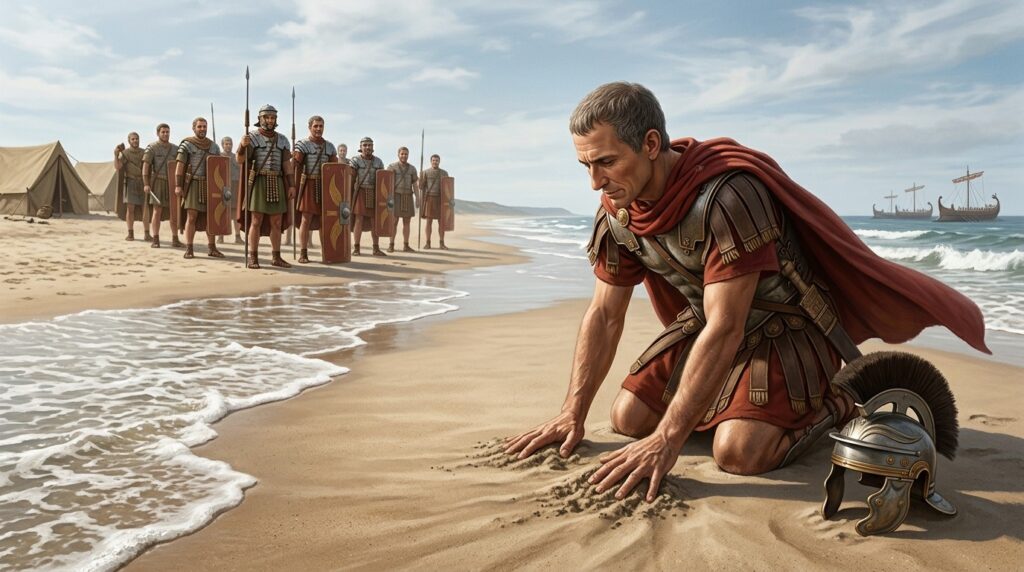
Caesar grabs the sand with his hands, turning a fall into a symbolic gesture
Incidentally, this quality of Caesar’s — the ability to manipulate omens and beliefs — later inspired both Shakespeare and the creators of HBO’s series “Rome.” In Shakespeare’s work, Caesar pretends to have seizures, because in antiquity epilepsy was called the “sacred disease” and was considered a sign of connection with the gods. And in the series, Caesar bribes the chief augur — the priest who interpreted omens — to declare the gods’ favor.
How Caesar’s African Campaign Ended
In any case, the army did not scatter. The campaign continued and concluded with a complete victory. In 46 BC, Caesar crushed his last opponents at the Battle of Thapsus, annexed the neighboring Kingdom of Numidia to Rome, and returned to the capital as a triumphant conqueror.
However, his luck — or divine favor — proved short-lived. Less than two years later, on the Ides of March in 44 BC, conspiring senators assassinated Caesar. Such was the danger of life as a Roman ruler. According to the historian Plutarch, a soothsayer had warned Caesar about that day in advance.
That is how Ancient Rome worked: omens and rituals were not a private matter but part of the state and military machine. And even the most powerful man of the era could lose everything because of one misstep — unless, of course, he could think fast.