Can the microbes in your gut influence what foods you crave?
When your hand reaches for a chocolate bar on its own or you can’t walk past a bakery, it seems like a personal decision. But scientists are increasingly confident that bacteria living in your gut can influence the food you choose. They produce substances that directly “communicate” with the brain and, it seems, know how to “order” their own menu through your desires, as well as influence feelings of hunger.
What Is the Gut Microbiome and How Does It Affect the Body
The gut microbiome is a massive community of microorganisms that live in your digestive tract. Bacteria, viruses, fungi — their total mass in an adult can reach 1.5–2 kilograms. These are not parasites or random hitchhikers: most of them perform useful work. They help break down food, synthesize vitamins, train the immune system, and protect against pathogenic microbes.
But, as it turns out, their influence extends far beyond digestion. Gut bacteria produce many of the same neurotransmitters — chemical signals — that the brain uses. And this opens up a completely unexpected possibility: microbes can “talk” to the nervous system through the gut–brain axis, influencing mood, appetite, and food preferences.
Why 90% of Serotonin Is Produced in the Gut, Not the Brain
Here’s a fact that surprises even people with medical education: approximately 90% of serotonin — the neurotransmitter that regulates appetite, mood, and satiety — is produced not in the brain but in the gut. This has been confirmed by research showing that gut bacteria play a direct role in serotonin production.
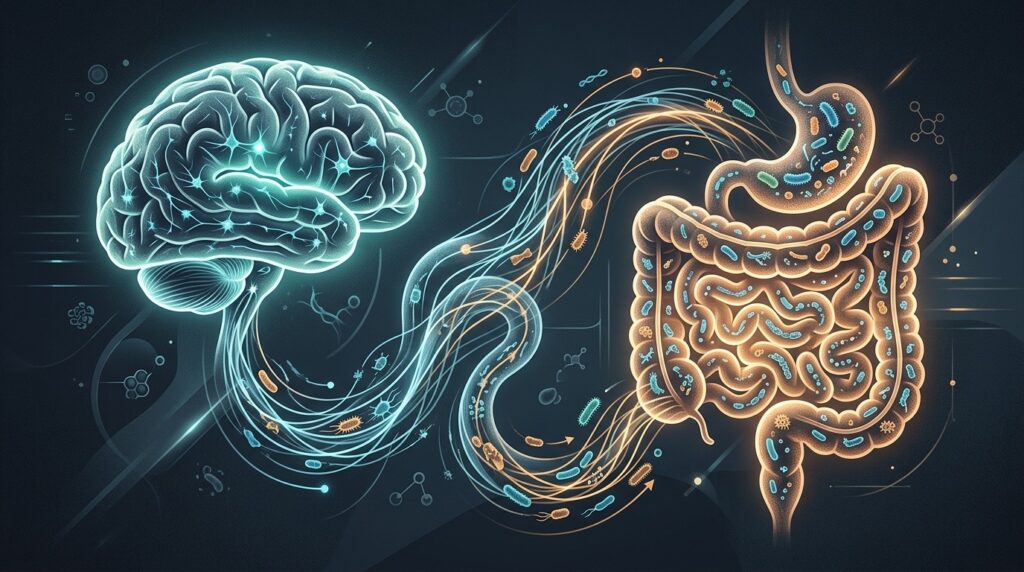
The connection between the brain and the gut — the axis through which bacteria can influence eating behavior
Serotonin in the gut tells the brain when you’re full. It also influences which specific foods seem appealing. Earlier research demonstrated that elevated serotonin levels suppress cravings for carbohydrates — sweets, baked goods, starchy foods. In other words, by changing the amount of serotonin, bacteria can literally shift your preferences from a pastry to a chicken breast or vice versa.
The key element in this chain is the amino acid tryptophan, from which the body builds serotonin. Experiments have shown that its levels in the blood depend on which bacteria inhabit the gut.
How Gut Bacteria Change Eating Habits
One of the most illustrative experiments in this field is a study in which mice received a microbiome transplant from herbivorous animals. The result was impressive: mice that received the “herbivore” set of bacteria began eating differently. They were found to have significantly more tryptophan in their blood and started choosing a high-protein diet instead of a carbohydrate-based one.
“This may be at least one of the pathways by which the microbiome influences diet, appetite, and food preferences,” explained researcher Brian Trevelline.
The logic looks like this: new bacteria → more tryptophan → more serotonin → less carbohydrate craving → shift toward protein-rich food.
Of course, this study was conducted on mice, and the results cannot be directly applied to humans yet. But the mechanisms — neurotransmitters, tryptophan, serotonin — work in the human body as well, making the hypothesis compelling.
How Diet Changes the Microbiome and Food Cravings
The most intriguing detail is that the relationship works both ways. Your microbiome influences what you want to eat. But what you eat, in turn, changes your microbiome. If you start eating more fiber, bacteria that thrive on it multiply in the gut. If you switch to sweets and fast food, entirely different species gain the advantage.
Kevin Kohl, a professor of biology at the University of Pittsburgh, describes this as a feedback loop: “I can absolutely envision cycles where shifts in the microbiome either reinforce existing eating behavior or give rise to new cravings.”
Think of it as a kind of negotiation. Bacteria that thrive on a protein diet “vote” for meat and eggs through chemical signals. You eat more protein — these bacteria multiply — their “voice” grows louder. But if you suddenly change your diet — for example, go vegan or, conversely, load up on simple carbohydrates — the bacterial composition gradually reshapes, and your cravings may shift along with it.
Do you really crave sweets, or is that desire caused by bacteria in your gut?
How to Restore Gut Microbiome and Reduce Food Cravings
Since the microbiome depends so heavily on diet, the logical question is: can you consciously “reprogram” your gut residents to crave healthy food instead of junk? There’s no direct recipe yet — research is still in its early stages. But several things are already fairly well studied:
- A diverse plant-based diet (vegetables, fruits, legumes, whole grains) supports a rich and resilient microbiome.
- Fermented foods — kefir, sauerkraut, miso — supply live bacteria.
- Fiber serves as “food” for beneficial bacteria (a prebiotic).
- Long-term monotonous eating, especially with large amounts of sugar and ultra-processed foods, reduces microbiome diversity.
It’s important to understand: the idea that you can take a specific probiotic and stop craving sweets has not been confirmed yet. Moreover, even sugar-free products don’t always solve the problem and sometimes only further confuse eating habits. The mechanisms by which the microbiome influences appetite are complex, and science is still far from specific recommendations like “drink this and you’ll love broccoli.”
Microbiome’s Influence on Nutrition: Facts and Hypotheses
Let’s summarize what we know for certain and what remains at the hypothesis level:
- Proven: gut bacteria produce neurotransmitters, including serotonin, and influence tryptophan levels in the blood.
- Proven (in mice): transplanting the microbiome from herbivorous animals changes food preferences.
- Well-supported hypothesis: increasing serotonin through the gut microbiome suppresses carbohydrate cravings.
- Still a hypothesis: humans can deliberately change their food preferences by altering the microbiome.
We’re accustomed to thinking that our tastes are a personal choice — culture, habits. But it turns out that trillions of microscopic creatures inside us conduct their own “lobbying work,” pushing us toward certain foods and away from others. This doesn’t negate free will, but it does make you look differently at that irresistible craving for something sweet after lunch. Perhaps it’s not a lack of willpower — it’s just bacteria casting their vote.