
For centuries, people learned to distinguish safe plants from dangerous ones, often through their own mistakes.
You may have heard that green potatoes are best avoided. And rhubarb leaves — even more so, although the stalks themselves are perfectly fine for pies and compotes. And for good reason: even familiar foods can contain poison. And this raises a question: how did people ever figure out that one plant could safely go into food while another was better left untouched? Without laboratories or chemical analysis — only through observation, others’ mistakes, and, unfortunately, very unpleasant experience.
Why Plants Need Poisons
A plant can’t run away from something that wants to eat it. So it has its own defense strategy — chemistry. Many plants produce substances that repel insects and animals, while also protecting against diseases. In essence, a plant is a small chemical factory.
A classic example is tobacco. The nicotine we all know was actually designed by nature not for humans, but against insects: for the plant, it’s a natural defense against those who want to feast on its leaves. We simply adapted this chemistry for our own, not particularly healthy, habits.
And there are a huge number of such plants. Around the world, there are tens of thousands of species containing poisonous compounds, and some poisonous plants are easily confused with harmless ones. At the same time, humans eat only a tiny fraction of all edible plants on the planet — the rest is either unpalatable, dangerous, or simply no one thought to try it.
Why Dosage Determines Whether a Plant Is Poisonous to Humans
The main principle of toxicology (the science of poisons) is simple: it’s all about the dose. The same substance can be harmless in small amounts and dangerous in large ones. And this applies even to the most ordinary products.
Take table salt. You eat it every day and feel perfectly fine, but in excessive amounts, salt harms your health. The same logic applies to plants. Green potatoes contain glycoalkaloids — substances that in large doses cause nausea, fever, and stomach upset. And rhubarb leaves are dangerous due to oxalates, which can also cause illness, but only if you eat a substantial amount of them.
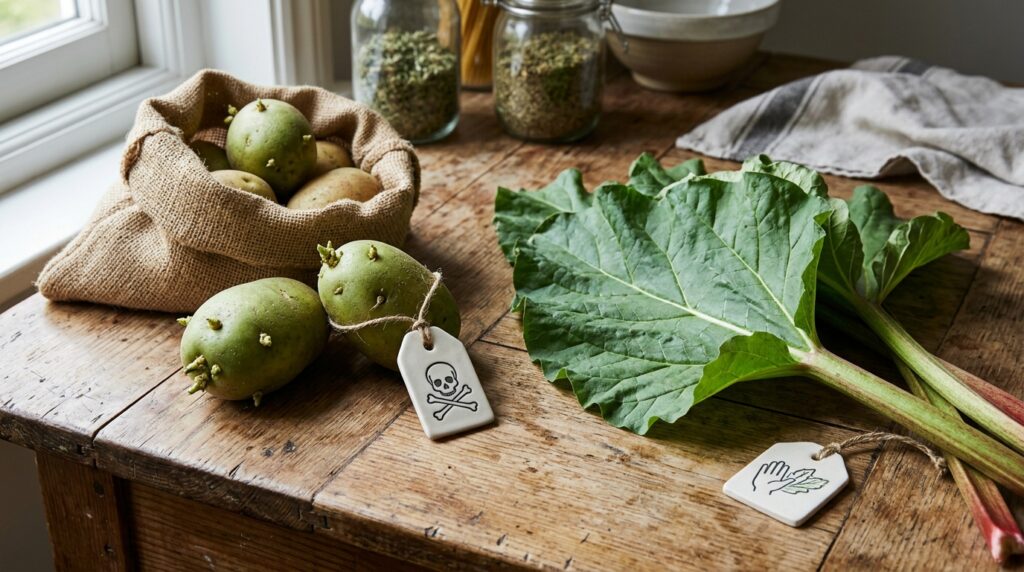
Green potatoes and rhubarb leaves contain substances that are dangerous in large quantities
In other words, a scary-sounding chemical compound name is not a death sentence. Danger appears when we overdo the quantity. And understanding this very rule once greatly helped humanity.
How Thermal Processing Neutralizes Poisons in Plants
At first, people dealt with plants simply: they tried, observed, and remembered. These were years of observation and experiments, often risky ones. But then a real breakthrough happened — it turned out that a dangerous plant could be made edible if prepared correctly.
The most striking example is cassava. It looks like an ordinary root vegetable, but its roots contain cyanide — a powerful poison. It’s no coincidence that cassava often appears on lists of the most dangerous foods in the world. Nevertheless, local communities invented methods to purify cassava of its poison, and today it feeds millions of people around the world. Indigenous peoples of Australia followed a similar path, soaking, grinding, and boiling cycad seeds to remove natural toxins.
This knowledge didn’t remain one person’s secret — it became part of the culture and was passed down from generation to generation. Essentially, the recipe for safe cooking was a means of survival.
And we still use these techniques today. A good example is ordinary red kidney beans. In raw or undercooked form, they contain the natural toxin phytohaemagglutinin, which can cause serious poisoning. But if the beans are soaked and thoroughly boiled, the poison is destroyed, and the dish becomes safe. So grandmother’s advice to “boil beans for a long time” didn’t come out of nowhere.
How Fermentation Helps Neutralize Toxic Plants
There is yet another ancient way to make a plant safe — fermentation. It sounds like a culinary technique, but in reality, it’s subtle chemistry. Fermentation changes the composition of a plant so that harmful substances are reduced or disappear entirely.
Take soybeans. During fermentation, microbes break down compounds like phytates and trypsin inhibitors that interfere with digestion. As a result, soy becomes safer and easier to digest, which is precisely why fermented soy products are so widespread in Asian cuisine. A similar principle works with other pickled and fermented foods: microbes essentially do the purification work for us.
When Science Explained Which Plants Are Safe to Eat
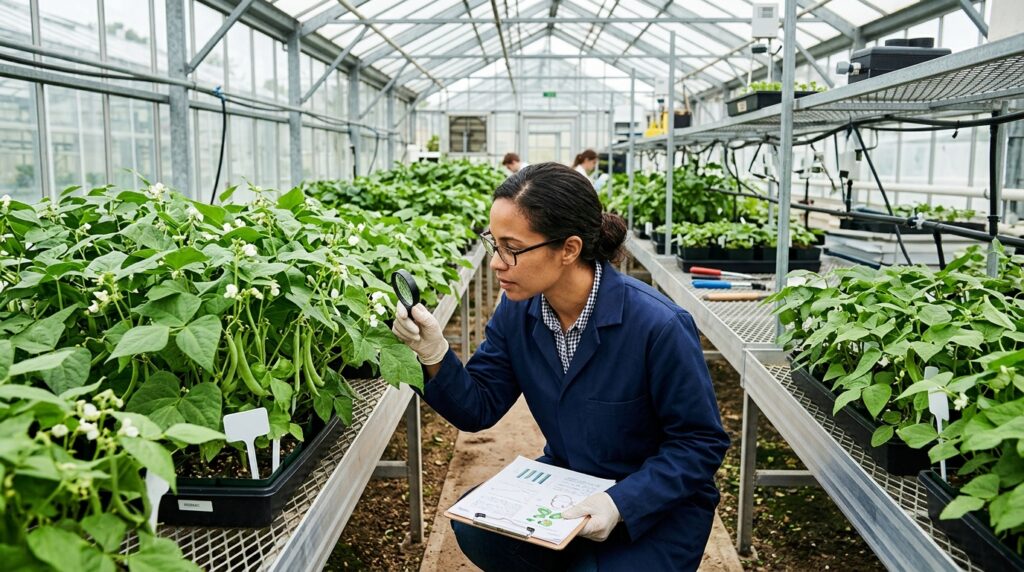
Breeders develop bean varieties with reduced levels of dangerous substances.
In the past, humans could only adapt to plants. Now they’ve learned to change them. Sometimes scientists modify a poisonous plant to make it safe.
A good example is fava beans (broad beans). They contain the substances vicine and convicine, which have no effect on most people. But for those born with a genetic trait — a deficiency of the enzyme G6PD — these compounds can trigger a dangerous reaction called favism, in which red blood cells are rapidly destroyed. The condition is serious and can be life-threatening.
Rather than abandoning this valuable crop, scientists developed new varieties with lower levels of these substances, and farmers are already growing these safer varieties. Chemistry and selective breeding accomplished what nature would have taken thousands of years to achieve.
What You Need to Know About Identifying Edible and Poisonous Plants
The main takeaway is simple and useful in everyday life: food safety depends not only on the plant itself, but also on how we prepare it and how much we eat. For thousands of years, people deciphered the chemistry of plants through trial and error, and today science helps us, but the basic rules remain the same.
In practice, this comes down to a few simple rules:
- green potatoes are best trimmed or discarded, not eaten “as is,”
- rhubarb leaves are not suitable for eating, although the stalks are perfectly edible,
- beans and similar legumes need to be soaked and thoroughly boiled,
- a scary-sounding substance name doesn’t mean instant danger — almost everything comes down to dosage.
This is one of those rare scientific stories that directly concerns anyone who has ever stood at the stove. And now, when you’re peeling potatoes or soaking beans, you know exactly why it all matters.