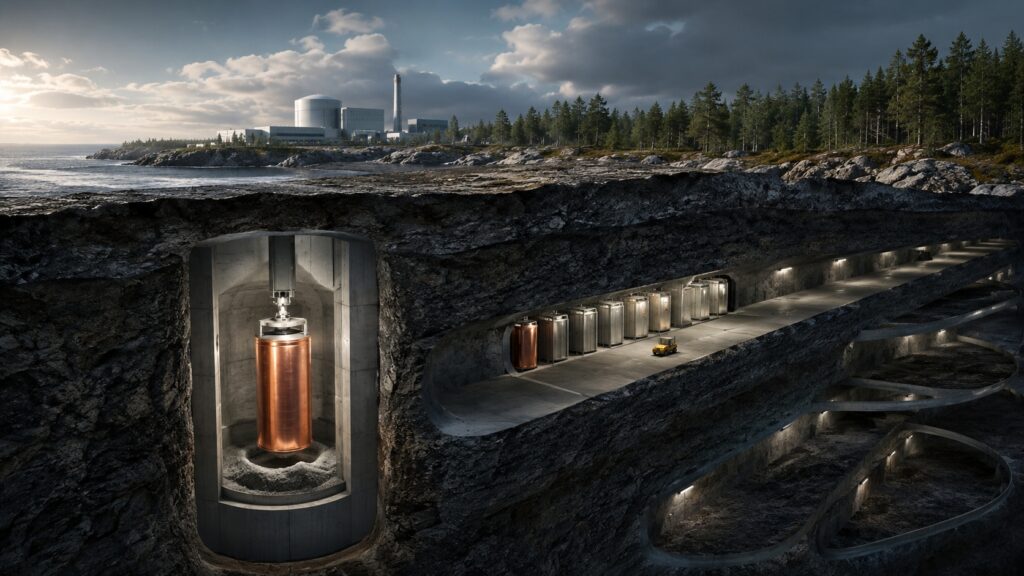
Finland is preparing to open an underground nuclear waste repository designed to operate for 100,000 years
Finland is completing construction of the world’s first permanent underground repository for spent nuclear fuel. The facility called Onkalo, which translates from Finnish as “cave,” is located at a depth of 433 meters and is expected to begin operations in late 2026 or early 2027. This is the first time a country has seriously attempted to solve the problem that humanity has been struggling with since the 1950s: where to put the dangerous waste from nuclear power plants.
Why Nuclear Waste Can’t Simply Be Thrown Away
When uranium fuel burns out in a reactor, it doesn’t turn into harmless ash. Spent fuel elements remain lethally radioactive for tens of thousands of years — longer than the entire written history of humanity.
Currently, almost all such waste in the world sits in temporary storage facilities. Most often these are water pools right on the grounds of nuclear power plants: water cools the fuel and also blocks the radiation. But this is not a solution for millennia, because the pools need to be maintained, cooled, and guarded.
The problem is that temporary storage depends on people, as well as on electricity, pumps, and maintenance. But the waste will still be dangerous long after today’s governments and companies are gone. That’s why scientists have been looking for a way to hide it so that it remains safe on its own, even if everyone forgets about it.
Where Is the Nuclear Waste Repository in Finland Located
The Onkalo repository is being built in the town of Eurajoki in southwestern Finland, next to the Olkiluoto nuclear power plant on the shore of the Baltic Sea. The tunnels are carved into bedrock that is 1.9 billion years old, because this is one of the most stable and geologically quiet sections of the Earth’s crust on the planet.
Over nearly two billion years, nothing catastrophic has happened to this rock — no major shifts, no volcanoes, no fault lines. If the location was stable for that long in the past, there’s a good chance it will remain stable in the future.
The company Posiva began constructing the facility back in 2004. Today the project’s cost is estimated at approximately one billion euros. Inside, there is space for 6,500 tons of uranium, which is enough to accommodate waste from all five Finnish reactors. This was reported by the authors at Science Alert.
How Clay Protects Against Radiation
The external environment will be protected from radiation by several barriers that back each other up. If one fails, the others will continue to hold the line.
- First, the spent fuel is sealed in massive capsules made of copper, which is resistant to corrosion. Copper was chosen because under local conditions it barely degrades over millennia;
- The capsules are lowered into deep holes drilled into the tunnel floors.
- These holes are filled with a special clay that swells when exposed to moisture and tightly seals the capsule, preventing water from getting through;
- When a tunnel approximately 300 meters long is filled, it is closed with a plug made of steel-reinforced concrete.
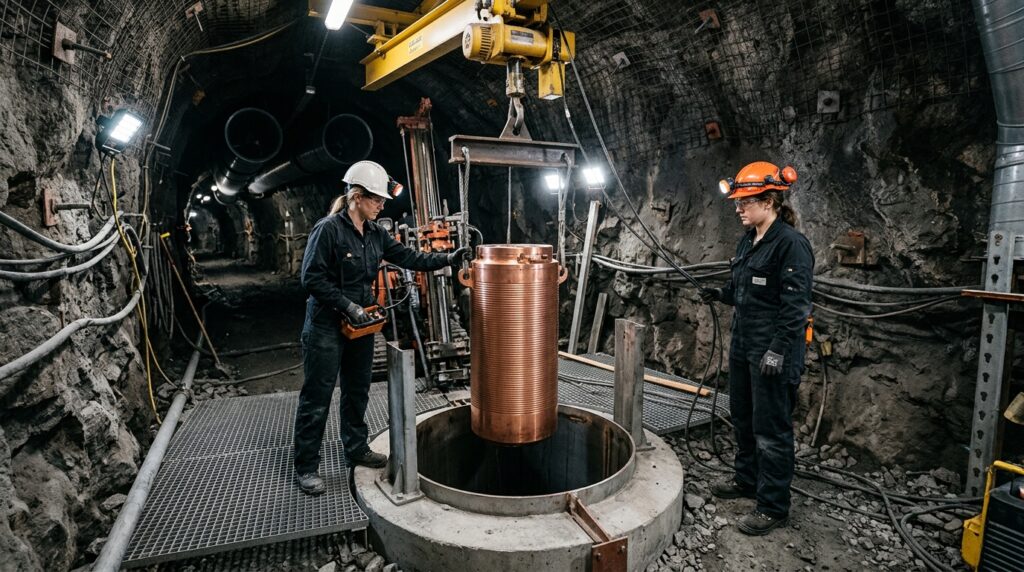
Copper capsules are lowered into holes and sealed with clay
Essentially, water is the main enemy of the repository, because it is what can corrode the metal and carry radioactive particles to the surface. But the clay prevents water from reaching the capsules, and the surrounding rock serves as the last, most reliable barrier.
How Dangerous Is Nuclear Waste
According to the plan, spent nuclear fuel will be buried in Onkalo for about 100 years, and if new reactors are built, the timeline could be extended. After that, the entire tunnel system will be sealed to store the waste for at least 100,000 years.
And this is where it gets most interesting. The radioactivity of the waste decreases over time. Specialists say that after one hundred thousand years, the radiation level will drop to roughly the level of the uranium ore from which the fuel was originally made. In other words, the ultimate goal is to return the dangerous material approximately to the state in which it was taken from the earth.
Nuclear energy experts believe that the first 10,000 years are the most critical. This is the period when the capsules need to remain intact while the radiation is still high.
What Could Go Wrong With the Underground Repository
No engineer promises that absolutely nothing will happen over such timeframes. There are two main long-term threats:
- Corrosion of the copper capsules — slow degradation of the metal under the influence of water and rock chemistry;
- Earthquakes during future ice ages, when enormous masses of ice will press on the Earth’s crust and could shift the rock. A strong tremor could theoretically damage a capsule and release radioactive fuel.
Risk assessments conducted over the years have produced positive results. But critics point out that we’re talking about timeframes that are impossible to verify experimentally.
No one can guarantee the safety of the Onkalo repository for thousands of years into the future, — said Tapani Veistola, a representative of the Finnish Association for Nature Conservation.
Supporters of the project believe that burying waste in stable rock with multiple barriers is more reliable than endlessly keeping it in pools under human supervision. Opponents of the project, however, think that we have no right to leave future generations with a danger whose safety we cannot verify.
Why Finland Decided to Go First
Repositories of this type are being built in other countries as well, such as neighboring Sweden and France. But Finland is leading the way.
An important role in this was played by public attitudes. In France, a similar project met strong resistance, while in Finland it was the opposite. Initially, in the 1970s, there were protests here too, but over time people got used to the idea and began trusting expert assessments. Today, support for nuclear energy in the country is at a historically high level.
There is also a legal reason. Under Finnish law, waste produced in the country must remain in the country. Before the law was changed in 1994, spent fuel was exported, including to Russia. Now Finland is betting on its own nuclear energy and is even considering the construction of compact modular reactors, which means the question of waste disposal will have to be solved at home.
The Onkalo nuclear waste repository is the world’s first attempt to give an honest answer to a question the nuclear industry has been putting off for decades. Whether the plan will work for a hundred thousand years, no one alive today will ever know. But this is precisely the project worth watching, because its experience will become either a model or a cautionary tale for all countries that have accumulated the same dangerous burden.