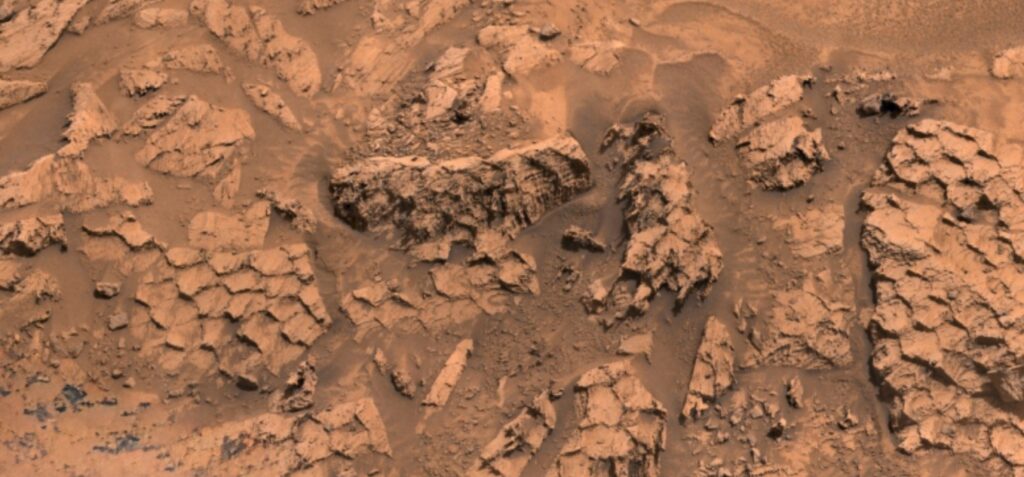
Scaly rocks on Mars. Image source: NASA
The Curiosity rover discovered thousands of rocks with unusual textures near the Antofagasta crater. These are hexagonal patterns covering the surface for several meters, resembling the scales of a giant reptile. Behind this beautiful image may lie the answer to one of Mars’s greatest mysteries: did the planet truly experience seasonal changes with rains and droughts?
Strange Rocks on Mars
On its way to the small Antofagasta crater, the Curiosity rover stumbled upon an amazing texture covering rocks on the surface. The pattern looks like reptile scales, as if a dragon once lay down in Martian mud. Project science lead Abigail Fraeman from NASA’s Jet Propulsion Laboratory described them as “honeycomb polygons” and noted that there are thousands of such shapes.
According to her, similar polygonal rocks have been encountered before, but never in such quantities — the patterns stretch for meters and meters in Mastcam camera mosaics. The images were taken on Sol 4865 — a Martian day corresponding to April 13, 2026, and scientists will need time to understand the nature of these patterns.
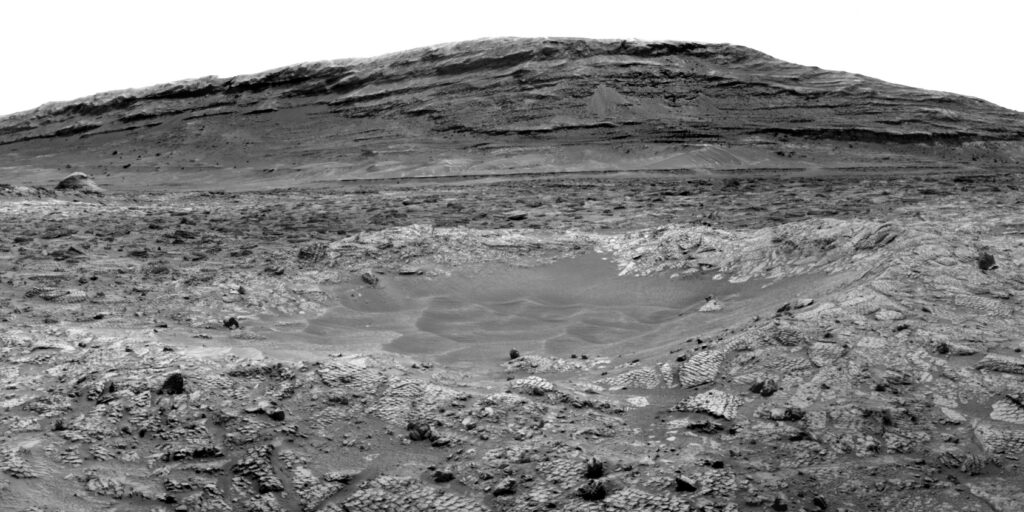
Antofagasta crater on Mars. Image source: NASA
The crater itself is also of interest. Antofagasta is a small crater about 10 meters in diameter, informally named after a region and city in Chile. Craters are interesting because they act as a “natural drilling rig”: their walls and the material ejected upon impact expose material that would otherwise remain buried beneath the surface.
Why Hexagonal Cracks Point to Rains and Droughts
To understand why scientists are so excited about these rocks, it’s worth understanding where such patterns come from in the first place. On Earth, polygonal cracks are a fairly common phenomenon. Imagine a puddle dried out in the sun: the mud contracts, becomes covered with a network of cracks, and a characteristic mosaic pattern remains on the bottom.
The physics of the process is simple: wet soil expands, and when it dries — it contracts and cracks. If this happened only once, the cracks intersect in a T-shape. But if the wetting and drying cycles repeat again and again, the picture changes.
Mud that dried once cracks with T-shaped intersections. With multiple drying cycles, the pattern matures, and the intersections become Y-shaped. These cracks grow, connect with each other, and form a hexagonal pattern.
In other words, the shape of the cracks is a kind of “climate diary.” Hexagons indicate that the territory experienced multiple alternations of wet and dry periods — possibly seasonal.
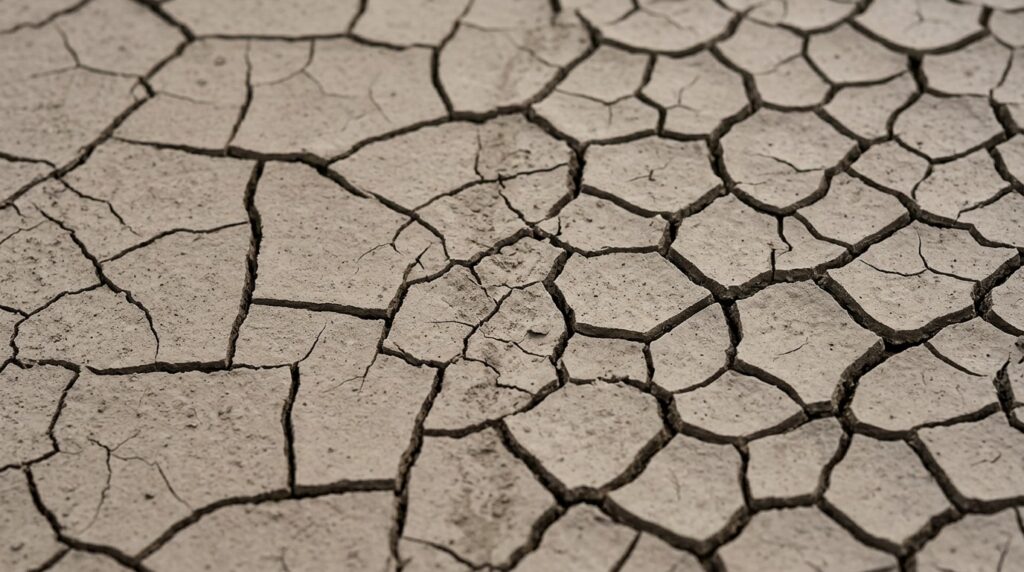
Comparison of different types of surface cracks
First Evidence of Seasons on Ancient Mars
The new find near Antofagasta is not the first such case. Back in 2023, well-preserved, remarkably regular hexagons were discovered at a Martian location called Pontours, which look very similar to the more extensive pattern now found near Antofagasta.
The hexagonal crack pattern at Pontours is the first evidence of wet-dry cycles on early Mars. Lead study author William Rapin called it “the first tangible evidence that the ancient climate of Mars had regular, Earth-like cycles of wetting and drying.”
Why is this so important? Scientists still don’t know exactly how life originated on Earth, but one of the leading hypotheses suggests that it was precisely regular cycles of moisture and dryness on land that helped assemble the complex chemical “building blocks” necessary for microbial life. If ancient Mars had similar conditions, this significantly increases the chances that the planet could once have been habitable.
There’s another nuance as well. Earth’s tectonic plates constantly “recycle” its surface, burying traces of history. Mars has no tectonics, so much more ancient periods of planetary history are preserved in stone.
How the New Find Differs from the Previous One
There are notable differences between Pontours and Antofagasta. The pattern at Antofagasta appears significantly more extensive, and the cracks have raised ridges, which may indicate a somewhat different formation process or a different stage of “fossilization.”
On Mars, such ridges can form when minerals fill ancient cracks and later resist erosion better than the surrounding rock. Imagine something like a relief stamp: the soft rock around it is worn away by wind, while the mineral-filled seams remain raised.
If the texture at Antofagasta is indeed analogous to Pontours, this is yet another confirmation of cyclical wet and dry conditions on ancient Mars — and that would be an exceptionally important find. However, it’s too early to confidently claim that both sites are analogous: the mineral composition of rocks at Antofagasta has not yet been studied. At Pontours, for example, the rocks contained salts indicating deposits from evaporating brines, and whether the same will be found here will only be shown by analysis.
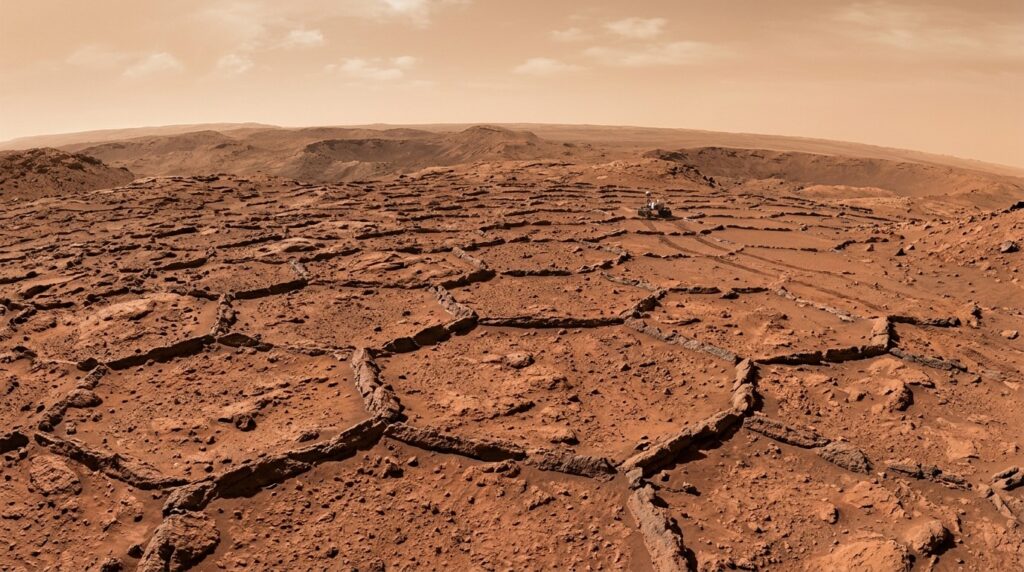
Raised mineral ridges on the Martian surface form a hexagonal grid
What the Rover Will Study Next on Mars
Curiosity collected data at the Antofagasta site before moving on, and now scientists must analyze the information to piece together a complete picture from these mysterious patterns. As Fraeman noted, the team continues to collect images and chemical data to distinguish between hypotheses about exactly how the honeycomb textures formed.
A separate question is the crater itself. From orbit, Antofagasta appears relatively young, possibly less than 50 million years old, which by Martian standards is not much at all. The Curiosity rover has previously found stable organic molecules that survived billions of years, and the crater may conceal even more interesting chemistry in its deeper rocks — but only if it’s deep enough and if a suitable rock for drilling can be found.
More and more data suggests that Mars’s water history was far more complex than one might think looking at its current dusty and dry surface. Each new discovery, from the hexagonal cracks of Pontours to the “dragon scales” of Antofagasta, adds a detail to a mosaic that may one day answer the main question: could Mars once have supported life? This hasn’t been proven yet, but the little rover continues to gather clues, rock by rock, crack by crack.