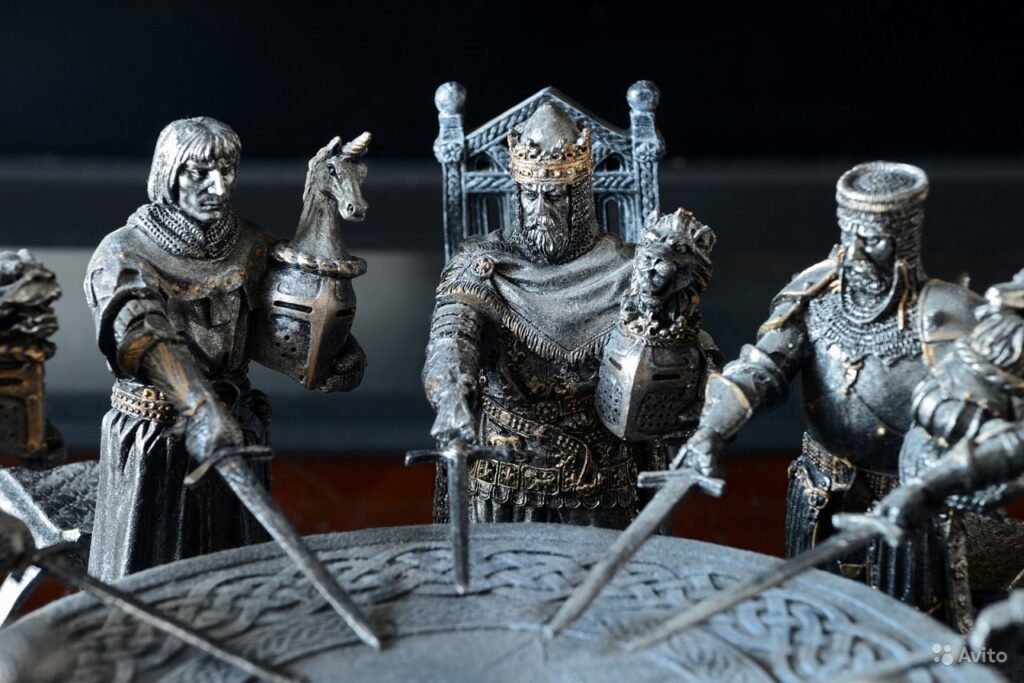
Did King Arthur really exist? Image source: cont.ws
The legend of King Arthur is one of the most enduring stories in world culture. The sword in the stone, the Knights of the Round Table, Camelot Castle — all of these have become symbols of the ideal ruler. But behind the beautiful myth lies an uncomfortable question: did King Arthur really exist, or was he entirely invented by medieval authors?
Where Did the Legend of King Arthur Come From
The earliest mentions of Arthur appear not in chivalric romances but in Latin chronicles. The earliest text that discusses him in detail is “Historia Brittonum” (translated from Latin — “History of the Britons”), written in the 9th century. It lists 12 battles in which Arthur allegedly fought against the Saxons. But this history was composed three centuries after the events it describes — and that is one of the main problems.
Nicholas Higham, professor at the University of Manchester and author of the book “King Arthur: The Making of the Legend” (Yale University Press, 2018), one of the leading specialists on the early Middle Ages in Britain, believes that Arthur was most likely invented by an unknown 9th-century author. In his view, this was an “inventive cleric” who created the image of a brave British commander to describe successful resistance against foreign invaders. Later, the Arthurian cycle began to acquire new details and even intersected with the legend of Stonehenge.
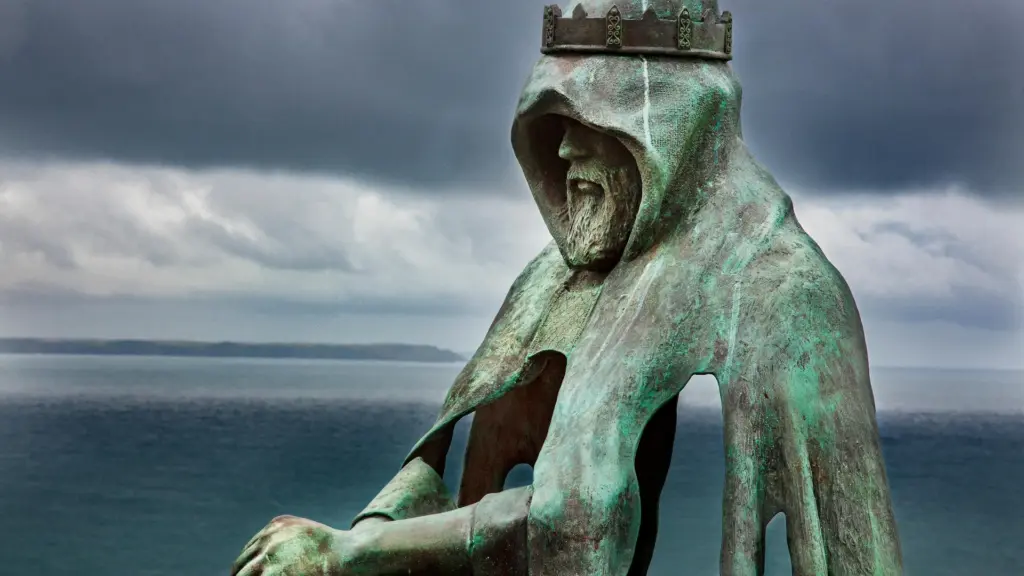
Bronze statue of King Arthur near the ruins of Tintagel Castle — a site associated with King Arthur that thrived in Cornwall, England, from the 5th to 7th century. Image source: livescience.com
Helen Fulton, professor of medieval languages and literature at the University of Bristol, agrees. She points out that Arthur “is not mentioned in any early source” and only appears in texts from the 9th century. At the same time, Fulton notes, Britain at that time had plenty of real kings and military leaders who fought among themselves and against the Saxons after the Roman withdrawal.
Welsh Chronicles About Arthur: What They Say
There is another important source — “Annales Cambriae”, meaning “Chronicles of Cambria” or “Chronicles of Wales.” These are Latin chronicles compiled at the monastery of St. David’s in Wales. In them, Arthur is mentioned twice. One entry concerns the Battle of Badon (around 516 AD), where the Britons were victorious. The other concerns the Battle of Camlann (around 537 AD), where both Arthur and a certain Medraut (Mordred) perished.
The problem is that the earliest surviving copy of the chronicles dates to approximately 1100 AD — more than five centuries after the events described. Many historians believe that the entries about Arthur may have been added significantly later — as late as 970 AD, when the legend was already actively taking shape.
Linguistic Analysis of the Chronicles: Evidence for Arthur’s Reality
However, not all scholars are convinced that Arthur is fiction. Bernard Mees, a specialist in historical linguistics at Monash University in Australia, conducted an analysis of the Latin text of the chronicles and reached an unexpected conclusion. He noticed that the language of the entries about Arthur contains anachronisms — spelling features characteristic specifically of the 6th century, that is, the period after the fall of the Roman Empire in Britain.
Mees published these findings in the book “King Arthur and the Languages of Britain” (Bloomsbury, 2025). In his opinion, the linguistic features of the text indicate that the entries about Arthur were composed in the 6th century, rather than added later. If this is the case, then Arthur is a real historical figure.
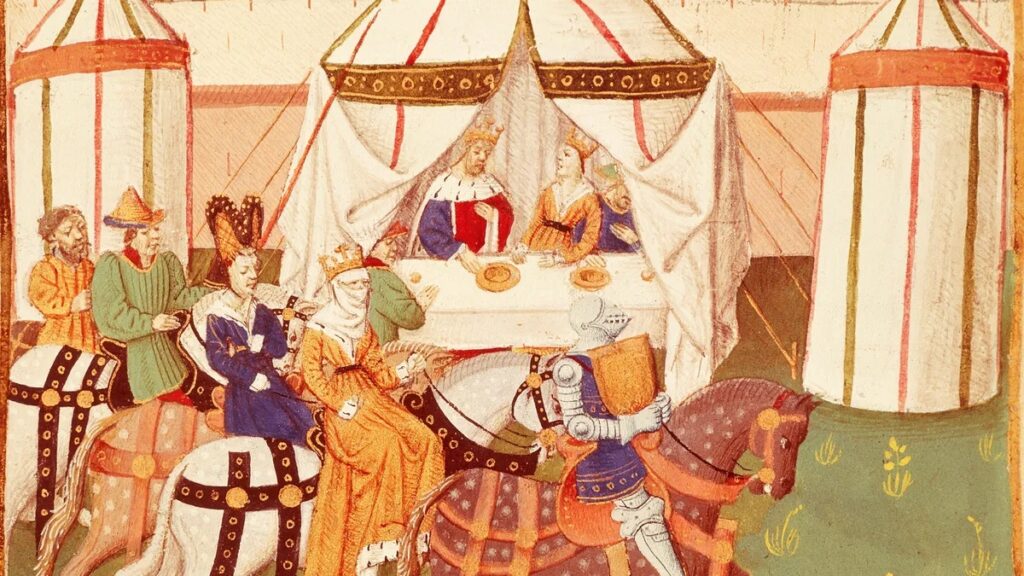
15th-century illustration depicting King Arthur at the feast table in Camelot. Image source: livescience.com
Who then was the real Arthur? Bernard Mees believes he was a king or prince.
“Early sources do not directly call Arthur a king, but it is hard to imagine what else he could have been,” the researcher notes.
The book also suggests that Arthur may have been a speaker of the Cumbric language — one of the Brittonic languages spoken in the area around Hadrian’s Wall.
Evidence for Arthur’s Existence: Facts and Theories
Ken Dark, professor of archaeology at the University of Cambridge, takes a cautious position: “Most likely, a historical Arthur existed, but we cannot say so with certainty.”
Professor Dark draws attention to the second entry in the chronicles — about the Battle of Camlann in 537 AD, where Arthur and Medraut perished.
This entry, according to Dark, may prove reliable for several reasons. First, it mentions a plague in Britain and Ireland. This aligns with known historical data: a powerful epidemic — likely bubonic plague (the so-called Justinianic Plague) — struck the Mediterranean in 541 AD and could well have reached Britain by the same decade. Second, the entry is short and laconic, without any legendary elements — unlike later stories of knights and wizards.
There is also another interesting argument. Dark notes that between the mid-6th and mid-7th centuries, there was an unusually large number of members of royal families in Britain and Ireland named Arthur. This may mean that the name was given in honor of some famous person. The famous Arthur who served as a model may have been a real military commander — although even this cannot be considered proof.

Ruins of Tintagel Castle in Cornwall — one of the places that legends associate with King Arthur
Who Was King Arthur in Reality
Even scholars who accept Arthur’s existence agree on one thing: the real person would have had almost nothing in common with the legendary hero. Ken Dark emphasizes that Lancelot, Guinevere, and the Knights of the Round Table are characters added by authors much later. The medieval romances we associate with Arthur today are products of the 12th–15th centuries, created in an entirely different cultural context.
“No one claims that any historical figure of the 5th, 6th, or even 7th century resembled the legendary Arthur,” says Professor Ken Dark, author of the book “Tyrants and Traders: Tintagel, Arthur and the Lost Kings” (Bloomsbury, 2026).
The real Arthur, if he existed, lived in the 6th century — a century and a half after the Roman legions left Britain. It was a time of chaos: the Britons fought among themselves and against the advancing Saxons, written sources were scarce, and even Latin was changing rapidly. A military leader of that era was not a knight in shining armor but rather a chieftain commanding a small mounted warband on the frontier of a crumbling civilization.
The debate over Arthur’s existence has continued for centuries and is unlikely to end anytime soon. Skeptics rightly point out that no source written during the supposed Arthur’s lifetime has survived. Supporters of his reality note, no less fairly, that almost nothing from 6th-century Britain has survived in written form — and the absence of direct evidence is not evidence of absence.