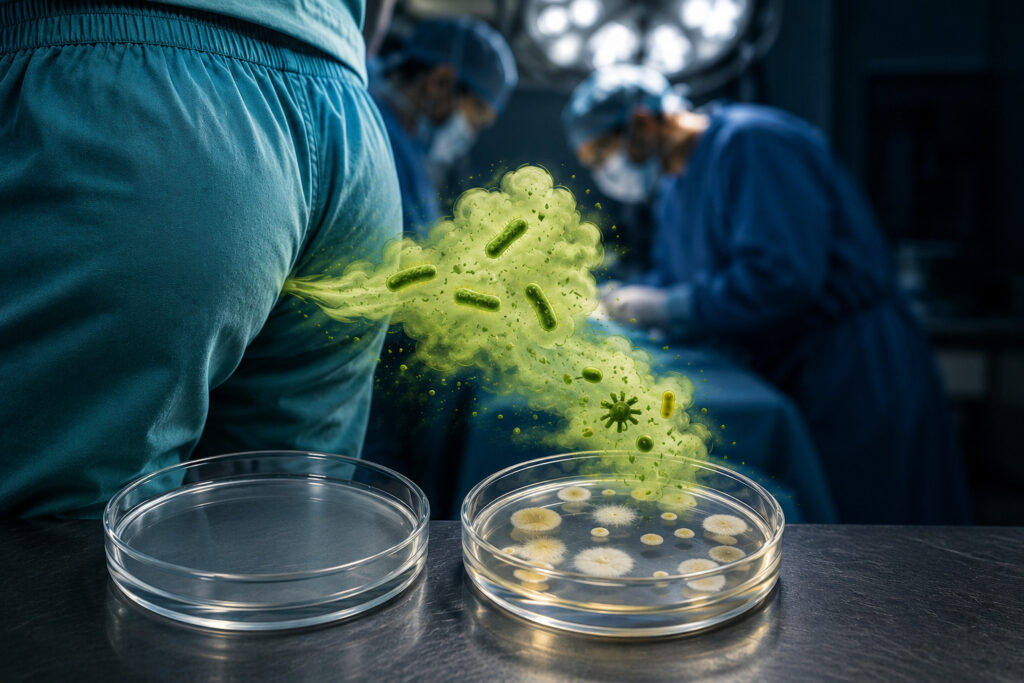
Can farts spread bacteria? Scientists conducted an experiment.
It may sound like a childish joke, but the question is absolutely serious: can an ordinary fart spread bacteria around a room? One day, medical professionals took this question seriously and decided not to guess but to test it experimentally. The experiment turned out to be as amusing as it was instructive.
Why Scientists Decided to Test Farts for Bacteria
It all started with a question that most people would be too embarrassed to ask out loud. During surgery, everything around the patient is sterile: masks, gowns, gloves, caps. Any microbe near an open wound is a potential threat. And then a nurse asked whether a fart could contaminate the operating room.
In 2001, Australian science communicator Karl Kruszelnicki and microbiologist Luke Tennent took on the question. The honesty of a scientist lies in being able to admit: “I realized I didn’t know the answer. And I decided to find out.”
What the Experiment with Petri Dishes and Gut Bacteria Showed
The experiment was tiny and nothing like a serious clinical study. A volunteer was asked to fart directly onto two Petri dishes from a distance of about five centimeters. Once while wearing clothes, and once with pants down.
The result was unexpectedly revealing. On the dish that received the “blast” without pants, two bacterial colonies grew — common inhabitants of the gut and skin. But on the second dish, where pants stood between it and the volunteer, nothing grew. The fabric acted as a filter and caught everything that could have traveled through.
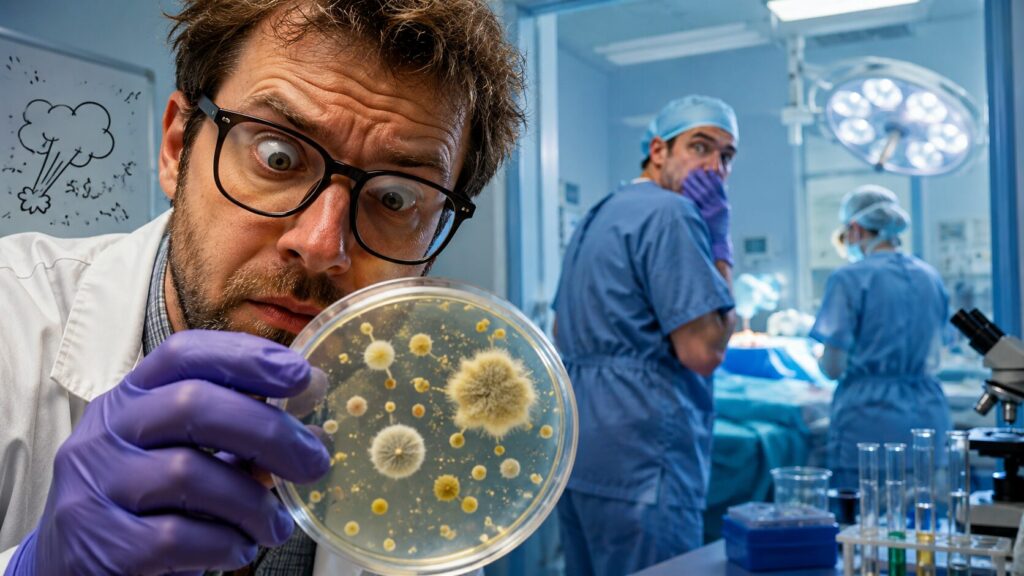
It’s not as silly as it might seem. During surgery, everything must be sterile.
The scientists summed up the results with humor: the bacteria turned out to be completely harmless, similar to those “friendly” microbes found in yogurt. And the main practical advice was: don’t fart naked near food. Hard to argue with that.
Why One Experiment Isn’t Enough to Draw Conclusions
This was a one-off humorous test, not a rigorous study. No conclusions about the real danger of farts in the operating room can be drawn from it — neither for nor against. It was published, by the way, in the Christmas issue of the medical journal BMJ, which traditionally features fun but honest scientific curiosities.
And yet, behind the joke hides an interesting thought. We have a strange blind spot: absolutely everyone farts, but almost no one talks about it out loud. The taboo is firmly embedded in culture, but biology doesn’t go away just because of our sense of propriety.
What Intestinal Gas Is Actually Made Of
The main thing to remember: a fart is mostly gas, not a cloud of bacteria. More than 99% of intestinal gas consists of nitrogen, carbon dioxide, hydrogen, methane, and a small amount of oxygen. All of them are odorless.
The smell comes from tiny impurities — less than one percent. These are mostly sulfur compounds formed when gut microbes break down food. In other words, smell and bacterial count are different things, and a strong aroma doesn’t necessarily mean a “bacterial attack.”
This doesn’t mean there are absolutely no bacteria in a fart. A later study from 2020 suggested that gas passing through clothing might still carry gut bacteria, and flushing a toilet can launch microdroplets with bacteria into the air. But this is only a cautious hypothesis, not a proven fact of infection transmission.
Why Farts Are Still Barely Studied
Strangely enough, human gas remains a vastly understudied topic, even though it’s an important part of our metabolism. The reason is simple: the subject is awkward, measuring it is difficult, and a funding application for such research would hardly be met with enthusiasm by a committee. But in recent years, the situation has been gradually changing.
Scientists at the University of Maryland created a wearable device nicknamed “smart underwear” that detects hydrogen in intestinal gas. The idea is to monitor the activity of gut microbes in everyday life rather than in artificial clinical settings. Hydrogen is produced by gut bacteria during fermentation, and farts contain significantly more of it than exhaled air.
Moreover, a project called the “Human Gas Atlas” has been launched: scientists want to collect data from many people and compare it with their diet and microbiome composition. The logic is simple: to understand which gases are abnormal, you first need to figure out what normal looks like.
Are Farts Dangerous to Others: What Science Says
In short: in real life, farts are not perfectly sterile, but the main danger comes not from the gas itself. The risk of contamination, if it exists at all, is more likely related to particles and bacteria picked up from the skin and around the anus. That’s exactly why clothing is so important — fabric really does work as a filter. And equally important is basic hygiene and washing your hands after using the toilet.
So there’s definitely no need to fear an ordinary fart from a person wearing pants. But studying this topic more seriously is indeed necessary, because behind the awkward joke lies a window into the workings of our gut, and it could tell us a lot about our health.