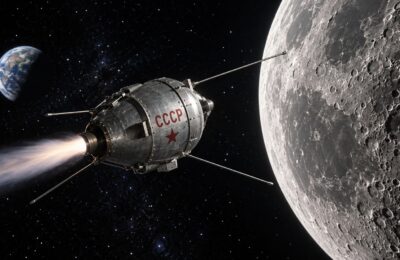
Can aliens visit Earth?
In May 2026, the Pentagon published more than 200 previously classified photos and videos of unidentified flying objects. The UFO topic is no longer the domain of conspiracy theorists — it is now discussed in Congress and in scientific journals. But one question still remains unanswered: can aliens actually physically reach Earth?
How Long Would It Take to Fly to the Nearest Star System: Distances That Are Hard to Even Imagine
There are no signs of intelligent life in our Solar System. This means hypothetical visitors would have to travel from another star system. The nearest star to us — Proxima Centauri — is 4.25 light-years away, or roughly 40 trillion kilometers.
To get a sense of how long it would take to fly there, imagine: if Earth were shrunk to the size of a pea, the distance to Proxima Centauri would be roughly like traveling from Kaliningrad to Petropavlovsk-Kamchatsky and back. And that’s the nearest star! The nearest intelligent civilization, if it exists, is almost certainly much farther away.
How Fast Can an Interstellar Ship Travel: Only 10% of the Speed of Light
The longer a flight lasts, the higher the chance that something will go wrong: a system fails, it collides with space debris, something critical breaks down. That’s why you need to fly as fast as possible.
The speed of light is the absolute ceiling — about 300,000 km/s. But long before that mark, engineering limitations kick in: fuel shortages, the risk of structural destruction. Most studies agree that a realistic cruising speed is about 30,000 km/s, or 10% of the speed of light.
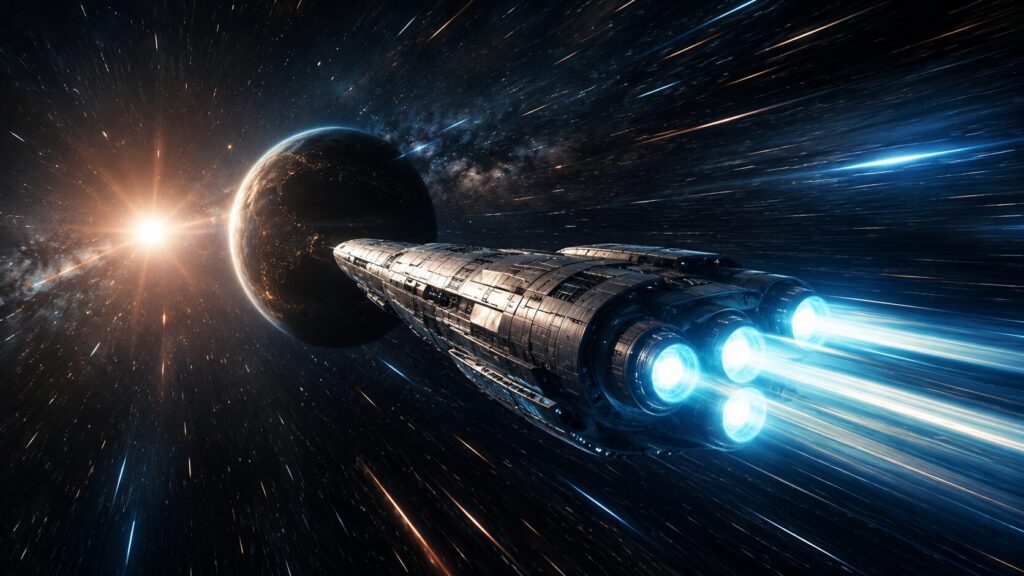
Given the scale of interstellar distances, any alien journey to Earth would inevitably stretch over many years, and possibly several centuries.
That sounds impressive until you do the math: at that speed, an interstellar journey of 10 light-years would take about 100 years. And in galactic terms, that’s literally the next door over.
The Fuel Problem and Engines Suitable for Interstellar Travel
In open space, there is no air, and therefore no resistance — a ship can simply coast by inertia with its engines off. But before arrival, it needs to decelerate, and that also requires fuel. It creates a vicious circle: the more fuel you carry, the heavier the ship, and the heavier the ship — the more fuel you need to accelerate it.
The engine options look like this:
- Chemical rockets — the very ones used for all our missions. The problem is that accelerating to 10% of the speed of light would require more fuel than the entire mass of the observable Universe. Seriously.
- Antimatter — theoretically the ideal fuel: when it contacts ordinary matter, 100% of its mass converts into energy. But in the entire history of physics, we have produced less than 20 billionths of a gram of antimatter, and it cost hundreds of millions of dollars.
- Thermonuclear fusion — the same process that powers the Sun. It produces 10 million times more energy per kilogram than chemical fuel. But even with such an engine, a ship would need a fuel supply 150 times its own mass.
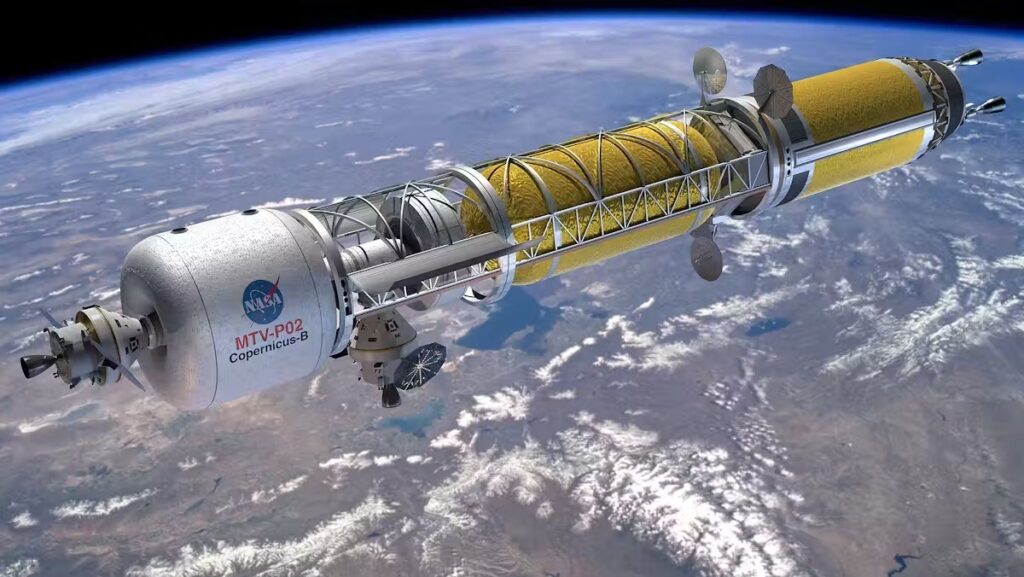
NASA is working on creating a nuclear propulsion system. Here is what a rocket with a nuclear power plant might look like.
There is also the laser sail idea: a powerful laser from the home planet pushes the ship by reflecting off a thin sail. No onboard fuel is needed, but there is nothing to decelerate with either. Moreover, the energy and infrastructure required for such a laser are beyond comprehension.
Why Cosmic Dust Is Dangerous for Interstellar Ships
Let’s say the fuel problem has been solved. But at a speed of 30,000 km/s, even a tiny speck of dust becomes a projectile. Interstellar space is not completely empty — it contains sparse hydrogen atoms and microscopic particles of cosmic dust. At such speeds, dust particles slam into the ship’s hull with the force of a .22 caliber bullet.
And the stream of hydrogen atoms creates a cascade of radiation capable of destroying even the strongest materials. To withstand such bombardment, you would need a true flying fortress with the most powerful magnetic shielding. But the heavier the shielding, the more fuel is needed. And we are back in the vicious circle again.
And this is just one of hundreds of engineering problems. The ship must be simultaneously lightweight and ultra-strong, compact and spacious, efficient and powerful. Each new requirement narrows the number of possible solutions (like filters when choosing a car on a classifieds website). With each new condition, there are fewer options, and at some point there may be none left at all.
Is an Alien Visit to Earth Possible?
No single law of physics prohibits interstellar travel. But the combination of hundreds of extreme and often contradictory engineering requirements may make it practically unfeasible. Even if a civilization exists somewhere with technologies beyond our wildest dreams, those technologies would also face their own engineering barriers — the laws of physics are the same for everyone.
Beyond engineering, planetary-scale resources are also needed, the collective will of an entire civilization, sufficient proximity to Earth, and — importantly — a reason to fly here. There are so many factors that the coincidence of all of them at once seems extremely unlikely.
But if someday someone’s ship does land on our planet, the main question will not be “where are you from?” or even “why are you here?” The most important question will be — “how did you even get here?” Because the answer to that question will overturn our understanding of physics and engineering once and for all.