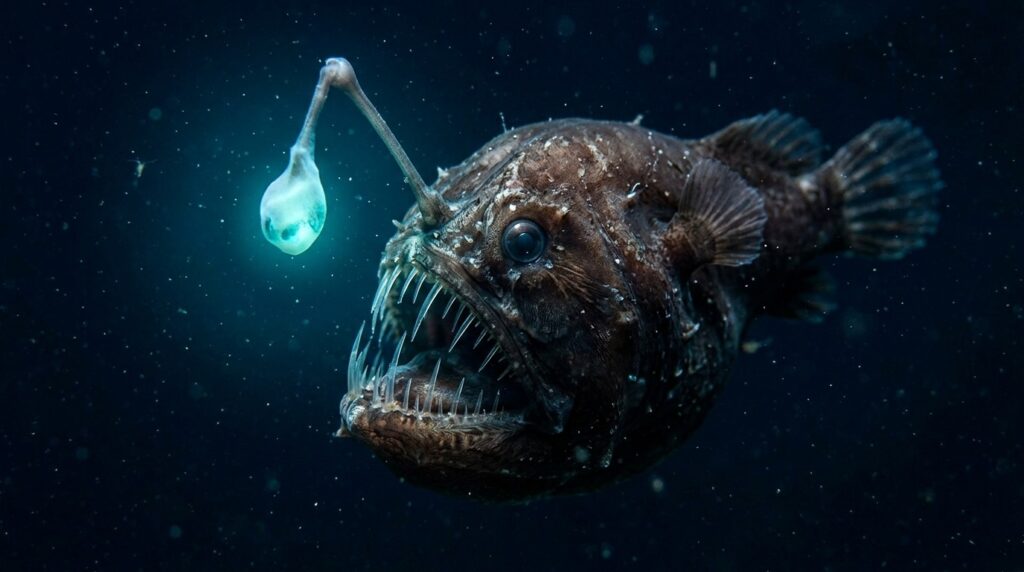
The anglerfish is also known as the monkfish
The anglerfish is a deep-sea fish that seems like it was invented for a science fiction novel. It possesses its own glowing lure that flickers in the pitch darkness at depths of over a kilometer. Moreover, the males of this genus literally fuse with the females’ bodies, and the immune system is forced to “break down” to make this possible. There are about two hundred species of anglerfish that most people have never heard of, and each one is more astonishing than the last.
The Anglerfish’s “Rod” Is Actually a Fin
What looks like an antenna with a light bulb on the head is actually a modified ray of the dorsal fin. Through evolution, it transformed into a long stalk with a lure at the end. In deep-sea species, this lure glows and works as a trap: small fish and other deep-sea inhabitants swim toward the light and end up right at the predator’s mouth. This is one of the strangest hunting strategies in nature.
Notably, only females have the “fishing rod” — male deep-sea anglerfish look completely different and are unable to hunt this way. Each species differs in the shape and length of the lure: some have a simple one, while others have a complex, branching structure.
Interestingly, the anglerfish’s dark skin absorbs light, functioning as camouflage. In the pitch darkness of the deep, the fish is practically invisible — only the flickering point of the lure is noticeable.
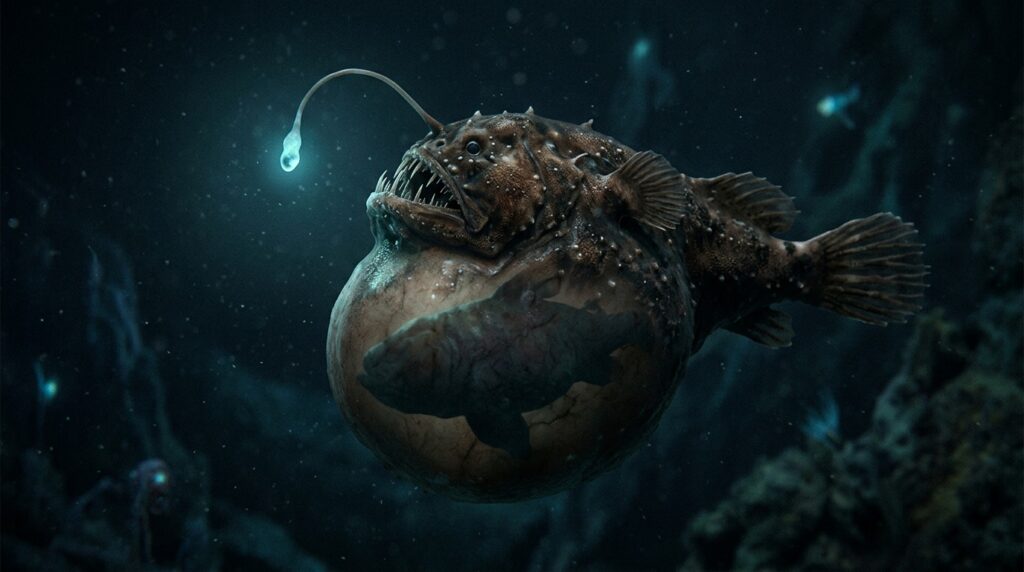
The anglerfish’s lure
The Anglerfish Doesn’t Glow on Its Own
The anglerfish doesn’t produce light by itself. Inside its lure live special bacteria that are capable of producing light. The fish provides them with “housing” and nutrients, and in return receives a constant source of luminescence. This is a classic example of symbiosis — a mutually beneficial coexistence of two completely different organisms.
But here’s what truly puzzles scientists: how exactly young anglerfish “colonize” the lure with bacteria. Research has shown that larvae and young fish do not carry luminescent bacteria — the lure forms later, and colonization occurs in adulthood. Most likely, the fish pick up the necessary microorganisms directly from the water, because the bacteria have been found in seawater samples at the depths where anglerfish live.
At the same time, the genome of these bacteria is roughly half “trimmed” compared to their free-living relatives. They have lost many genes necessary for independent life but have retained the ability to move through water. Scientists suggest that the bacteria may exit the lure back into the water, providing the next generation of fish with access to luminescent microbes.
The Male Anglerfish Fuses with the Female Forever
This is perhaps one of the most unusual methods of reproduction among all vertebrates. A tiny male, sometimes tens of times smaller than the female, finds her in the darkness by scent and bites into her side. Gradually, his tissues fuse with the female’s body, their circulatory systems merge, and the male transforms into something like a permanent appendage.
From that point on, he receives nutrition directly from the female’s blood and essentially exists as a supplier of reproductive cells. He can no longer live independently. Sometimes several attached males have been found on a single female.
This type of reproduction is called sexual parasitism, and it is not found in all anglerfish species. In some species, males attach temporarily; in others, permanently; and some get by without fusing at all.
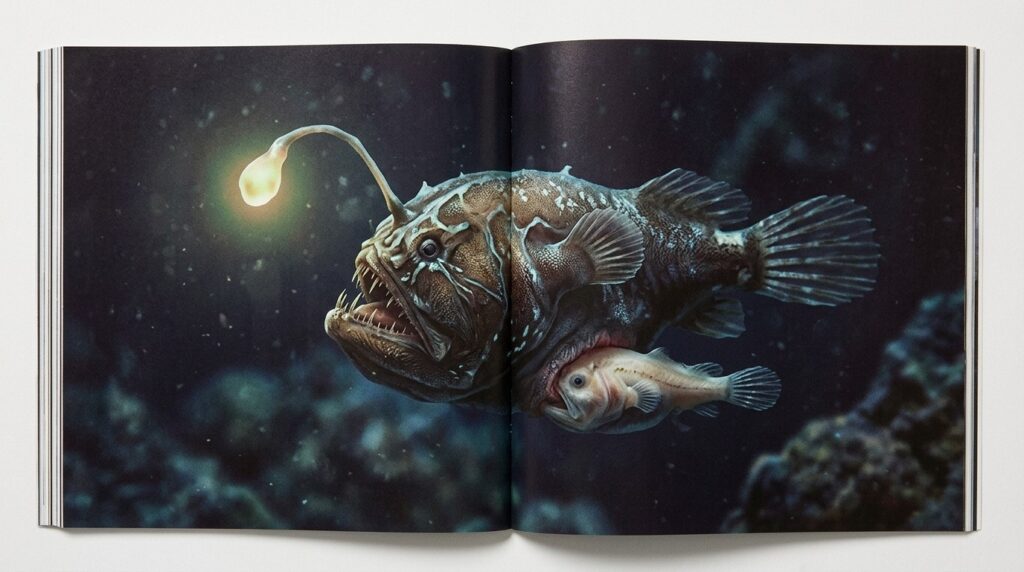
A tiny male anglerfish fused with the body of a large female
The Anglerfish Can Shut Down Its Immune System
When two organisms fuse together, a serious problem arises. The female’s immune system should perceive the male’s tissues as foreign and reject them. This is exactly what happens with organ transplants in humans if there isn’t a suitable tissue “match.”
But in anglerfish, evolution found a radical solution. Research showed that in species with permanent male fusion, massive changes occurred in the immune system’s functioning. In the most “extreme” species — those where multiple males can fuse to a single female — the genes responsible for producing antibodies and killer cell function were found to be lost (these are key elements of the so-called adaptive immunity that protects us from viruses and foreign tissues).
According to scientists, if they diagnosed a human with this condition, it would mean “severe combined immunodeficiency” with a fatal prognosis. But anglerfish live with it and feel perfectly fine. Researchers believe the fish compensate for the loss of adaptive immunity with enhanced innate immunity — a more ancient and simpler type of defense. This discovery showed that the vertebrate immune system is far more flexible than previously thought.
The Anglerfish Can Swallow Prey Larger Than Itself
At great depths, food is scarce. An encounter with suitable prey may happen once every few weeks or even months. That’s why anglerfish have developed the ability to not let anything slip away, even if the “meal” looks too large.
Their bones are thin and flexible, and their stomach can stretch to incredible sizes. This allows them to swallow fish that are roughly twice their own length. Their teeth curve inward, so the victim cannot slip back out — only deeper into the mouth.
And some bottom-dwelling anglerfish species actually move along the seafloor using modified fins as legs. Their pectoral and pelvic fins function almost like limbs, allowing them to literally “walk” along the ocean floor.
There Are More Than 200 Species of Anglerfish
When we say “anglerfish,” we usually picture a black, toothy fish with a glowing light on its head. But that’s just one of many variations. In reality, the order Lophiiformes includes more than 200 species, and they are incredibly diverse.
Among them are bottom-dwelling forms — sea toads and batfish that crawl along the seabed. There are frogfish that camouflage themselves as rocks and sponges in shallow waters. The familiar “monster from the deep” is only the deep-sea branch, comprising about 170 species from 12 families.
Some anglerfish live at shallow depths, while others inhabit zones deeper than three kilometers. Sizes range from a few millimeters (parasitic males) to two meters (the European monkfish, whose meat is considered a delicacy). In other words, the “classic anglerfish” from cartoons and documentaries is more of a media image than a complete portrait of an entire group.
Everything we know about anglerfish reminds us how little the ocean depths have been studied. A fish that “switched off” part of its immune system for the sake of reproduction. Bacteria that scientists still don’t fully understand how they reach their host. Hundreds of species with completely different survival strategies. Each new fact about anglerfish doesn’t so much close questions as open new ones — and that’s exactly what makes them some of the most fascinating fish on the planet.