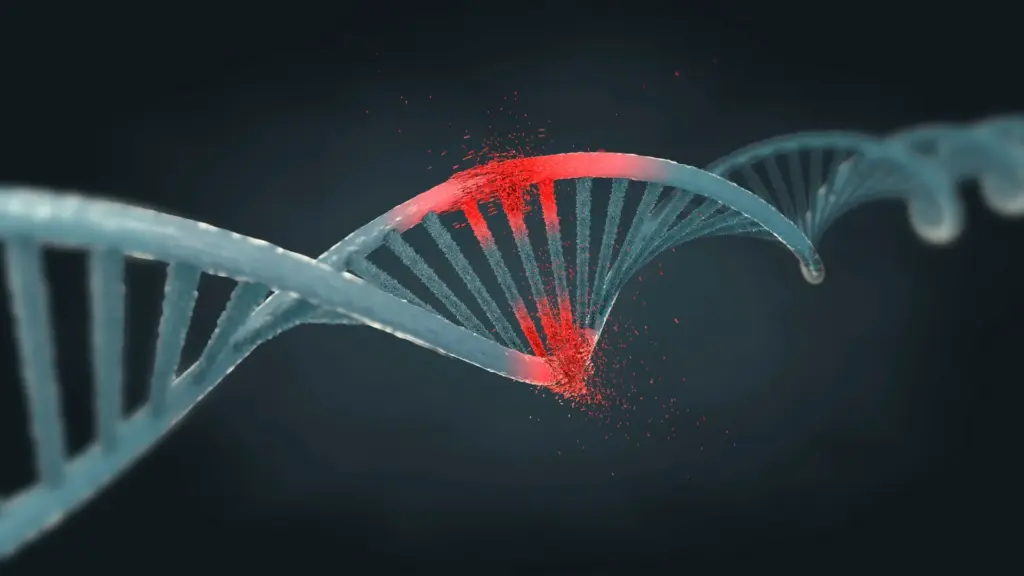
Changes in a specific DNA region of female mice altered their development so that they formed male sex organs.
Inserting just one nucleotide into a regulatory region of DNA led to a complete sex reversal in mice: genetic females with XX chromosomes developed as males — with testes and male genitalia. The study, published in Nature Communications on April 9, 2026, showed that triggering male development doesn’t necessarily require changing the genes themselves — the tiniest change in a DNA region that controls those genes is enough. The result is so striking that it forces a reassessment of many ideas about the genetics of sex.
How Sex Is Determined in Mammals: The Role of SRY and SOX9 Genes
The sex of mammals is determined at the embryonic stage, and two genes play a key role in this process — SRY and SOX9. The SRY gene is located on the Y chromosome: it produces a protein that “switches on” the second gene — SOX9. Activation of SOX9 triggers a chain reaction that leads to the formation of testes and male germ cells. If SOX9 remains switched off, ovaries develop and the embryo follows the female pathway.
But SOX9 has something like a remote control — a region of non-coding DNA called Enh13 (from the word enhancer). This fragment, only 557 base pairs long, is located hundreds of thousands of base pairs away from the SOX9 gene itself, but it is precisely what determines whether the gene is active. The SRY protein “sits” on this switch and sets SOX9 to work.
Importantly, Enh13 is not a gene — it does not encode any proteins. It belongs to the so-called non-coding “junk” DNA, which makes up about 98% of the genome. For a long time it was called “junk,” but it is now becoming clear that it plays a huge role in regulating gene activity.
How a Single DNA Mutation Changes a Mouse’s Sex
A team led by Dr. Nitzan Gonen from Bar-Ilan University (Israel) used CRISPR technology to edit Enh13 in mouse embryos. Using molecular “scissors,” the scientists introduced a minimal mutation — inserting a single letter (nucleotide) into this regulatory region.
The result was astonishing. Mice with XX chromosomes — that is, genetic females — developed as males: they formed testes and male external genitalia. As Nitzan Gonen noted: “One DNA letter out of approximately 2.8 billion — and that was enough to completely change the developmental pathway.”
In addition to inserting one nucleotide, the team conducted a parallel experiment deleting three letters in the same Enh13 region. Both mutations led to testis development in XX mice, although the single-nucleotide insertion produced a more pronounced effect.
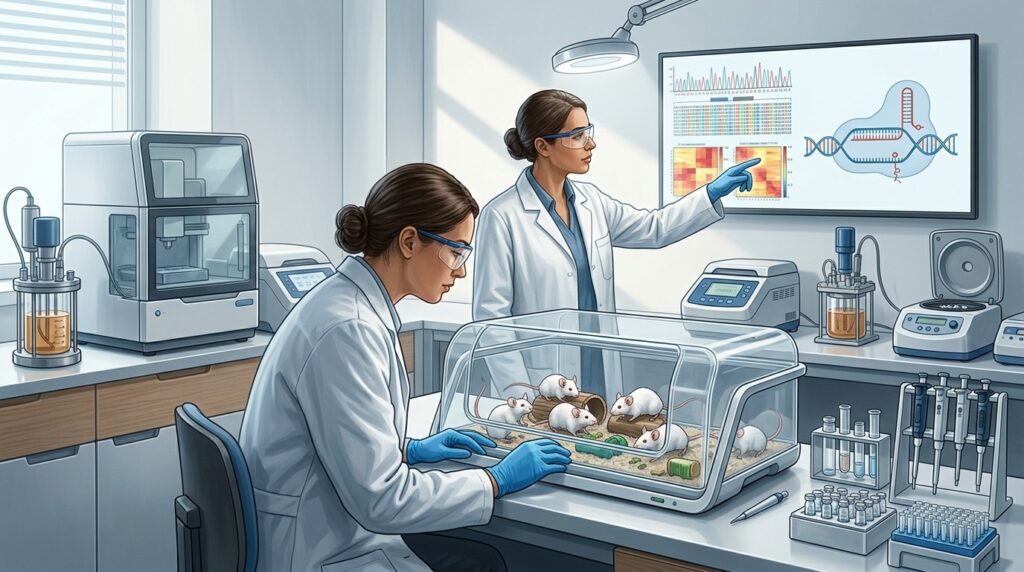
Laboratory mice are the primary model for studying sex genetics in mammals
For the sex switch to occur, the mutation had to affect both copies of Enh13 — since each cell has two copies of chromosome 17, where this region is located. If the mutation was present in only one copy, the females developed normally, with ovaries and no male characteristics.
What Is Enh13 and How Does It Affect Sex Determination
Previous work by the same group had already shown that Enh13 is critically important for male development. In 2018, the scientists discovered that complete deletion of Enh13 leads to the opposite effect: mice with XY chromosomes (genetic males) developed as females. Without this switch, SOX9 activity dropped by approximately 80%, and ovaries formed instead of testes.
The new study revealed the other side of Enh13 — its role in suppressing the male pathway in females. It turned out that under normal conditions, repressor proteins (such as RUNX1, NR5A1, and GATA4) “sit” on Enh13 and block SOX9 in female embryos. When a mutation disrupts the function of these repressors, SOX9 is activated even without the SRY protein — the very one that normally triggers male development.
The scientists describe Enh13 as a kind of “battleground of the sexes”: on this DNA region, proteins promoting male development compete with proteins supporting female development. The outcome of this molecular struggle determines whether the embryo becomes male or female. And a mutation just one letter long can decisively shift the balance.
Another important nuance: SOX9 is capable of maintaining and amplifying its own activity through a feedback loop. Therefore, even a minimal “leak” of activation — when repressors stop working — triggers a self-sustaining amplification loop for the gene. The study authors note that even a small initial impulse is sufficient to launch the full chain of male development.
How Mouse DNA Mutations Relate to Human Genetics
Humans and mice are far from twins, but genetically we are much closer than one might think. By various estimates, the human and mouse genomes match by approximately 85%, and if only protein-coding genes are compared, the similarity reaches 80–99% depending on the counting method. This is why mice remain the primary model in genetics and medicine.
The Enh13 region studied in this research has a direct analog in the human genome. Earlier work showed that deletion of this region in humans also leads to sex reversal in XY individuals, and its duplication is associated with the development of male characteristics in XX individuals.
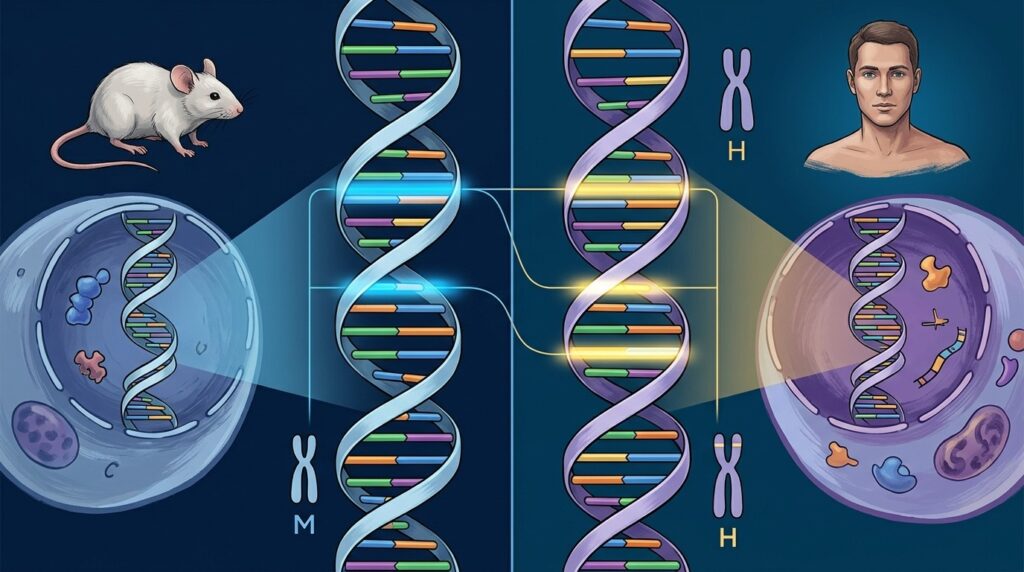
Comparison of mouse and human genomes shows high similarity of key regulatory regions
This makes the study results potentially important for understanding disorders of sex development (DSD) in humans. These conditions occur in approximately 1 in 4,500–5,500 newborns and manifest as a mismatch between the chromosomal set and anatomical sex characteristics. More than half of DSD cases still do not receive a genetic diagnosis — largely because standard genetic tests analyze only protein-coding genes, which make up just 1.5% of all DNA.
However, for now this involves only a mouse model. The mechanisms of Enh13 activation may partially differ between humans and mice, and additional research is needed for clinical conclusions.
Non-Coding DNA: How It Controls Gene Activity
One of the main implications of this work is yet another proof that “junk DNA” is not junk. 98% of our genome does not encode proteins, but it contains thousands of regulatory elements — enhancers, silencers, promoters — that control when, where, and how intensely genes work.
Elisheva Abberbolk, a doctor at Bar-Ilan University and lead author of the paper, emphasized: it is not enough to look only at genes. Disease-causing mutations can be hidden in the non-coding genome — in DNA regions that control gene activity rather than encode proteins.
Gonen’s team believes that Enh13 is just the beginning. According to them, hundreds of similar regulatory elements likely exist in the genome, mutations in which could explain not only unresolved DSD cases but also other genetic diseases whose causes remain unknown.
This work doesn’t simply supplement the textbook on sex genetics — it shifts the focus of attention from genes to their regulators. If a single letter in a DNA region that doesn’t even produce a protein can completely change an organism’s development, then to truly understand the genome, it’s not enough to read only its “instructions.” We need to understand who switches those instructions on and off — and how.