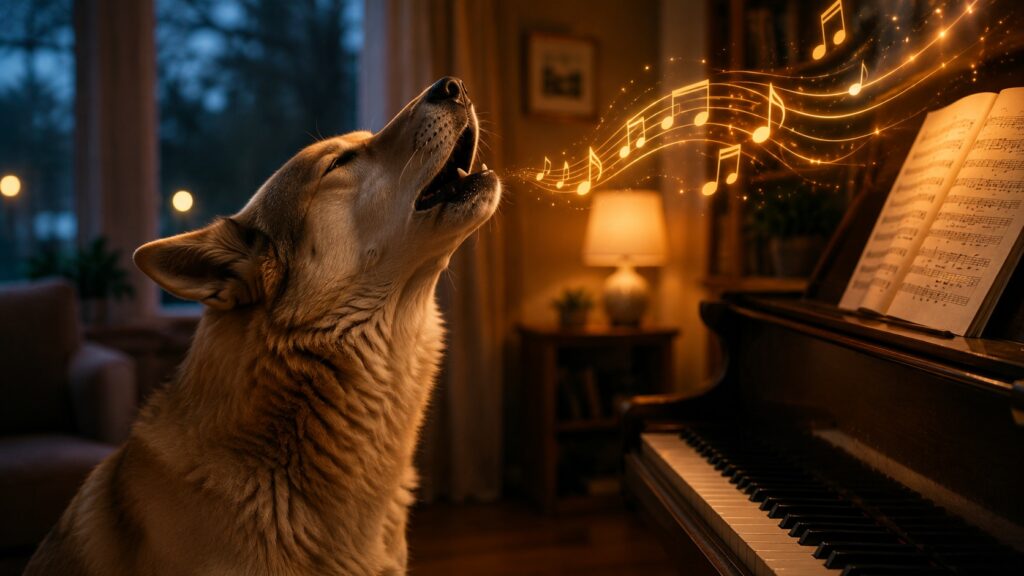
Dogs can hit notes, but singing can mean both contentment and irritation
You’re singing at home, playing your favorite song, and suddenly your dog starts howling along in their own way? We often think our pets are howling in tune with our singing. Scientists say that dogs are indeed capable of adjusting the pitch of their howl to match a sound, but not all of them do it. It’s believed that behind this amazing phenomenon of dogs howling to music lies an instinct inherited from wolves.
What Does a Dog’s Howling to Music Mean
Dogs howl for a wide variety of reasons, and music is just one of them. Howling can be a way to attract attention, and if the owner reacts to it, the behavior becomes reinforced. Sometimes a dog howls out of irritation at a specific sound, such as a loud siren, and sometimes it expresses anxiety when left alone for a long time.
Essentially, a dog’s howling, barking, and whining are a language through which the dog communicates with humans and strengthens its bond with them. When a dog howls in response to music, it’s as if it’s telling its owner that it wants to join in the fun or wants the noise to stop. This is how Zachary Silver, a psychology professor and head of the Canine Cognition Lab, explains it on Kinship.com.
Do Dogs Really Hit the Right Notes
Yes, dogs can do this, and the ability to adjust the pitch of their howl suggests that the dog is truly engaged in what’s happening. That is, it’s no longer just “I hear a sound and respond” — it’s more deliberate behavior.
Dogs inherited this ability from wolves, for whom howling is a crucial communication tool. Wolves howl to stay in contact over long distances, maintain pack cohesion, and mark territory against rival packs. And they can also adjust their pitch. Wolves sometimes adjust the pitch of their howl to make their group seem larger, or conversely, change it to stand out as an individual.
How Howling Is Connected to Dogs’ Wolf Ancestors
The main difference is that in the wild, wolves don’t typically encounter music, while modern domestic dogs hear it regularly. And here an interesting pattern emerges.
Howling is more common in ancient breeds — hounds and huskies — which are genetically closer to wolves than later-bred “Victorian” breeds like terriers or retrievers. Therefore, the tendency of such dogs to howl to music, according to scientists, looks like an ancient instinct manifesting itself in a modern setting, next to a speaker or piano.
How Scientists Studied Dog Howling
Since 2020, researchers at Harvard’s Hecht Lab have been conducting a special study of howling as part of the Canine Brains Project. They are testing whether dogs can change the pitch of their howl depending on the sound they’re accustomed to responding to.
The design was as follows:
- owners of dogs that already howl were asked to fill out questionnaires about the breed, situations in which the dog howls, and what exactly triggers the howling — a siren or a song;
- participants were then sent the same recording but shifted up or down in pitch;
- owners were asked to film whether the dog would try to adjust its howl to match the higher or lower version of the sound.
By this point, data from 700 questionnaires had already helped determine which dogs howl most often and hit the notes, what drives them to do it, and how domestication has changed this behavior.
Which Dog Breeds Howl to Music Most Often
The main finding of the study is that not all dogs can hit the notes. Signs of such pitch-matching were found, but far from all animals exhibit it.
Ancient dog breeds howl more often:
- hounds;
- huskies;
- Shiba Inus;
- Salukis.
Breeds that are evolutionarily farther from wolves do this noticeably less often. This suggests that howling has changed significantly due to domestication and selective breeding. Modern breeds howl less but bark more — meaning they invest in short-distance communication rather than long-distance.
Interestingly, survey results showed that most often dogs howled not because of music but because of separation from their owner. And those that did respond to sound were often selective. Some howled only to live music but not to recordings. For example, one dog howled along to the piano only when its owner was playing — which hints at social motivation, a desire to be close and participate.

Dogs often howl because they miss their owner
How to Tell If Your Dog Enjoys Music or Is Irritated
From howling alone, it’s hard to say for sure whether the dog is delighted or, on the contrary, asking you to turn off the sound. Howling can signify both engagement and displeasure, so you need to look at the overall behavior rather than just the fact of howling.
If the dog comes closer, looks relaxed, sings along with you, and clearly wants contact — most likely it enjoys the process and the interaction. If the dog is tense, pins its ears back, tries to leave, or howls specifically at sharp sounds like sirens, it’s closer to irritation or anxiety.
A separate case is when a dog howls because it has been left alone for a long time. This is no longer about music but about separation anxiety — and here you should pay attention to the pet’s overall condition and, if necessary, consult a veterinarian or dog trainer. Constant howling without an obvious reason is a reason to look more closely.
What to Do If Your Dog Howls to Music
If the howling is specifically related to music and the dog looks happy while doing it, there’s no need to fight it, because it’s normal and in some sense touching behavior. Singing together with your dog strengthens the bond between owner and pet.
If, however, the dog’s howling is bothersome, you can act gently and without punishment:
- Observe which specific sounds the dog reacts to — a particular song, high notes, or a siren;
- If necessary, lower the volume or remove the irritating sound;
- Don’t reinforce the howling with an excited reaction if you want it to decrease;
- Distinguish musical howling from separation howling, because the latter is handled differently — through training the dog to stay alone.
It turns out that howling along to music is an ancient wolf communication tool that has survived into the era of speakers and pianos. Scientists have already confirmed that some dogs do indeed adjust the pitch of their howl, but much remains to be clarified: how precisely they do it and why some pets “sing” while others stay silent. In the meantime, if your dog starts singing along to the piano, you can simply play along with them.