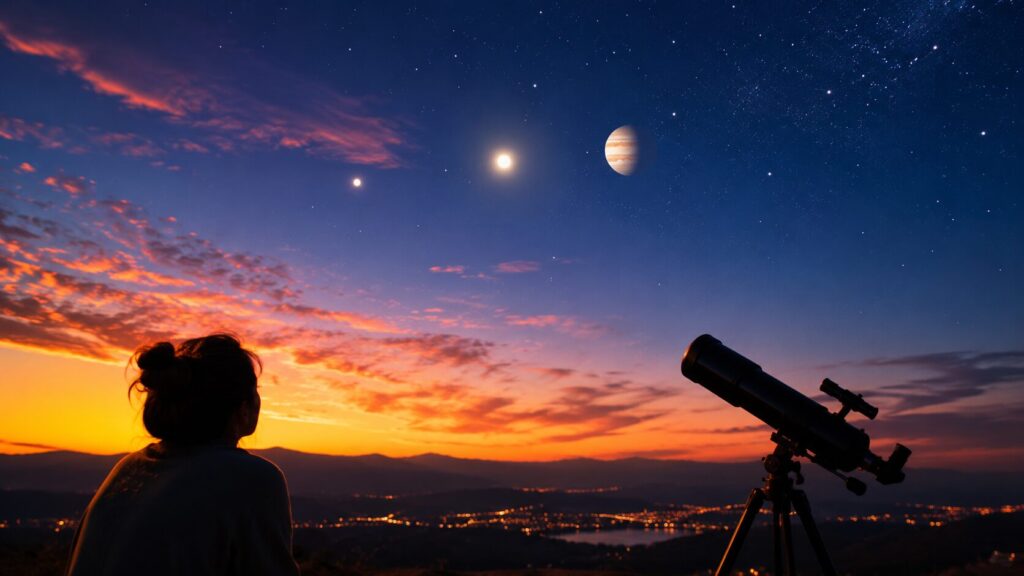
Planetary Parade: where and when to watch Mercury, Venus, and Jupiter.
On June 12, 2026, right after sunset, look to the west: Mercury, Venus, and Jupiter will gather there. This isn’t a grand parade of six planets, but a compact mini-parade of three — and that’s exactly why it’s convenient to observe. All three planets are visible without a telescope or binoculars; you just need to catch the right moment and find an open horizon. Here’s how and when to catch this beautiful moment.
Which Planets Will Be Visible on June 12, 2026
In mid-June, three planets will gather in a small sector of the evening sky. An important point: in space, they don’t actually line up perfectly. It’s all about perspective. The planets orbit the Sun in roughly the same plane, so from Earth they almost always appear along one line — called the ecliptic (the apparent path of the Sun, Moon, and planets across the sky).
This is why planetary alignments often look like a tilted line or arc. In June 2026, three planets will gather in one small area of the sky, so you won’t need to search the entire sky — and that’s what makes this parade convenient even for beginners.
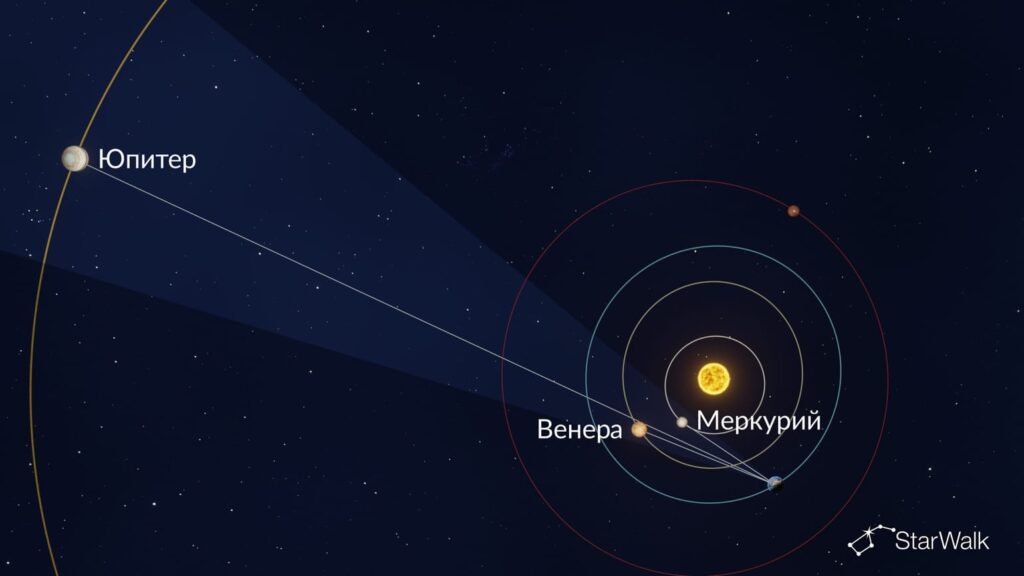
How the alignment of Mercury, Venus, and Jupiter will look on June 12, 2026 (top-down view of the Solar System plane). Image source: starwalk.space
What Time to Watch the Planetary Parade in June 2026
The best window opens approximately 30 minutes to one hour after sunset. By then, the sky is dark enough, but the planets haven’t yet sunk too low toward the horizon. The exact time depends on your city, latitude, and how open your western horizon is.
Simple observation plan:
- 30 minutes after sunset, Venus and Jupiter may already be visible, but Mercury is still lost in the twilight glow.
- About one hour after sunset is the best balance — the sky is darker, and all three planets are easiest to spot.
- Later in the evening, Mercury drops to the horizon and disappears first.
For convenience — several Russian cities and their observation windows on June 12:
- In Makhachkala, sunset is at 19:29; best viewing from 20:04 to 20:41.
- In Sochi, sunset is at 20:02; best time from 20:38 to 21:14.
- In Krasnodar, sunset is at 20:11; window from 20:48 to 21:22.
- In Rostov-on-Don, sunset is at 20:17; observe from 20:57 to 21:26.
- In Volgograd, sunset is at 20:04; best time from 20:47 to 21:12.
- In Astrakhan, sunset is at 20:40; watch from 21:19 to 21:50.
- In Khabarovsk, sunset is at 21:01; window from 21:43 to 22:09.
- In Vladivostok, sunset is at 20:52; viewing time from 21:27 to 22:04.
- In Samara, sunset is at 21:06; convenient time from 21:58 to 22:08.
- In Kaliningrad, sunset is at 21:15; best viewing from 22:11 to 22:14.
- In Ufa, sunset is at 21:53; watch from 22:49 to 22:52.
The farther north the city, the shorter the window: at high latitudes, June twilight lasts a long time, and Mercury barely manages to appear above the horizon.
Where to Look for Mercury, Venus, and Jupiter After Sunset
Look low above the horizon in the west-northwest direction — toward where the Sun just set. The planets will be gathered close together, so you won’t need to search for long. The key is finding a spot with a flat, open horizon: a field, shoreline, hilltop, or a balcony with a western view will work.
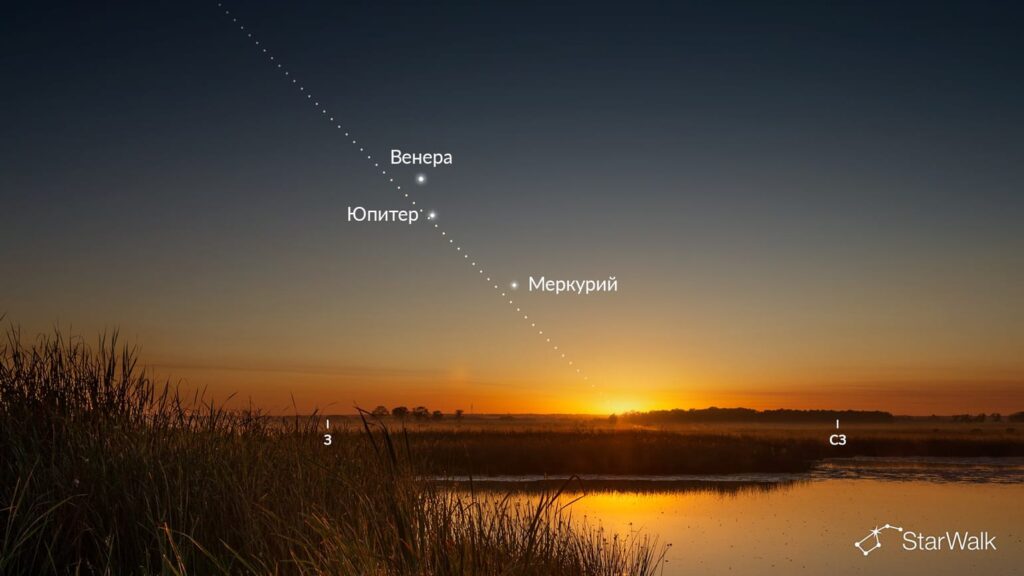
Mercury, Venus, and Jupiter line up low above the horizon after sunset (view from the Northern Hemisphere). Image source: starwalk.space
The order for finding the planets is simple:
- First, find Venus — it’s the brightest object in the west after sunset and impossible to confuse with anything else.
- Near Venus, locate Jupiter: it’s bright, though not as dazzling.
- Lower, closer to the horizon, look for Mercury — it’s the hardest to spot because of the twilight.
The three planets will form a tilted line, and the tilt angle differs slightly depending on the hemisphere. If trees or buildings block your western horizon, Mercury will be the first one you lose sight of, but the beautiful pair of Venus and Jupiter will still be there.
Can You See the Planetary Parade Without a Telescope
Each of the three planets behaves differently. Venus (apparent magnitude -4.0) is the brightest landmark. It shines brighter than any star and is visible even before the sky fully darkens. To the naked eye, it’s simply a very bright white dot, but through a telescope you can make out a small disk or phase.
Jupiter (apparent magnitude -1.8) is also easily visible without optics — it’s dimmer than Venus but much brighter than most stars. If you point binoculars at it after sunset, you can spot its four largest moons as tiny dots in a row next to the planet.
Mercury (apparent magnitude 0.3) is more finicky, so you’ll need to hurry for its sake. It orbits close to the Sun and almost never strays far from the sunset glow, so it stays low above the horizon and sets quickly. You don’t need a telescope for it — you need an open horizon and a basic understanding of how to find planets in the sky. On June 15, Mercury reaches greatest elongation (its maximum apparent distance from the Sun — 24°31′), making it one of the best chances of the year to catch it.
Best Dates for Observing the Planetary Parade in June 2026
Good news: a planetary parade is not a one-evening event. The view changes from night to night, so it’s worth going outside several times from early to mid-June.
- Early June: Venus and Jupiter draw closer in the western sky — a good warm-up before the parade.
- June 8–9: Venus and Jupiter come especially close, only about 1°40′ apart, and both fit in the field of view of binoculars.
- June 12: The main alignment of three planets — the best day to see everything at once.
- June 15: Mercury is at maximum distance from the Sun — an excellent chance to catch it.
- June 16–17: A thin crescent Moon joins the planets.
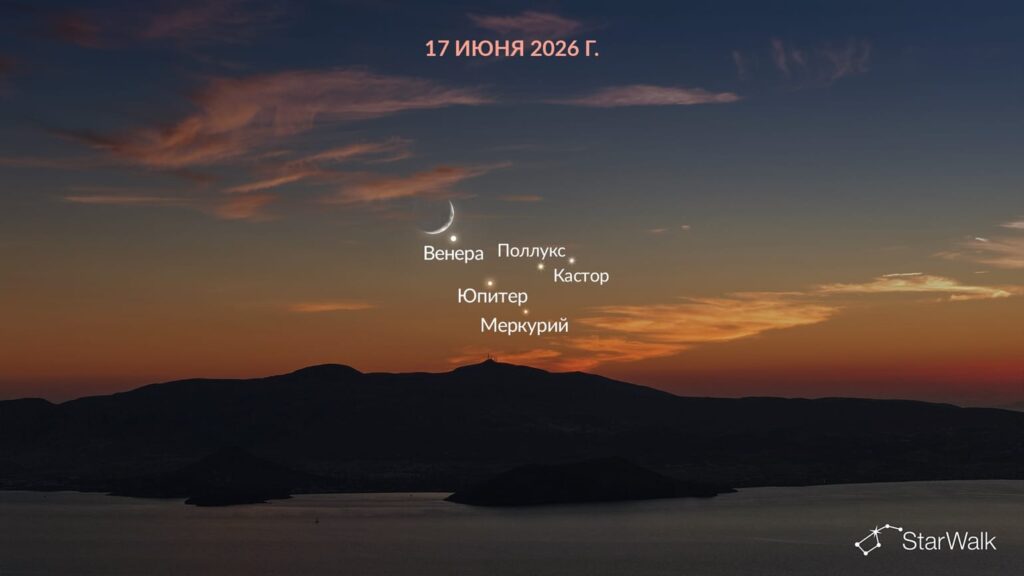
On June 16–17, a thin crescent Moon and two bright stars will join the planets. Image source: starwalk.space
June 16 and 17 may turn out to be the best dates for photos: a thin crescent Moon makes the scene with the planets noticeably more beautiful, and the bright stars Pollux and Castor from the constellation Gemini will be nearby. You can even capture it all with a phone: turn on night mode, keep the camera steady (preferably on a tripod), and focus on Venus.
If June 12 turns out to be cloudy — no worries: try on neighboring clear evenings. The next notable parade will occur around August 12, 2026, but that will be a morning event with six planets, some of which will already require binoculars. So the June mini-parade is the most beginner-friendly one.