Multiplayer online role-playing games are taken for granted today: vast maps, thousands of players in a single world, voice chat, raid dungeons, and economies that live by their own rules. But the genre we know today took decades to form, and its roots go back to an era when computers didn’t yet have full-fledged graphics, and a player’s imagination did far more than any video card.
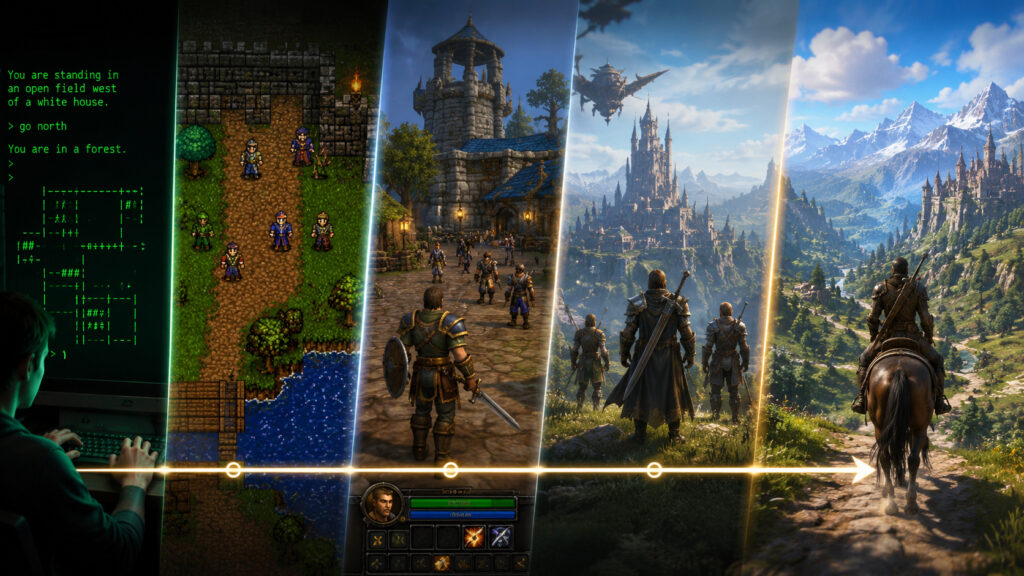
How online RPGs evolved
Text Worlds: The MUD Era
The first online role-playing worlds were entirely text-based. They were called MUDs — Multi-User Dungeons. The player didn’t see an image but rather a description of a room, its exits, and nearby creatures. Commands were entered as words: “go north,” “take sword,” “attack orc.” The server processed these commands and returned new text — and that’s how an entire world was built.
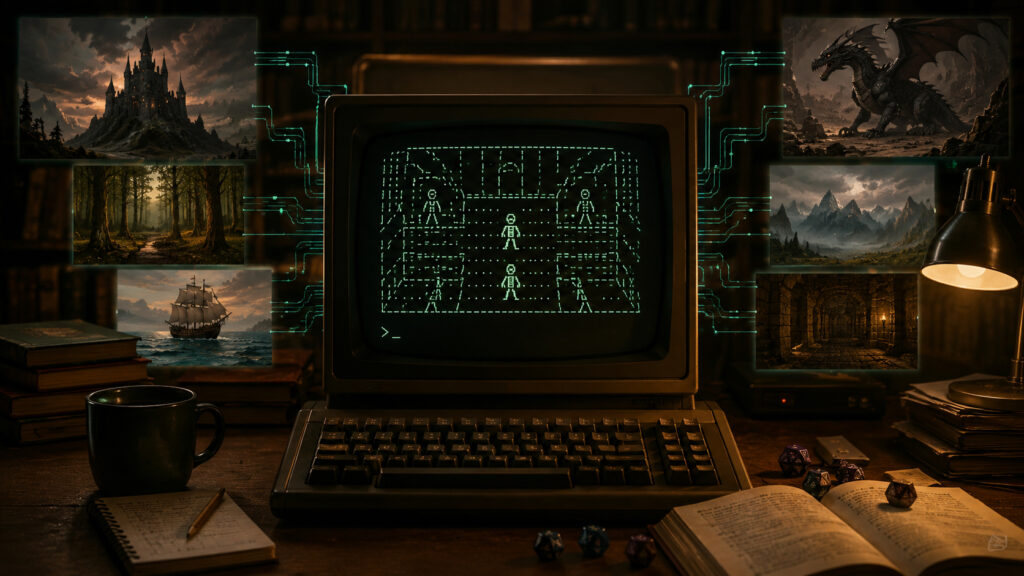
Games once looked like this
Despite their austere appearance, MUDs established nearly all the core mechanics of the genre. It was there that character levels, experience points, classes, inventory, stats like strength and dexterity, and the idea of cooperatively clearing dungeons as a group first appeared. Text worlds were surprisingly social: people formed guilds, engaged in roleplay, debated tactics, and became attached to their characters no less than players of modern titles. Many design principles that later migrated to graphical games were refined during this very era.
The First Graphical MMORPGs
With the development of home computers and the spread of the internet, developers began adding graphics to text worlds. At first, these were simple two-dimensional images and schematic maps, but the mere fact that a player could see their character and surroundings fundamentally changed the experience. Gradually, the format we now call MMORPG — massively multiplayer online role-playing game — took shape.
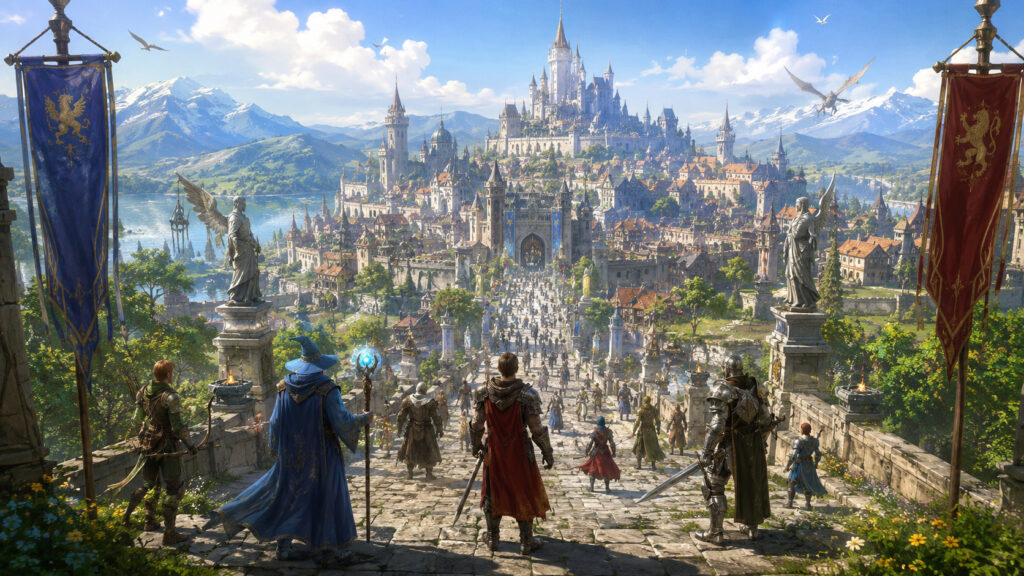
With the development of graphics, games began to look completely different
Early graphical projects preserved the MUD legacy: the same system of levels, classes, character progression, and group content. But fundamentally new things also appeared — visual combat, animations, the ability to literally see crowds of other players in a city. Servers designed for hundreds and thousands of simultaneous connections became a technological challenge in themselves. Developers had to solve problems of synchronization, anti-cheat protection, and load balancing that single-player game creators never even thought about.
An important feature of this period was the birth of a fully-fledged in-game economy. Items obtained in dungeons could be sold to other players, and rare items acquired real value within the community. This gave rise to trading, auctions, and speculation — behavioral models that were later studied even by economists.
The 2000s Boom: The Golden Age of the Genre
The true golden age of MMORPGs came in the 2000s. Three-dimensional graphics became the norm, high-speed internet became widespread, and millions of people around the world simultaneously immersed themselves in virtual worlds. It was then that the mechanics still considered genre classics took shape: raids involving dozens of players, castle sieges, PvP battles over territory, professions and crafting, and complex stat and equipment systems.
The community played a huge role. Clans and guilds became true collectives with their own hierarchies, diplomacy, and reputations. Cooperatively clearing difficult content required coordination, and friendships forged in-game often extended beyond it. For many, it was the social component, rather than the gameplay itself, that became the main reason to keep returning to the world again and again.

Everything about MMORPGs here
At the same time, two major design philosophies emerged. Some projects bet on hardcore: slow progression, serious penalties upon character death, a high cost of failure, and strong interdependence between players. Others pursued accessibility, simplifying entry and reducing “penalties” to attract a wider audience. This debate over what a “proper” online world should be has not subsided to this day. Thematic reference resources help players navigate the terminology, classes, and mechanics of different game generations — for example, MMORPG Wiki, which compiles descriptions of systems, quests, and gameplay mechanics of the genre.
Modern Open Worlds
Today’s online RPGs have advanced far beyond in technology. Seamless open worlds without loading screens, advanced physics, dynamic weather and time-of-day changes, elaborate storylines, and cinematic cutscenes have become the norm. Many projects blur the line between single-player and multiplayer gaming, allowing players to progress through the story at their own pace while encountering real people at any moment.
Approaches to audience retention have also changed. Seasonal updates, regular events, and cross-platform play — where a player continues their session from a computer on a mobile device — have appeared. Mobile MMORPGs have become a powerful standalone segment, opening the genre to those who never sat at a gaming PC.
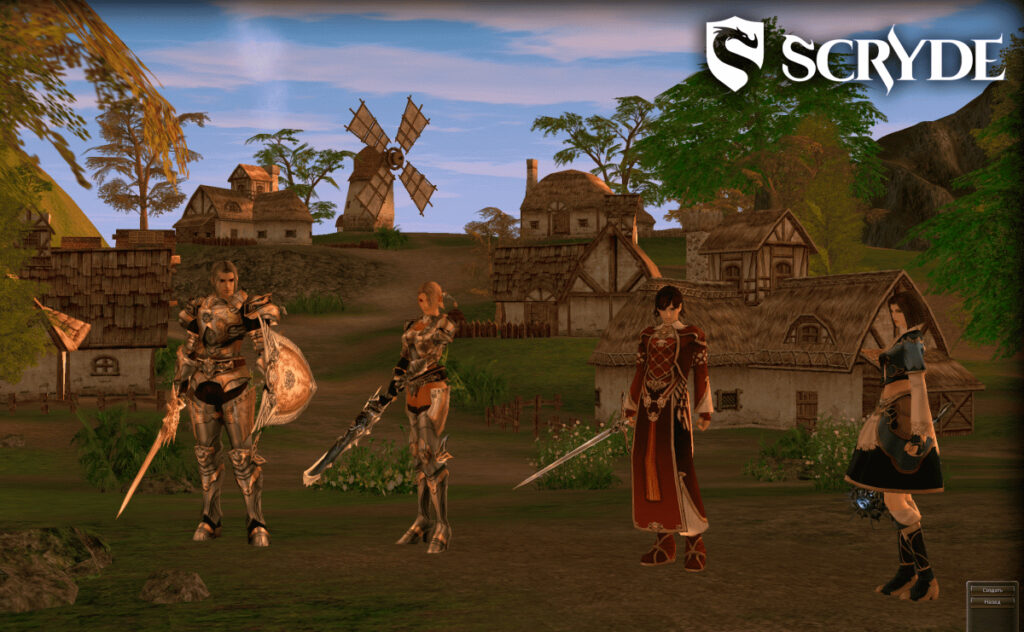
And some people, on the contrary, enjoy games with old-school graphics
Against the backdrop of the technological race, a counter-trend is also noticeable — interest in old-school projects. Part of the audience deliberately seeks worlds with a slow pace, where every item matters and community plays a strong role — in other words, the very feelings that characterized the genre in its early years. For example, there is an independent old-school MMORPG from Scryde Tech, which has been in development for over 11 years and focuses precisely on the classic values of the genre — it’s not Lineage 2, but a separate project in the same style of unhurried, “big” worlds.
What Has Remained Unchanged
Over decades of evolution, the graphics, technologies, and scale have changed beyond recognition. But it’s remarkable how resilient the core of the genre has proven to be. Character progression, development, cooperation toward a common goal, a sense of belonging to a community — all of this came from text-based MUDs and continues to work today.
The history of online RPGs is a story of how imagination gradually took form. From lines of text on a black screen to boundless three-dimensional continents, the journey has been long, but the motivation of players has hardly changed: people still want to live another life in another world and do it together with others. It is this need, not technology, that remains the true driving force of the genre.