When choosing a powerful Android phone, we first pay attention to the smartphone’s processor, since performance depends on it first and foremost. But what do we know about RAM? It’s commonly believed that RAM often determines whether a smartphone will run smoothly or start lagging after a few months. Is that true? To answer this question, it’s important to understand how much RAM a phone needs and whether it actually affects speed. Let’s figure out what RAM is, what it affects, and what amount is considered the norm in 2026.
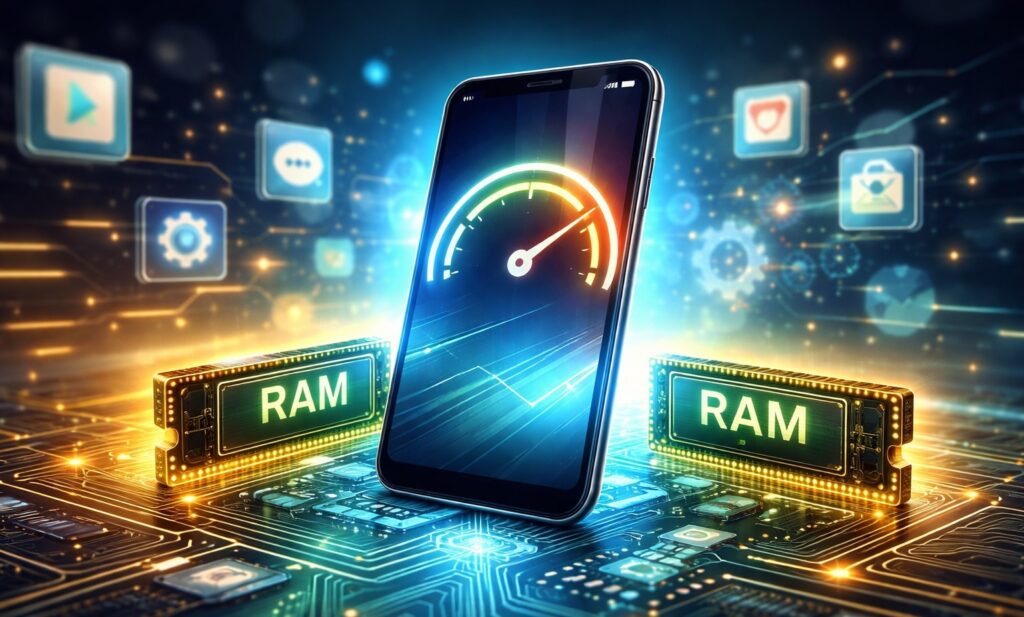
Is it worth chasing more RAM?
What Is RAM in a Phone
To explain it as simply as possible, phone RAM is the place where data the smartphone is currently working with is stored. It holds open apps, browser tabs, games, and system processes.
Many people confuse it with storage memory, but these are different things. Storage memory is where files and programs are kept, and what RAM in a phone is can be best understood with an everyday example. Imagine a desk and a cabinet: the cabinet is the device’s storage, and the desk is the RAM, where everything you’re currently using is laid out.

RAM is an important component of a smartphone
When there’s not enough RAM, the system has to free up space by closing background processes. Because of this, apps may restart, and the smartphone starts working less smoothly.
What Does RAM Affect
The amount of RAM primarily affects multitasking and performance stability. The more RAM a smartphone has, the more apps can run simultaneously without restarting.
The difference is especially noticeable in tasks such as:
- switching between apps;
- games and resource-heavy programs;
- camera use and photo processing;
- browser with many open tabs;
- system and app updates.
For example, a phone with 4 GB of RAM in 2026 can already noticeably lag during active use. Meanwhile, a phone with 8 GB of RAM usually works significantly more stably.

RAM affects many things, but to varying degrees
At the same time, many people try to speed up their device by clearing phone RAM, but on Android this rarely helps. The system manages memory on its own and closes processes when it’s truly necessary.
Does the Amount of RAM Affect Smartphone Speed
A large amount of memory alone doesn’t make a phone faster. You can take two devices with the same amount of RAM, and they’ll perform differently. Speed is affected not only by Android RAM, but also by the processor, storage, and the system shell itself. Typically, smartphones with more RAM come with a more powerful chip, which creates the impression that it’s the RAM speeding things up.
It’s also important to consider the type of memory. Modern standards work faster than older ones, so a phone with good RAM isn’t just about the number of gigabytes, but also about the speed of the memory itself.
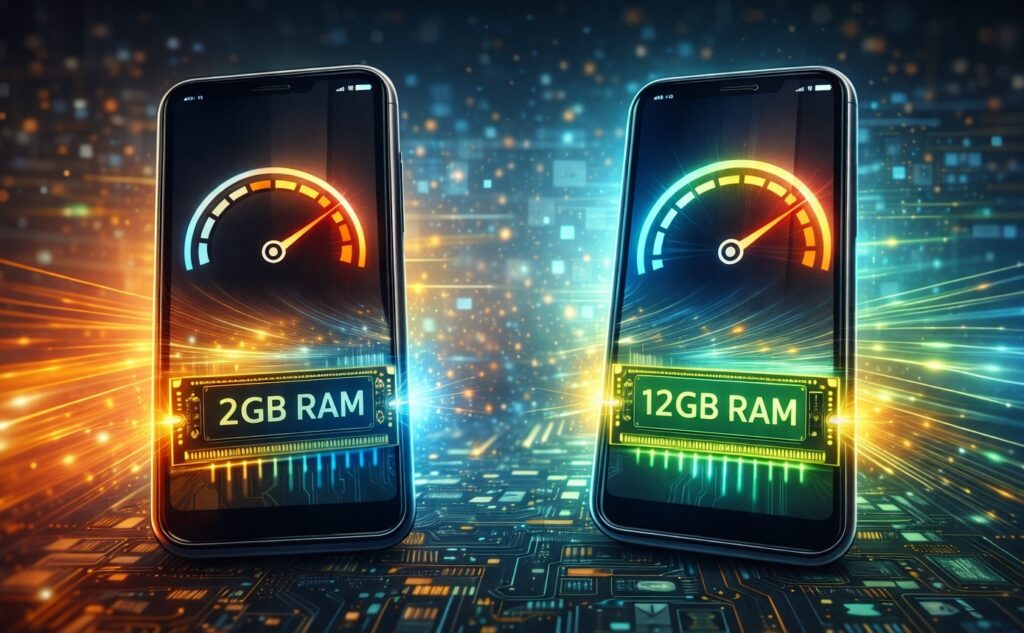
Smartphones with different RAM amounts do indeed differ
It’s also worth mentioning RAM expansion on phones. This feature uses part of the internal storage as additional RAM. In practice, it barely speeds up performance, because regular storage is much slower than actual RAM. Sometimes it can even make the system perform worse.
How Much RAM Does a Smartphone Need
Just a few years ago, 4–6 GB was enough, but now the requirements have grown. Modern apps, games, and system shells have become heavier, so the minimum comfortable amount has increased. In 2026, you can use these guidelines:
- Phone with 4 GB of RAM — only for basic tasks;
- Phone with 8 GB of RAM — a reasonable minimum;
- Phone with 12 GB of RAM — a good buffer for several years;
- Phone with 16 GB of RAM — maximum for gaming and heavy tasks.
But it’s important to consider more than just the amount. The type of memory sometimes matters even more than the number of gigabytes. Newer LPDDR5 or LPDDR5X works noticeably faster than older standards, so a smartphone with less RAM but faster memory can actually be snappier.
In conclusion, answering the question of how much RAM a phone needs, we can say this: in 2026, the comfortable minimum is 8 GB, and the optimal choice is 12 GB. But when choosing, it’s important to look not just at the spec sheet number, but at the overall device class, processor, and memory type. Sometimes the speed of RAM affects smartphone performance more than its volume.