
There is a direct connection between your elevator rides and Einstein’s work. Still from the film “500 Days of Summer”
Each of us has felt that strange heaviness in the body when an elevator starts going up, and an unusual lightness when the cabin begins to descend. Some attribute it to the vestibular system, others to imagination. But if you were to step on a scale at that moment, you’d find that your weight actually changes — and it’s pure physics, not a trick of the senses.
What Is Weight and Why It’s Not the Same as Mass
Before we get into the elevator physics, it’s worth clarifying one important thing: mass and weight are not the same thing.
Mass is the amount of matter in your body — it stays the same whether you’re on Earth, on the Moon, or in a falling elevator.
Weight is the force with which a body presses against a surface. And this force depends not only on mass but also on the acceleration you’re experiencing.
In physics class, the weight formula is written simply: P = m × g, where m is the body’s mass and g is the acceleration due to gravity (approximately 9.8 m/s² on Earth’s surface).
But this formula only works when you’re standing still. Add acceleration, and everything changes. That’s precisely why astronauts on the ISS, being in a state of constant free fall around the Earth, experience weightlessness: their mass remains the same, but their weight equals zero. Simply put, they aren’t pressing against anything.
An elevator, of course, is not a space station, but the principle is the same: any upward or downward acceleration adjusts the force with which you press against the floor.
Why You Get Heavier When the Elevator Goes Up
When the elevator is stationary, your weight is the usual, say, 70 kilograms. But as soon as you press the button for an upper floor, the cabin starts accelerating upward. At that moment, the elevator’s acceleration a is added to the usual gravitational acceleration g. The weight formula becomes P = m × (g + a).
In practice, this means the following: if the elevator accelerates at about 1 m/s² (a typical value for a residential elevator), a person with a mass of 70 kg will press against the floor with a force equivalent to approximately 77 kg. For comparison, it’s as if you instantly gained 7 kilograms — the sensation is quite real, and your body feels it perfectly well.
But here’s what’s important: the effect only lasts during the acceleration. Once the elevator reaches a constant speed and moves uniformly, the acceleration disappears — and the scale shows your honest 70 kg again. The thing is, at constant speed there is no additional force. That’s why you feel the “heaviness” only in the first few seconds after starting, and then everything returns to normal.

While going up in an elevator, a person momentarily becomes about 7 kilograms heavier. Still from the film “The Weather Man”
What Happens to Your Weight When the Elevator Goes Down
Now the opposite situation: the elevator starts going down. The cabin accelerates in the direction of gravity, and the elevator’s acceleration a is “subtracted” from g. The formula becomes P = m × (g − a). Your weight decreases, and the scale would show something like 63 kg instead of 70. You literally become lighter — hence the familiar “fluttering” sensation in your stomach.
It turns out this feeling is related not only to the vestibular system: your internal organs, which normally rest neatly on top of each other, briefly “float” slightly due to the reduced normal reaction force. This is especially noticeable in high-speed elevators in skyscrapers, where acceleration can reach 2–3 m/s².
And now a thought experiment. If the cable snapped and the elevator began to free-fall, the cabin’s acceleration would equal g. In the formula P = m × (g − g), the result is zero. You would experience true weightlessness — just like an astronaut in orbit. This is exactly how so-called parabolic flights work, in which an airplane creates brief weightlessness for astronaut training. The only difference is that in an airplane it’s safe, while in an elevator — to put it mildly, it’s not.
How Einstein Used an Elevator to Revolutionize Physics
Remarkably, a simple observation about how objects behave in an elevator led to one of the greatest breakthroughs in the history of science. Albert Einstein, in the early 20th century, asked himself: can you distinguish gravity from acceleration? His answer — the famous equivalence principle — states: you cannot. A person in a closed box with no windows cannot determine whether they are standing on the surface of a planet or accelerating through space at an acceleration of g.
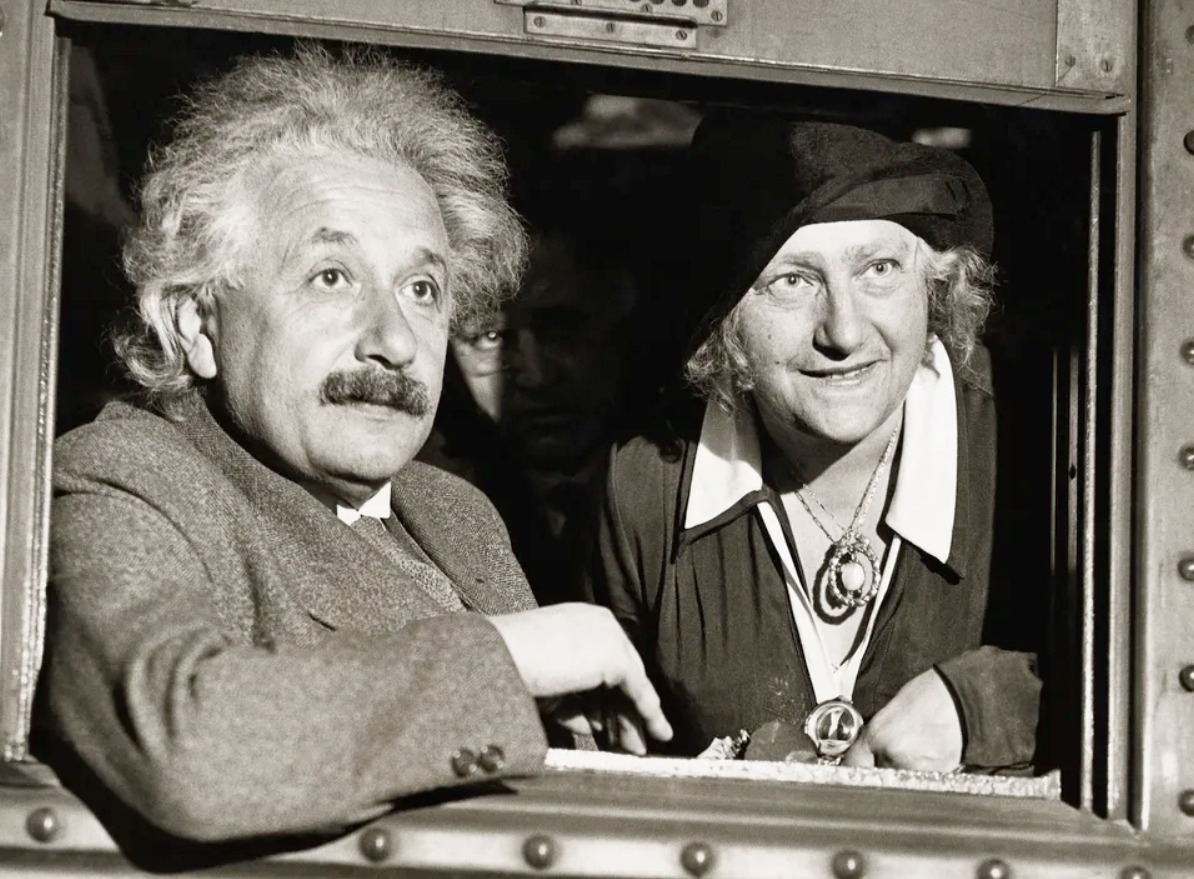
Albert Einstein with his wife Elsa. Image source: Live Science
From this simple, almost everyday observation, general relativity was born — a theory describing gravity as the curvature of spacetime. For comparison: classical Newtonian mechanics did an excellent job of explaining why an apple falls on your head, but couldn’t properly account for Mercury’s orbit. Einstein could, and it all started with a thought experiment about an elevator.
So the next time you feel that slight heaviness when the cabin starts moving, remember: you are experiencing the very same effect that pushed Einstein to rethink the Universe. Not bad for a ride to the fifth floor.
Your weight in an elevator is not an illusion or a fantasy of the nervous system. It is a real change in the force with which your body presses against the surface. Physics works all the time, even when you’re simply riding home from work. And perhaps this is one of those things that makes everyday life a bit more amazing than it seems.