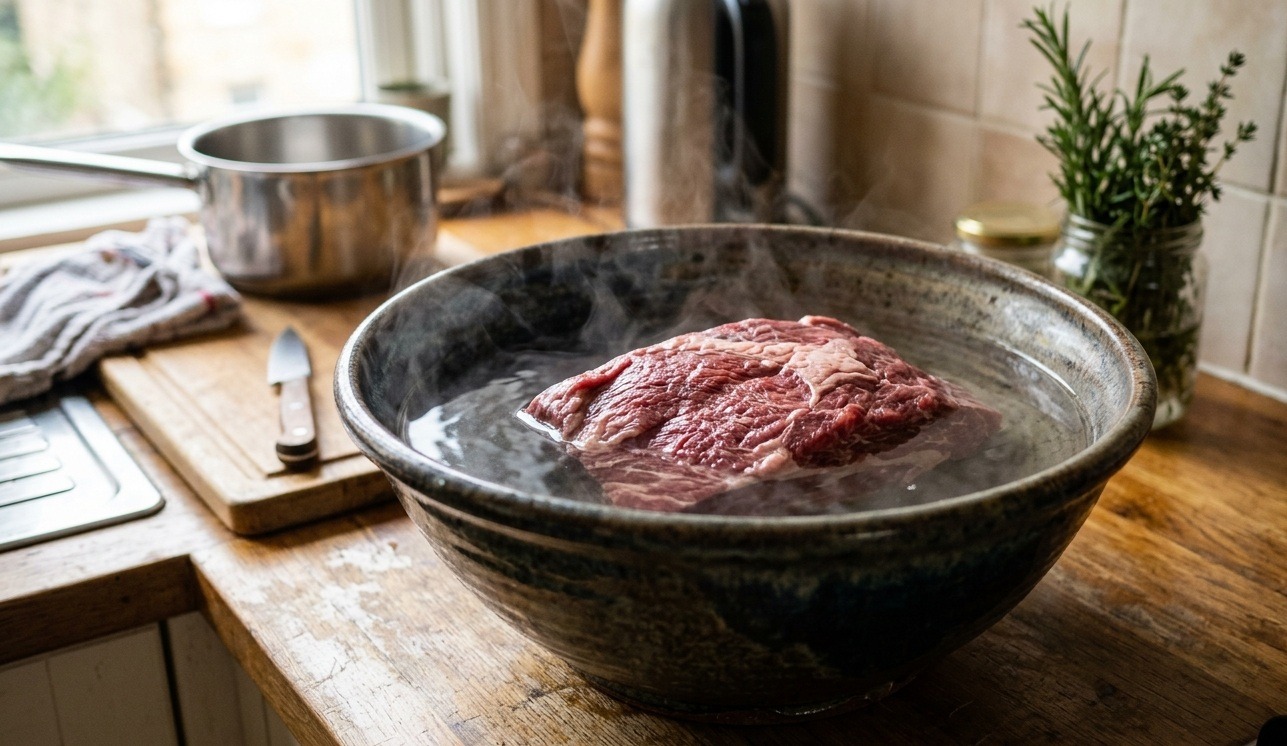
Defrosting meat in hot water is a common but dangerous practice
Many of us have at least once tossed a frozen piece of meat into a bowl of warm or hot water to speed up defrosting. It seems logical: the warmer the water, the faster it thaws. But hot water creates ideal conditions for dangerous bacteria to multiply on the surface of the meat while its center is still frozen solid. However, sometimes you can defrost meat in water if you know one rule.
Why You Shouldn’t Defrost Meat in Hot Water
The main problem is uneven heating. When you place a frozen piece in hot water, its surface quickly warms up to 20–40 degrees Celsius and above, while the inside remains below zero. This creates a paradoxical situation: the outside of the meat is essentially “warm,” while the inside is still frozen.
It is precisely the range from +4 to +60 degrees Celsius that microbiologists call the “danger zone.” Under these conditions, bacteria, including salmonella, double their numbers every 20–30 minutes. While you wait for the center to thaw, the outer layers of the meat turn into a real incubator. According to Anna Dzhabakova, senior lecturer at the Department of Food Safety at ROSBIOTECH University, water above +4 degrees Celsius creates ideal conditions for pathogen growth.
But it’s not just about bacteria. A sharp temperature difference destroys muscle fibers, making the meat tough after cooking. And direct contact with water washes out proteins, juices, and minerals, resulting in a dry and tasteless product even if you cook it perfectly.
Can You Defrost Meat in Cold Water?
Cold water is an entirely different story. It is one of the acceptable methods for quick defrosting, but with an important condition: the meat must be in airtight (preferably vacuum-sealed) packaging, and the water must be changed every 30 minutes.
Why packaging? It solves two problems at once. First, it prevents water from contacting the meat directly — meaning juices and proteins stay in place and flavor is preserved. Second, it prevents bacteria from the water from reaching the product’s surface.
Why change the water? Cold tap water is usually around 10–15 degrees Celsius. As the meat thaws, the water around it warms up. If you don’t change it, the temperature gradually rises, and we end up back in that dangerous zone. Replacing the water every half hour maintains a low temperature and speeds up the process through convection — the movement of fresh cold currents around the piece.
A small piece (up to 500 g) thaws in cold water in about an hour. A large one takes 2–3 hours. This is significantly faster than in the refrigerator and incomparably safer than in hot water.
What Water Temperature Is Correct for Defrosting Meat?
The gold standard is slow defrosting in the refrigerator at a temperature of +2…+4 degrees Celsius. This is the range recommended by both sanitary regulations and food production technologists. At this temperature, bacteria barely multiply, the meat thaws evenly, and muscle fibers maintain their structure.
The only downside is time. Half a kilo of meat takes 8–12 hours to defrost in the refrigerator, and a large piece or a whole chicken can take up to 24 hours. So you need to plan dinner in advance: move the meat from the freezer to the lower shelf of the refrigerator the evening before.
Important note: it's best to place the meat in a container or on a plate with raised edges. As it thaws, liquid is released that can get onto other products in the refrigerator — and that's a direct path to cross-contamination.
Defrosting Meat in the Microwave
If you need the meat right now, a microwave with a “defrost” mode is an acceptable option. But with one strict condition: after microwaving, the meat must be cooked immediately, without a pause.
The thing is, microwaves heat the product unevenly. Thin edges may start to partially cook while the thick center is still frozen. Those areas that have already warmed up enter the dangerous temperature zone again. If you leave the meat to “rest” on the counter after microwaving, bacteria get a head start.
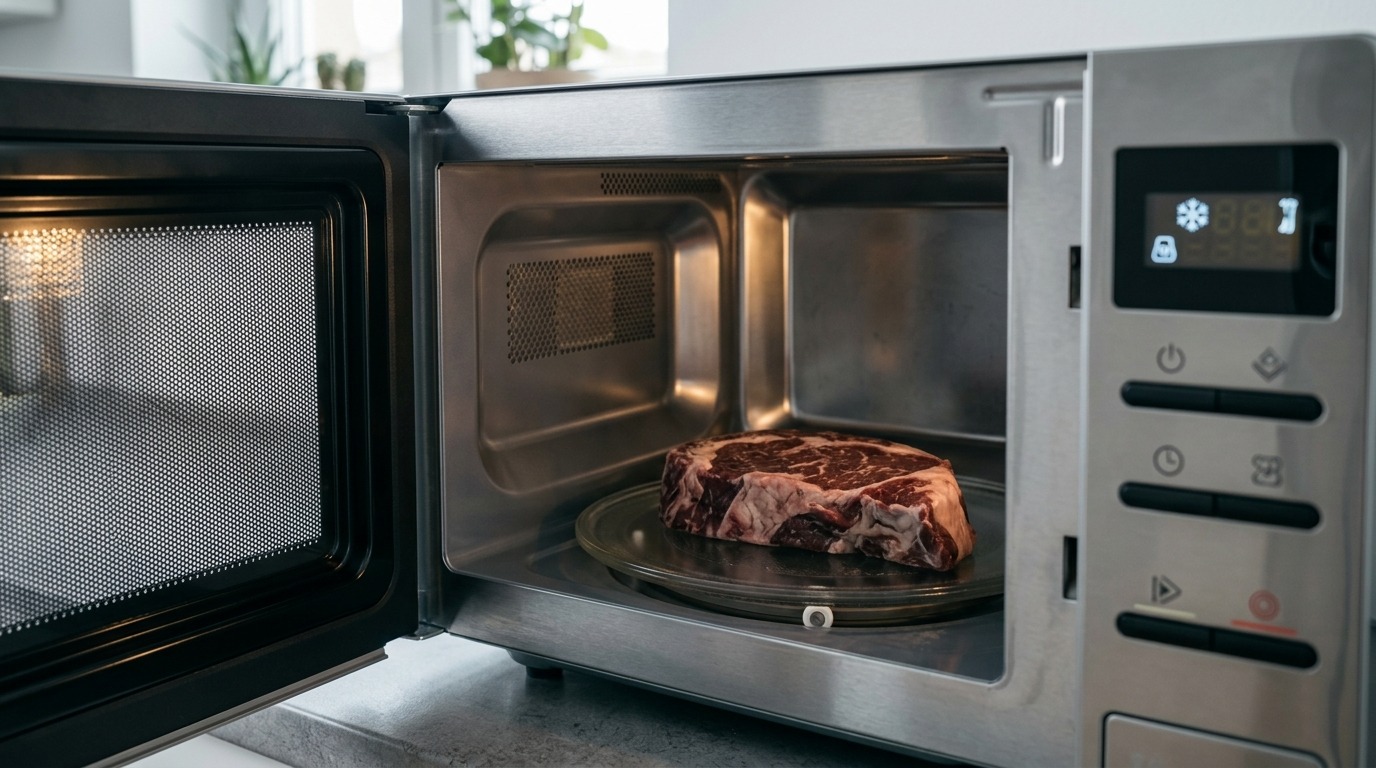
The “defrost” mode in the microwave is an acceptable option if you cook the meat right after
Here’s a quick guide to defrosting methods — from best to worst:
- In the refrigerator (+2…+4 degrees Celsius) — the safest method, but the slowest (8–24 hours);
- In cold water in airtight packaging — fast and safe if you change the water every 30 minutes;
- In the microwave on “defrost” mode — acceptable, but you must cook immediately;
- In hot water or at room temperature — dangerous, not recommended.
Why You Shouldn’t Refreeze Thawed Meat
Another important point the expert reminds us of: refreezing meat after it has been thawed in water is strongly discouraged. And the logic is simple.
During the first defrosting, bacteria have already started multiplying — especially if the meat was in a warm environment. Freezing doesn’t kill them; it only “puts them on pause.” When thawed again, the microorganisms continue to multiply from where they left off, only now there are significantly more of them. The risk of food poisoning increases dramatically.
Moreover, each freeze-thaw cycle further destroys the cellular structure of the meat. Ice crystals damage the fibers, moisture leaks out — and you end up with a tough, dry, and potentially unsafe product.
If your plans change after defrosting and you’re not going to cook right away, it’s better to cook the meat first (heat treatment will kill most bacteria), and then you can refreeze the prepared dish.
Overall, the rule is simple: the slower and colder the defrosting, the safer the result. Hot water saves you twenty minutes but could cost you a ruined dinner or a trip to the doctor. The refrigerator, cold water changed every half hour, airtight packaging — that’s all it takes to keep meat both delicious and safe.