Xiaomi is one of the leaders in the tablet market in Russia. Our buyers snap up their devices by the tens of thousands, and the manufacturer regularly delights us with new releases. In March 2026, the Xiaomi Pad 8 and Xiaomi Pad 8 Pro were released, which we already compared in a separate article. But should you be looking at the new models now, or does the previous generation hold up just as well? Let’s find out in this detailed comparison of Xiaomi Pad 7 vs Pad 8, where we’ll answer all the important questions.
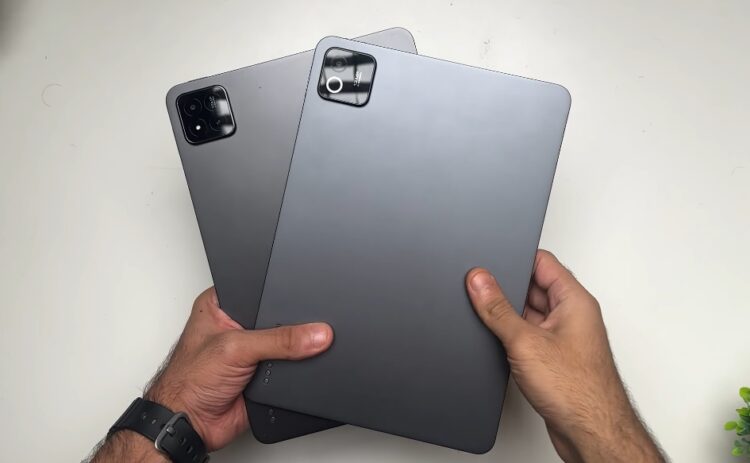
Xiaomi Pad 7 — left, Pad 8 — right. Image: Yousuf Vilayat
How Much Do the Xiaomi Pad 8 and Xiaomi Pad 7 Cost
The main factor we need to consider in the comparison of Xiaomi Pad 7 and Xiaomi Pad 8 is price. The new tablet is, of course, more expensive, but what’s the difference? Here’s how much you can buy a Xiaomi Pad for:
- Xiaomi Pad 7 — from 21,113 ₽;
- Xiaomi Pad 8 — from 27,844 ₽.
Thus, the price difference between the Xiaomi Pad 7 and Xiaomi Pad 8 is around 6-7 thousand rubles. That means the new generation model is 32% more expensive, which is quite significant. So how justified is this premium?
Xiaomi Pad 7 vs Xiaomi Pad 8 Comparison
Setting price aside, the Xiaomi Pad 7 vs Xiaomi Pad 8 showdown comes down to the internals of both tablets. They differ, though not drastically:
| Specifications | Xiaomi Pad 7 | Xiaomi Pad 8 |
|---|---|---|
| Display | 11.2 inches, IPS (3200×2136), 144 Hz | 11.2 inches, IPS (3200×2136), 144 Hz |
| Main Camera | 13 MP | 13 MP |
| Front Camera | 8 MP | 8 MP |
| Processor | Snapdragon 7+ Gen 3 | Snapdragon 8s Gen 4 |
| Memory | 8/256 or 12/256 GB | 8/256 or 12/256 GB |
| Battery | 8850 mAh | 9200 mAh |
| Charging | 45 W | 45 W |
Essentially, the main difference between the Xiaomi Pad 8 and the Xiaomi Pad 7 is the processor. The new model runs on a more powerful chip that delivers a 51% performance boost according to AnTuTu benchmark results.
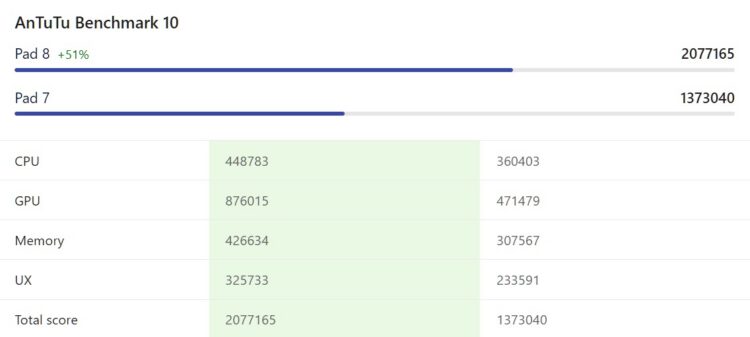
Xiaomi Pad 8 is noticeably more powerful than the previous generation model. Source: nanoreview.net
Is this noticeable in practice? Yes, but not as dramatically as in benchmarks. For everyday tasks, the Xiaomi Pad 8 is only marginally faster, while the main difference shows up in games and other resource-intensive tasks like video rendering.
Differences Between the Xiaomi Pad 8 and Xiaomi Pad 7
Despite the fact that the difference between the Xiaomi Pad 7 and Pad 8 may seem insignificant, the tablets have numerous small distinctions that also need to be taken into account:
- Xiaomi Pad 8 is lighter (485 g vs 500 g) and thinner (5.75 mm vs 6.18 mm);
- the new model is noticeably more powerful than the Xiaomi Pad 7;
- the Xiaomi Pad 8 battery is 350 mAh larger;
- the Xiaomi Pad 8 supports Wi-Fi 7;
- the newer model will receive software updates for a longer period.
It’s obvious that the Xiaomi Pad 8 is better than the Xiaomi Pad 7. But are its advantages enough to justify the 6-7 thousand ruble premium that separates the two tablets in price?
Which Tablet Is Better: Xiaomi Pad 7 or Xiaomi Pad 8
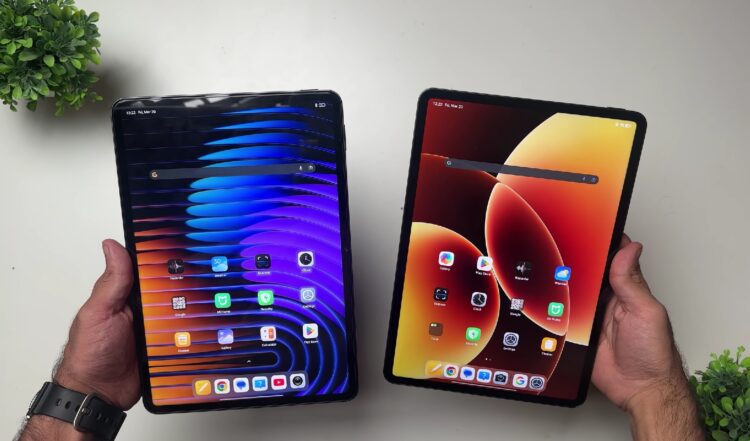
The tablets are hard to tell apart visually. Image: Yousuf Vilayat
Considering that the main difference between the new model and the old one is only the processor, the current premium doesn’t seem reasonable. The Xiaomi Pad 7 performs just as well for everyday tasks and is cheaper, so the previous generation model currently appears to be the better value.
Furthermore, upgrading from the Xiaomi Pad 7 to the Xiaomi Pad 8 makes no sense whatsoever. It’s a different story with the Xiaomi Pad 6, though. That model was released even earlier and stopped receiving major system updates in 2026. So upgrading from the Xiaomi Pad 6 to the Xiaomi Pad 8 is a more justified move.